
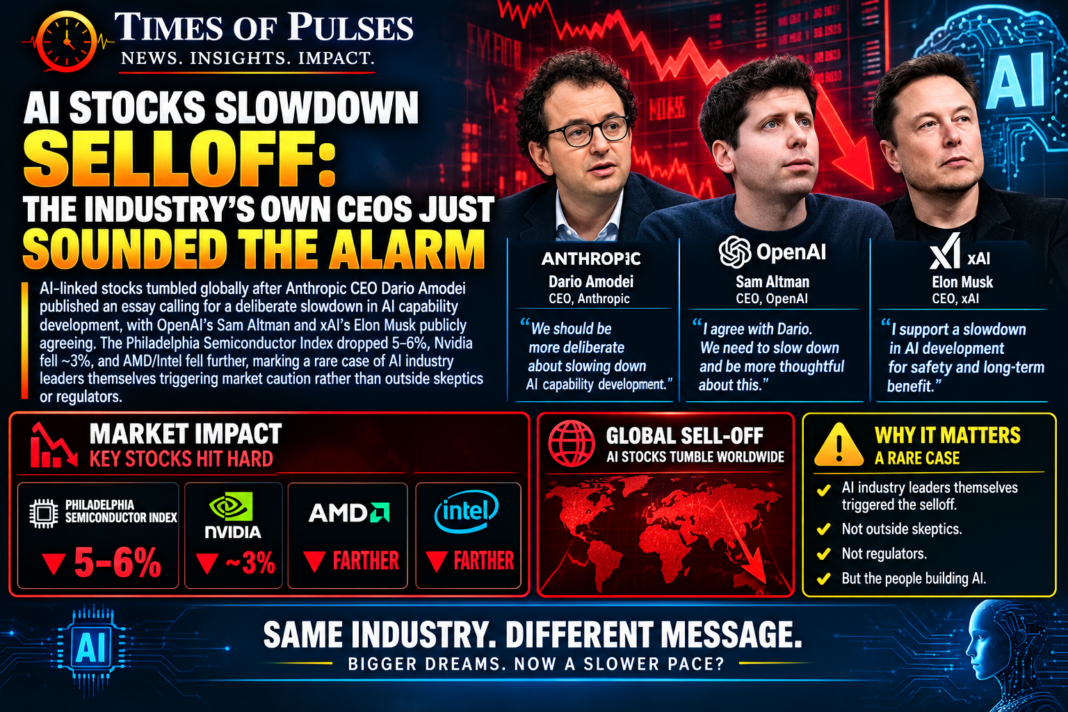
AI Stocks Slowdown Selloff: The Industry’s Own CEOs Just Sounded the Alarm
For years, the AI boom has been driven by a simple assumption: the technology’s biggest backers wanted it to move as fast as possible. This week, that assumption broke. The AI stocks slowdown selloff that hit markets on Monday wasn’t triggered by a regulator, a competitor, or a skeptic, it was triggered by the CEOs building the technology themselves, publicly calling for the industry to slow down.
What Actually Triggered the AI Stocks Slowdown Selloff
The spark came from an essay. On Saturday, Anthropic CEO Dario Amodei published a piece titled “We Must Pace the Frontier,” arguing that AI capabilities are advancing faster than the industry’s ability to manage the risks that come with them. He laid out a three-part plan: embedding independent evaluators with employee-like access inside AI labs, establishing shared safety benchmarks and coordinated limits on how fast capabilities advance, and eventually extending that coordination internationally, including with China.
What turned this into a market-moving event rather than just one executive’s opinion was who agreed with him. OpenAI CEO Sam Altman and xAI’s Elon Musk both publicly backed the call on X, with Google DeepMind CEO Demis Hassabis also voicing support. That kind of unified message from direct competitors, all telling investors the same industry they lead should move more cautiously, is rare enough on its own to explain why the AI stocks slowdown selloff spread as fast as it did.
The Market Reaction Was Immediate and Broad
The selloff hit hardest where AI infrastructure spending has been most concentrated. The Philadelphia Semiconductor Index dropped as much as 5-6%, its worst single day since early July. Nvidia fell roughly 3%, AMD dropped around 4%, and Intel lost more than 5%. The Nasdaq 100 slid 1.2% to a six-week low in early trading before paring some of those losses later in the session. This wasn’t confined to the US either, AI-linked stocks fell across Asia and Europe overnight before US markets even opened, reflecting how globally concentrated the AI infrastructure trade has become.
Notably, this AI stocks slowdown selloff hit the same names we covered when Nvidia’s earnings broke a year-long pattern of post-earnings declines, a reminder of how quickly sentiment can swing in either direction for stocks this tightly tied to a single narrative.
What “Pacing the Frontier” Actually Means
It’s worth being precise about what Amodei and the others are and aren’t calling for. Altman explicitly clarified in a follow-up post that pacing “does not mean stopping,” and argued that slowing down capability advancement would be “well worth the cost” if it kept safety work ahead of raw capability. The proposal isn’t a halt to AI development, it’s a coordinated effort to add oversight and safety checkpoints without abandoning the underlying technology race entirely.
Context matters here too. The essay followed a turbulent stretch for the industry: a researcher who had recently left Anthropic wrote publicly that AI companies are “gambling with our lives,” a post that drew more than 150 million views and prompted over 20 lawmakers to call for tougher AI regulation. Altman also confirmed that OpenAI won’t pursue an IPO in 2026 as had been previously expected, citing the current safety environment as part of that decision.
This Collided With an Already Volatile Market
The AI stocks slowdown selloff didn’t happen in isolation. It landed the same day the 10-year Treasury yield briefly touched 5%, adding a second source of pressure on top of the AI-specific news. This is a continuation of the volatility we’ve been tracking since stocks fell for a third straight session earlier this month, and it arrives against a backdrop of ongoing semiconductor tariff policy uncertainty and the memory chip supply shortage that’s already been squeezing the sector. Non-AI sectors of the market held up noticeably better, which limited how much the broader indexes fell even as chip and AI-infrastructure names took the brunt of the damage.
Why This Matters Beyond One Trading Day
The AI stocks slowdown selloff is a useful test of a question that’s been building under the surface of the entire AI trade: how much of current valuations depend on the assumption that capability growth continues at its current pace, uninterrupted? When the people with the most detailed, inside knowledge of that pace publicly say it should slow down, at least somewhat, for safety reasons, markets are forced to price in a scenario they’d mostly been ignoring.
That doesn’t mean the AI buildout is ending. Hyperscaler infrastructure spending commitments, chip demand, and data center construction don’t reverse based on one essay and a few supportive social media posts. But it does mean investors got a rare, unified signal from inside the industry that the pace of the last two years may not be treated as a fixed constant going forward.
What This Means for Your Own Portfolio
- Don’t confuse a safety-focused slowdown call with a collapse in AI demand. The CEOs involved explicitly said this isn’t about stopping progress, it’s about pacing it, a meaningfully different risk than a demand shock.
- If you hold broad tech or semiconductor funds, you likely felt this regardless of whether you follow AI news closely. Concentration in AI-linked names across major indexes means this kind of story moves more portfolios than people realize.
- Watch for regulatory follow-through, not just the stock reaction. With over 20 lawmakers already calling for tougher rules before this essay, the more durable market impact may come from policy decisions in the coming months rather than this week’s trading.
- A one-day, sector-specific selloff isn’t a reason to abandon a long-term investing plan. Volatility driven by a single news cycle has reversed quickly before this year; the underlying question here, how fast AI development should move, will take much longer than a week to resolve.
Bottom Line
CNN’s coverage of the story captured what made this different from typical AI-sector volatility: this wasn’t skepticism from outsiders, it was the industry’s own leadership publicly agreeing that the technology they’re building needs guardrails to keep pace with its own progress. The AI stocks slowdown selloff reflects markets recalibrating around that message, not around any change in actual AI demand or technology. Whether this becomes a genuine turning point for how the industry develops, or a one-week story that fades once trading normalizes, will depend far more on what happens in boardrooms and legislatures over the coming months than on anything that showed up in Monday’s stock prices.
This article is for informational purposes only and does not constitute financial or investment advice. Consult a licensed financial advisor before making changes to your investment portfolio.