
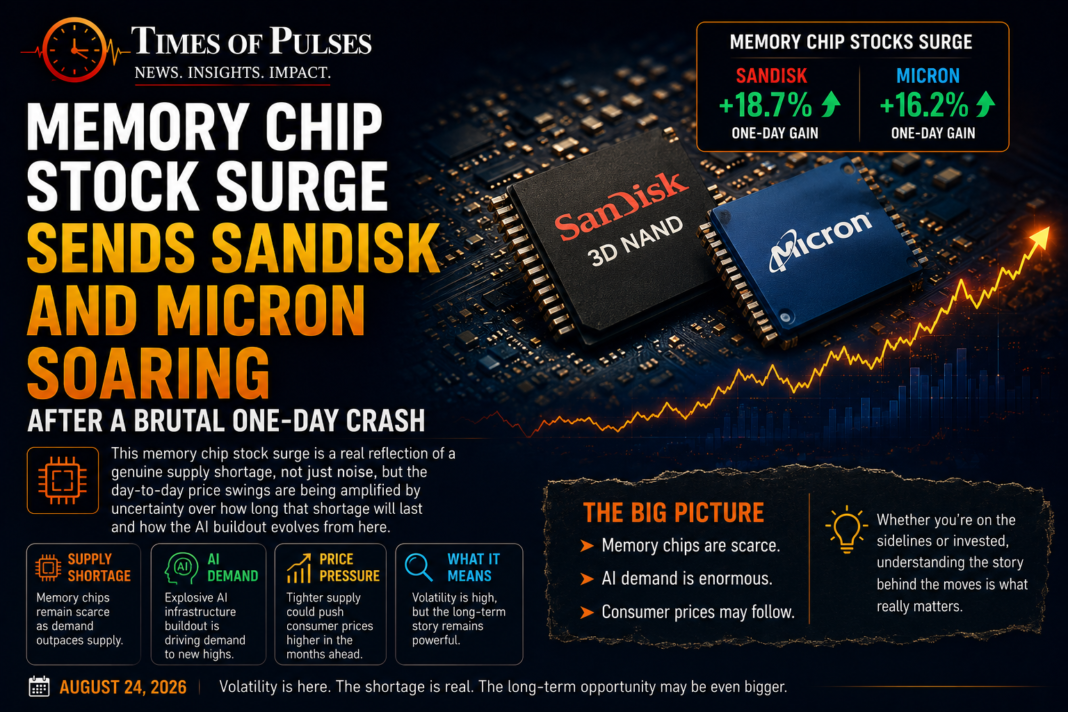
Memory Chip Stock Surge Sends Sandisk and Micron Soaring After a Brutal One-Day Crash
Wall Street just watched memory chip stocks fall off a cliff and then claw right back up within 24 hours, and the whiplash is making investors nervous and excited at the same time. This memory chip stock surge is happening right as Nvidia prepares to report earnings this week, and it’s tangled up with a bigger story that could quietly raise the price of your next phone or laptop. Here’s exactly what happened, why it happened, and what it actually means for your money.
The Crash That Came Right Before the Surge
On Monday, August 24, semiconductor stocks dragged the broader market lower. The S&P 500 slipped 0.28% and the Nasdaq Composite lost 0.76%, weighed down almost entirely by chip names. Micron Technology sank 5.8%, Sandisk dropped 6%, and Seagate Technology tumbled 6.5%. The iShares Semiconductor ETF (SOXX), which tracks the sector as a whole, fell 2.7% on the day. It looked, for a moment, like the AI trade was cracking.
Then came the memory chip stock surge nobody quite expected so soon. By early Tuesday trading, chip stocks were reversing hard. Every major memory name advanced in premarket trading, with Sandisk and Micron leading the bounce and Nasdaq 100 futures climbing 0.7% to recover Monday’s losses.
What’s Actually Driving the Memory Chip Stock Surge
The swings aren’t really about any single company. They’re about a structural shortage of memory chips, the components (DRAM and NAND) that let computers and AI servers store and process data. According to a report cited by Benzinga, J.P. Morgan Global Research estimates DRAM prices could climb more than 400% between the start of 2024 and the end of 2026, a phenomenon the bank has nicknamed “chipflation.” That shortage is the real engine behind this memory chip stock surge, and it’s also why the stocks are so jumpy: any headline about supply, demand, or a hyperscaler’s next contract sends the whole group swinging in one direction or the other.
The root cause is straightforward. AI data centers need enormous quantities of high-speed memory, and hyperscalers like Microsoft, Google, and Amazon have been locking up supply through long-term agreements, some running five years or longer. That leaves memory makers with far less flexibility to serve everyday consumer electronics, tightening supply everywhere else at the same time.
Why This Trade Keeps Whipsawing Investors
What makes the memory chip stock surge so dramatic is how binary the sentiment has become. When a report suggests supply is loosening or a hyperscaler might be pulling back, memory stocks get hit hard, exactly what happened Monday. When the next data point suggests the shortage is even worse than feared, the same stocks rip higher just as fast, exactly what happened Tuesday morning. Analysts have described this memory chip stock surge and its mirror-image selloffs as one of the most volatile corners of the entire AI trade, precisely because the underlying shortage is real but the timing of when it eases is genuinely uncertain.
Adding to the tension this week: investors are also digesting new U.S. sanctions tied to geopolitical tensions, incoming housing and consumer data, and Nvidia’s closely watched earnings report, all landing in the same 48-hour window as this memory chip stock surge.
The “Chipflation” Problem: What This Means for Your Wallet
Here’s the part that matters even if you don’t own a single share of Micron or Sandisk. Memory chips aren’t just an investing story, they’re a component in nearly every device you own. As DRAM and NAND prices climb, manufacturers pass at least some of that cost on to consumers. Reports have already pointed to memory now accounting for a much larger share of PC build costs than it did a year ago, and device makers have flagged the possibility of higher prices on everything from laptops to smartphones as this shortage continues. In other words, the same memory chip stock surge that’s exciting traders could show up later this year as a slightly higher price tag the next time you shop for electronics.
What This Means for Your Own Money
- Don’t chase the swing. A stock that’s up double digits one morning after crashing the day before is not a stable long-term signal on its own, it’s a sign of a volatile, headline-driven trade.
- If you own broad market or tech-heavy index funds, you already have exposure. Companies like Micron and Sandisk carry real weight in tech and semiconductor indexes, so you may be riding this memory chip stock surge without realizing it. If you haven’t reviewed where your money is actually allocated in a while, this is a reasonable moment to check.
- Budget for higher electronics prices, not just watch the stock. If chipflation continues as J.P. Morgan expects, a new laptop or phone next year could simply cost more than it does today.
- Keep an eye on interest rates too. Volatile growth stocks tend to react even more sharply when Treasury yields are moving, since higher borrowing costs change how investors value future earnings from companies like these.
- **Update:** Chip stocks fully recovered from this selloff within days — read how the rebound happened here chip-stocks-erase-selloff.
Bottom Line
This memory chip stock surge is a real reflection of a genuine supply shortage, not just noise, but the day-to-day price swings are being amplified by uncertainty over how long that shortage will last and how the AI buildout evolves from here. Whether you’re watching from the sidelines or holding shares through an index fund, the underlying story, memory chips are scarce, AI demand is enormous, and consumer prices may follow, is worth understanding regardless of which way the stock moves on any given morning.
This article is for informational purposes only and does not constitute financial advice. Consult a licensed financial advisor before making changes to your investment portfolio.