
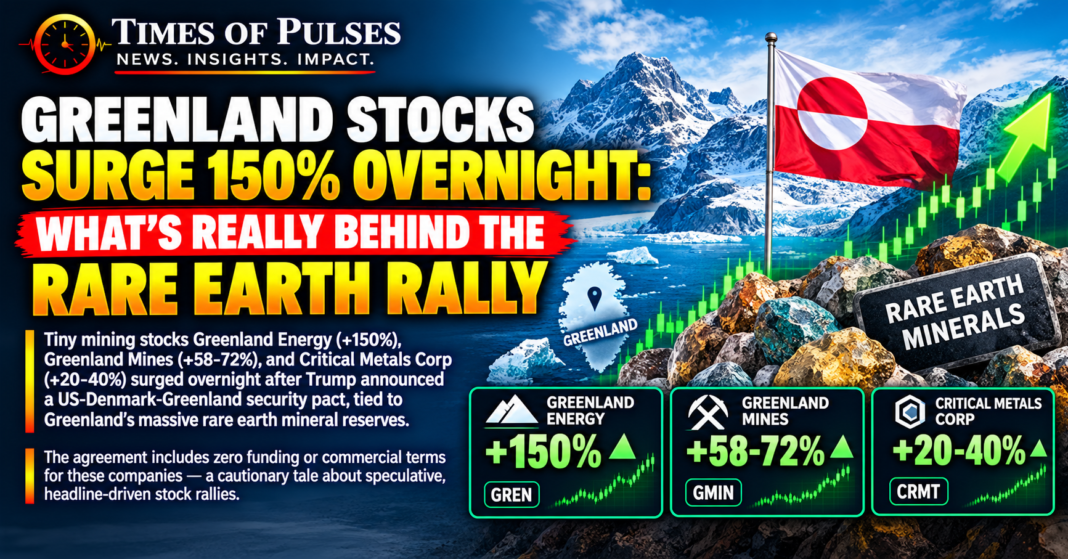
Greenland Stocks Surge 150% Overnight: What’s Really Behind the Rare Earth Rally
A handful of tiny, little-known mining stocks just did something that stops most investors mid-scroll: they surged well over 100% in a single overnight session. Greenland stocks surge headlines took over trading screens this week after President Trump announced a sweeping US-Denmark security agreement over the Arctic territory, and the story behind the rally is as much about rare earth minerals as it is about geopolitics.
Greenland Stocks Surge: The Numbers That Stopped People Scrolling
The moves were genuinely extreme. Greenland Energy (GLND) soared as much as 150% in overnight and premarket trading, Greenland Mines (GRML) jumped between 58% and 72%, and Critical Metals Corp (CRML) rose anywhere from 20% to 40% depending on the exact moment measured. For context, moves of this size in a single session are typically reserved for tiny biotech stocks on drug trial results, not mining companies reacting to a diplomatic announcement, which is exactly what makes this Greenland stocks surge story worth understanding rather than just watching.
What Actually Triggered the Greenland Stocks Surge
The catalyst was a security pact between the US, Denmark, and Greenland, announced by President Trump via social media on a Friday night. Trump said the agreement would give the US the “complete ability to do what is necessary in Greenland” to secure and defend the territory, adding that Washington would begin developing “a large Military presence” there, at no cost to the US. The deal is expected to be formally signed this week during the United Nations General Assembly, though full details haven’t yet been made public.
This follows months of Trump publicly floating the idea of the US acquiring or even annexing Greenland outright, a self-governing Danish territory. The actual agreement falls well short of that, Danish Prime Minister Mette Frederiksen said the arrangement “respects the sovereignty and territorial integrity” of Denmark, but the Greenland stocks surge reaction shows markets read even a security-only deal as a meaningful signal about US involvement in the region’s resources.
Why Rare Earth Minerals Are the Real Story
Here’s what connects a military security pact to mining stock prices: Greenland holds an estimated 1.5 million tonnes of rare earth reserves, the eighth-largest deposit globally. Rare earth elements are essential inputs for electric vehicles, renewable energy systems, advanced electronics, and defense equipment, and China currently dominates global rare earth processing. Critical Metals Corp, one of the biggest movers in this Greenland stocks surge, holds a 92.5% stake in the Tanbreez rare earth project in southern Greenland, positioning it directly in the path of any US push to diversify rare earth supply away from China.
This ties into a broader theme we’ve been tracking around supply chain and chip-adjacent policy risk, including semiconductor tariff moves aimed at reshoring production. Rare earths and semiconductors sit in the same strategic category for policymakers right now: materials the US wants more control over, and the market for both.
The Important Catch Most Headlines Skip
Before assuming this Greenland stocks surge reflects real business progress, it’s worth being direct about what the agreement actually includes: nothing. No funding, no licenses, no commercial arrangements for any of these three companies were disclosed alongside the security deal. The rally reflects investors betting on future political support, infrastructure investment, and financing opportunities that could follow, not anything that’s actually happened yet. Critical Metals’ own drilling at its flagship site was delayed until winter 2027 amid ongoing regulatory review, a detail that got far less attention than the overnight stock chart.
It’s also worth noting the starting point: heading into this news, GLND and GRML were down roughly 79-88% and 80% respectively for the year, meaning even after this surge, both stocks remain well below where they started 2026. A 150% overnight jump sounds dramatic, but on a stock that had already lost most of its value, it can still leave shares far from a full recovery.
What This Means for Your Own Money
- A geopolitical headline moving a stock 100%+ overnight is a volatility signal, not a value signal. These moves reflect speculation about what might happen, not confirmed revenue, contracts, or production.
- Check what’s actually been agreed to, not just the stock chart. In this case, zero funding or commercial terms were disclosed, the entire rally is investors pricing in possibilities.
- Retail trader enthusiasm isn’t a substitute for due diligence. Online sentiment around these stocks has been described as “extremely bullish,” with talk of short squeezes, exactly the kind of momentum that can reverse as quickly as it built.
- If you’re drawn to this kind of speculative story, size the position accordingly. This fits the same category of high-risk, headline-driven trades we discussed when covering oil price volatility investing, appropriate for a small, deliberate allocation, not a core portfolio holding.
Bottom Line
CNBC’s coverage of the deal captured the essential tension in this story well: a real geopolitical agreement triggered a very real stock rally, but the underlying commercial fundamentals, funding, mining permits, actual rare earth production, haven’t changed at all yet. The Greenland stocks surge is a genuine case study in how quickly speculative capital moves on political headlines alone, useful to understand even if you have no plans to buy any of these specific stocks, because the same pattern shows up across markets whenever geopolitics and scarce resources intersect.
This article is for informational purposes only and does not constitute financial or investment advice. Highly speculative stocks carry significant risk of loss. Consult a licensed financial advisor before making changes to your investment portfolio.