
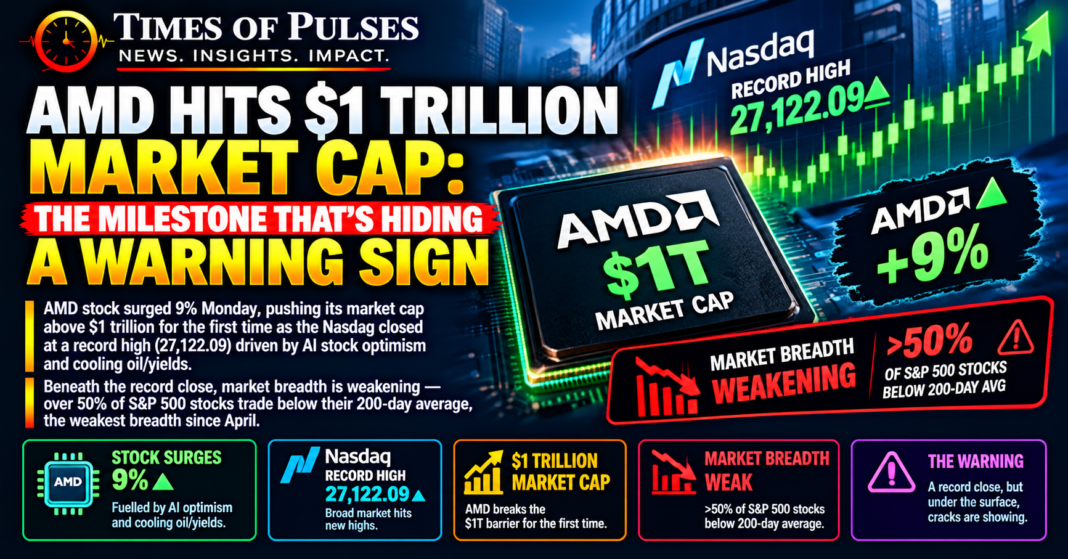
AMD Hits $1 Trillion Market Cap: The Milestone That’s Hiding a Warning Sign
Advanced Micro Devices just joined one of the most exclusive clubs in the stock market. AMD hits $1 trillion market cap territory for the first time in the company’s history, a milestone that capped off a broader Monday rally, but a closer look beneath the headline number reveals a market that isn’t quite as healthy as the record closes suggest.
AMD Hits $1 Trillion: How It Got There
AMD shares surged 9% on Monday, pushing the stock to a record high and pushing the company’s market capitalization above $1 trillion for the first time ever. The move wasn’t isolated, it came as part of a broader rally that saw the Nasdaq Composite jump 2.26% to a record close of 27,122.09, its first record close since June. The S&P 500 climbed 1.49% to 7,764.70, its best single day since early August, while the Dow Jones Industrial Average added 366 points, or 0.71%, to 52,048.83.
The Cooling Oil and Yields Behind the Rally
AMD hits $1 trillion status arrived alongside two macro tailwinds working in the market’s favor simultaneously: oil prices and Treasury yields both cooled off during Monday’s session, easing two of the pressures that had weighed on markets in recent weeks. This continues the pattern we tracked when chip stocks fully erased their AI-slowdown selloff just days earlier, semiconductor names have now gone from recovering lost ground to setting fresh records, all within the same short stretch.
Why AI Stocks Are Leading the Charge Again
Part of what drove Monday’s rally, and AMD hits $1 trillion specifically, was renewed optimism around AI-driven chip demand. Reports pointed to viral popularity around Meta’s new “Muse” AI agent as sparking fresh bets that AI adoption, and the chip demand that comes with it, has real staying power. That optimism rippled beyond US markets too, with AI-linked names like Samsung Electronics rising overseas on the same wave of sentiment. It’s a notable turnaround from where this exact narrative stood just weeks earlier, when AI industry leaders themselves warned the pace of development needed to slow down, triggering a sharp selloff in these same stocks. AMD hitting a trillion-dollar valuation now shows just how quickly sentiment around the AI trade can swing from caution back to enthusiasm.
The Warning Sign Hiding Beneath the Rally
Here’s the part of the AMD hits $1 trillion story that’s easy to miss if you only look at the index-level numbers: market breadth is quietly deteriorating even as headline indexes hit records. More than 50% of S&P 500 stocks are now trading below their 200-day moving average, according to Barchart data, the weakest breadth reading since early April. At the same time, downside volume on the New York Stock Exchange, as a share of total trading volume, has surged to 54%, near its highs for the year.
In plain terms, that means Monday’s rally, including AMD hits $1 trillion headlines, was driven by a relatively small group of large, AI-linked winners, while a majority of individual stocks in the broader market are actually trending weaker underneath the surface. This is exactly the kind of divergence analysts watch closely, because narrow, concentrated rallies have historically proven less durable than broad-based ones.
What This Means for Your Own Portfolio
- A record index close doesn’t mean every stock is participating. If your portfolio isn’t concentrated in the same handful of AI-linked mega-caps driving days like this one, don’t assume your own holdings are performing similarly.
- Check what’s actually inside your index funds. AMD hits $1 trillion territory partly because AI infrastructure names now carry outsized weight in major indexes, meaning broad market funds have more concentrated exposure to this single narrative than many investors realize.
- Weakening breadth is worth tracking, not panicking over. A rising percentage of stocks below their 200-day average is a signal to watch, similar to how we’ve flagged other underlying risk indicators worth monitoring beyond the headline number, not an automatic reason to sell.
- Milestone numbers make good headlines, not investment theses. AMD crossing $1 trillion is a genuine achievement, but the decision to hold, buy, or trim any single stock should rest on your own research and risk tolerance, not a round-number milestone alone.
Bottom Line
CNBC’s live coverage of Monday’s session captured both sides of this story clearly: a genuinely record-setting day for major indexes and for AMD specifically, alongside real signs that the rally’s foundation is narrower than the headline numbers suggest. AMD hits $1 trillion is a legitimate milestone reflecting real AI-driven demand, but the deteriorating breadth beneath Monday’s gains is a reminder that even record closes deserve a second look before assuming the broader market is as strong as its headline number.
This article is for informational purposes only and does not constitute financial or investment advice. Consult a licensed financial advisor before making changes to your investment portfolio.