
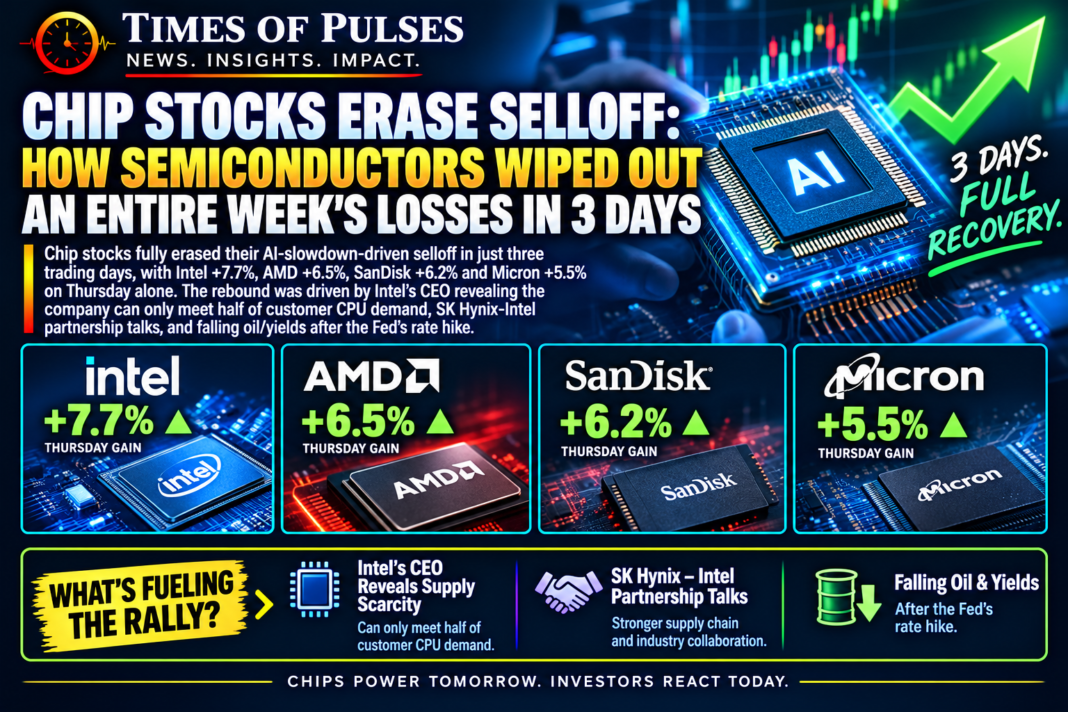
Chip Stocks Erase Selloff: How Semiconductors Wiped Out an Entire Week’s Losses in 3 Days
Just days after top AI executives warned their own industry needed to slow down, sending semiconductor stocks into a sharp selloff, those same stocks have done something remarkable: chip stocks erase selloff territory now describes the entire week, with Thursday’s rally wiping out essentially all of Monday’s losses in a single session.
Chip Stocks Erase Selloff: The Numbers Behind the Comeback
Thursday’s rebound was broad and sharp. Intel jumped 7.7%, AMD rose about 6.5%, SanDisk advanced 6.2%, and Micron climbed 5.5% to close at $975.26, a level that effectively erased the stock’s net loss from Monday’s AI-slowdown shock. The iShares Semiconductor ETF (SOXX) rose roughly 3.4% on the day, with Nvidia gaining 2.5% and Arm jumping 8.6%. For a sector that had been reeling just three trading sessions earlier, this chip stocks erase selloff move represents one of the fastest full reversals we’ve tracked this year.
Why Investors Suddenly Looked Past the AI Slowdown Fears
The chip stocks erase selloff story isn’t really about investors deciding the AI pacing concerns don’t matter, it’s about a different, more immediate story taking over: supply, not demand. Intel CEO Lip-Bu Tan told an AI infrastructure conference that his company can currently meet only about half of customer CPU demand, a striking admission of just how tight chip supply has become across the industry. That kind of scarcity signal tends to be bullish for chipmakers regardless of what’s happening with broader AI safety debates, tight supply generally means pricing power and strong near-term revenue, whatever the longer-term pace of AI development looks like.
This connects directly to the memory shortage dynamic we covered when Sandisk and Micron shares swung wildly on DRAM and NAND scarcity earlier this year, that underlying supply tightness never actually went away, it just got temporarily overshadowed by the AI-slowdown headlines.
A Surprise Partnership Rumor Added Fuel
Adding to the chip stocks erase selloff momentum, Reuters reported that SK Hynix is in exploratory talks with Intel to manufacture memory chips in the United States for the first time. While SK Hynix confirmed only preliminary discussions with no agreement finalized, the possibility alone was enough to send Intel shares higher earlier in the week and extend that momentum into Thursday’s broader rally. A US-based memory manufacturing partnership would be a meaningful shift for an industry that’s been almost entirely concentrated in Asia.
The Macro Backdrop Helped Too
Chip stocks didn’t rally in isolation. Falling oil prices and Treasury yields following the Federal Reserve’s rate hike decision eased broader market anxiety, giving risk assets across the board, not just semiconductors, room to recover. Since data center construction and AI infrastructure spending are notably sensitive to borrowing costs, easing yields directly supports the same chip names that had been under pressure from both the AI-slowdown story and elevated rates simultaneously.
What This Reversal Actually Tells Us
The speed of this chip stocks erase selloff move is itself a useful data point. When a sector can fully recover from a values-based, industry-leadership-driven selloff in just three trading sessions, it suggests the underlying fundamentals, chip demand, supply constraints, and AI infrastructure spending commitments, remain stronger than the initial safety-focused headlines implied. That’s consistent with what we noted when covering Nvidia’s own earnings beat: the AI infrastructure buildout has repeatedly proven more resilient to single news cycles than initial market reactions suggest.
What This Means for Your Own Portfolio
- Don’t assume a values-driven selloff means demand is falling. This week showed that AI safety concerns and chip demand fundamentals are genuinely separate stories, a warning about pacing development doesn’t mean fewer chips are actually being ordered.
- Supply constraints are often more predictive of near-term stock moves than sentiment. Intel’s admission it can only meet half of CPU demand is the kind of concrete operational detail that tends to matter more than a week of mixed headlines.
- Watch how sensitive this sector remains to yields and Fed policy. Chip stocks erase selloff momentum got real help from falling yields this week, a reminder that semiconductor valuations remain tied to macro conditions as much as company-specific news.
- Volatility this sharp in both directions argues for position sizing discipline. A sector that can lose and then fully regain double-digit percentages within a week isn’t one to bet the majority of a portfolio on, regardless of which direction the latest headline points.
Bottom Line
Coverage of Thursday’s rally captured the shift clearly: what started the week as an AI-safety-driven selloff ended it as a supply-and-macro-driven rally, with chip stocks erase selloff conditions fully intact by Thursday’s close. The underlying lesson isn’t that the AI slowdown conversation doesn’t matter, lawmakers and industry leaders are still actively debating it, it’s that markets ultimately price chip stocks on demand, supply, and interest rates first, and safety headlines second, at least in the short term.
This article is for informational purposes only and does not constitute financial or investment advice. Consult a licensed financial advisor before making changes to your investment portfolio.