
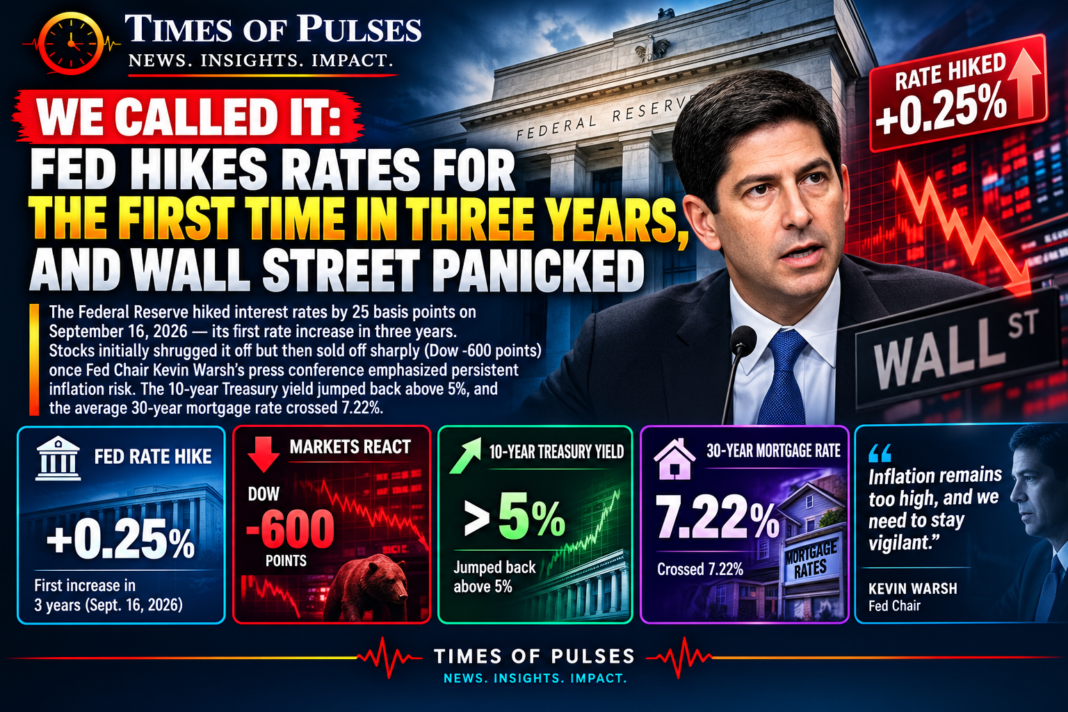
We Called It: Fed Hikes Rates for the First Time in Three Years, and Wall Street Panicked
The wait is over, and the outcome wasn’t the relief markets had been hoping for. On Wednesday, the Federal Reserve hiked interest rates by 25 basis points, its first rate increase in three years, and rather than settling markets, the decision, combined with what Fed Chair Kevin Warsh said afterward, sent stocks sharply lower and pushed a key mortgage rate above 7.2%.
Fed Hikes Rates: The Decision Itself
The Fed hikes rates announcement itself was, in some ways, the least surprising part of Wednesday. Markets had been pricing in rising odds of exactly this move for weeks, ever since a stronger-than-expected jobs report pushed rate-hike odds higher and a hot PPI reading added further pressure. The Fed’s own dot plot, the chart showing where individual officials expect rates to go, revealed that the median official now sees at least one more hike coming before the end of 2026, signaling this Fed hikes rates decision isn’t necessarily a one-time move.
Why Markets Turned Lower So Quickly
Here’s what made Wednesday genuinely dramatic: stocks initially took the Fed hikes rates news in stride. The increase itself had been well telegraphed, and an initial muted reaction suggested markets had already priced it in. That changed the moment Fed Chair Kevin Warsh began his press conference. Warsh repeatedly emphasized that inflation risk wasn’t improving, a notably more hawkish tone than markets had hoped for, and stocks reversed course in real time as he spoke. By the close, the Dow had fallen roughly 600 points, down about 1.07% to 1.2%, while the S&P 500 slipped around 0.4-0.45% and the Nasdaq dipped just below flat.
This is now the second time in recent weeks that a Warsh appearance has moved markets sharply. We saw a similar pattern when his hawkish Jackson Hole speech partially reversed gold’s record August rally, and Wednesday’s Fed hikes rates press conference followed the same script: the substance of the decision mattered less than the tone Warsh used to frame it.
The 10-Year Yield Flashed a Warning Sign
Perhaps the most telling reaction to the Fed hikes rates decision came from the bond market. The 10-year Treasury yield traded back above 5% following Warsh’s remarks, reflecting a specific fear: that even after raising rates, the Fed might still be behind the curve on inflation. That’s a meaningfully different signal than a simple “rates went up” story, it suggests bond investors aren’t convinced this hike alone solves the inflation problem that’s been building for months.
Mortgage Rates Just Crossed a Painful Threshold
The most immediate real-world impact of the Fed hikes rates decision landed on housing. The average 30-year fixed mortgage rate climbed to 7.22%, according to Mortgage News Daily, a level that meaningfully raises the monthly cost of buying a home for anyone shopping for a mortgage right now. This connects directly to the tradeoffs we walked through when covering whether to save or pay off debt first, a mortgage rate this high shifts that math further in favor of paying down high-rate debt rather than taking on new borrowing at today’s rates.
How This Fits the Bigger Picture
The Fed hikes rates decision arrives at the end of a stretch we’ve been tracking closely: oil prices pushing past $100 a barrel, stocks falling for multiple straight sessions, a brief relief rally when CPI came in as expected, and now this. It’s worth remembering that the Dow’s 500-point rally just last week was driven partly by relief that inflation data wasn’t worse than feared. Wednesday’s Fed hikes rates decision and Warsh’s hawkish framing effectively challenge how much that relief was justified, the Fed’s own dot plot now suggests officials see inflation as a bigger, more persistent problem than the market had been pricing in just days earlier.
What This Means for Your Own Money
- Mortgage shopping just got more expensive. If you’re house hunting, a 7.22% average rate is real money over the life of a loan, it’s worth running the numbers again on affordability before moving forward with a purchase.
- This Fed hikes rates decision likely isn’t the last one this year. With the dot plot pointing to at least one more hike, don’t assume rates have peaked, budget for borrowing costs to potentially climb further.
- Watch Fed Chair communications as closely as the actual rate decisions. Twice now, Warsh’s tone in a press conference or speech has moved markets more than the underlying data itself, that pattern is worth remembering heading into future Fed meetings.
- Don’t overreact to one volatile trading day. Markets have swung sharply in both directions repeatedly this month, a single post-Fed selloff doesn’t by itself signal a longer downturn.
Bottom Line
CNBC’s live coverage of Wednesday’s session captured exactly how the day unfolded: a widely expected rate hike that markets shrugged off, followed by a Fed Chair press conference that turned a calm day into a 600-point selloff. The Fed hikes rates decision itself confirmed what weeks of jobs and inflation data had been signaling, but Warsh’s insistence that inflation risk isn’t improving is what actually rattled investors. With the dot plot pointing to further hikes ahead and mortgage rates already above 7.2%, the bigger question now isn’t whether this was the last hike of the cycle, it’s how much higher borrowing costs go before inflation genuinely cools.
This article is for informational purposes only and does not constitute financial or investment advice. Consult a licensed financial advisor before making changes to your investment portfolio.