
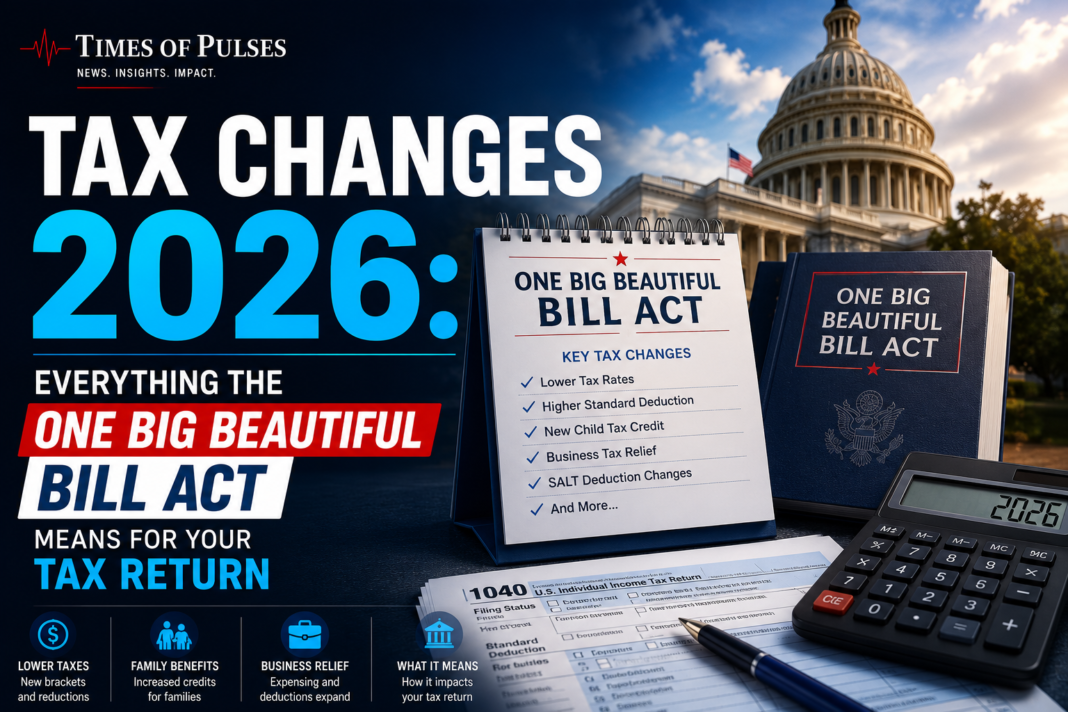
Tax Changes 2026: Everything the One Big Beautiful Bill Act Means for Your Tax Return
If you’ve heard about the “One Big Beautiful Bill” but aren’t sure what it actually means for your wallet, you’re not alone. Tax changes 2026 stemming from this legislation are genuinely significant, affecting everything from your standard deduction to whether tips and overtime pay get taxed at all. Here’s a clear breakdown of what actually changed, and what you should do before filing season.
What the One Big Beautiful Bill Actually Is
Signed into law on July 4, 2025, the One Big Beautiful Bill Act (OBBBA), also known as the Working Families Tax Cut, makes most of the 2017 Tax Cuts and Jobs Act’s individual tax provisions permanent, while adding a mix of new temporary and permanent rules. Some tax changes 2026 provisions actually apply retroactively to your 2025 taxes (which you file in early 2026), while others don’t kick in until the 2026 tax year itself, so it’s worth knowing which category affects you.
The Biggest Tax Changes 2026 for Individuals
Tax brackets made permanent. The seven tax rates from the 2017 tax law — 10%, 12%, 22%, 24%, 32%, 35%, and 37% — are now permanent, with an inflation adjustment applied to the two lowest brackets starting in 2026.
No tax on tips and overtime (temporary). One of the most talked-about tax changes 2026 brings is a new deduction eliminating federal tax on qualified tip income and overtime compensation for eligible workers. The IRS has already issued guidance and FAQs on how this deduction actually works, and it applies to both 2025 and 2026 tax years.
Child Tax Credit increased. The credit rose by $200 per child under 17, from $2,000 to $2,200, for both the 2025 and 2026 tax years.
A new deduction for car loan interest. Starting with tax year 2025, taxpayers can deduct interest paid on qualifying vehicle loans — a genuinely new benefit that didn’t exist before this legislation.
Extra deduction for seniors. Taxpayers 65 and older can now take an additional $6,000 deduction on top of their standard or itemized deduction, running from 2025 through 2028. This benefit phases out for those with a Modified Adjusted Gross Income over $75,000 (single) or $150,000 (joint), and isn’t available if you file as Married Filing Separately.
SALT deduction cap increased. The cap on how much state, local, sales, and property tax you can deduct was raised significantly compared to prior years — a meaningful change for taxpayers in high-tax states.
Tax Changes 2026 That Specifically Start This Year
A few provisions specifically take effect with the 2026 tax year, rather than applying retroactively to 2025:
- A new cap on itemized deductions for the highest tax bracket. Starting in 2026, the OBBBA limits the overall amount of itemized deductions available to top-bracket filers.
- A new educator expense deduction for certain unreimbursed classroom expenses.
- Gambling loss deductions reduced. Previously, you could deduct wagering losses up to the amount of your winnings. Starting in 2026, only 90% of those losses are deductible.
- Clean energy credits eliminated. The Energy Efficient Home Improvement Credit, Residential Clean Energy Credit, and Alternative Fuel Vehicle Refueling Property Credit are all eliminated starting with the 2026 tax year.
- Charitable deduction for non-itemizers. If you don’t itemize, you can now deduct up to $1,000 in cash charitable contributions ($2,000 for joint filers) — a new benefit for people who take the standard deduction.
Business Tax Changes 2026 Worth Knowing
If you run a small business, a few provisions are directly relevant:
- 100% bonus depreciation restored for business investments made after January 19, 2025, allowing full expensing in the year of purchase rather than spreading it over several years
- Increased Section 179 expensing limits, effective for all of 2025, letting small businesses deduct more equipment costs upfront
- Form 1099-K reporting threshold reverted back to $20,000, undoing a lower threshold that had been set to take effect
What About Trump Accounts?
The same legislation also created Trump Accounts, the new child savings program we’ve covered in detail before. As of March 2026, the IRS reported 4 million children had been signed up, with 1 million families already claiming the $1,000 pilot program contribution — worth revisiting if you have young kids and haven’t looked into it yet.
What You Should Actually Do Before Filing
- Check if you qualify for the tips or overtime deduction. If you work in a tipped occupation or regularly earn overtime, this could meaningfully reduce your taxable income for 2025 and 2026.
- Recalculate your withholding. The IRS specifically released an updated Tax Withholding Estimator to help account for these changes — using it can prevent an unexpected tax bill or a smaller-than-expected refund.
- If you’re 65 or older, confirm you’re claiming the new $6,000 senior deduction, assuming your income falls under the phase-out thresholds.
- If you itemize and live in a high-tax state, revisit your SALT deduction calculation given the increased cap.
- Small business owners should talk to a tax professional about bonus depreciation and Section 179 changes before making any major equipment purchases this year, since timing can affect how much you can deduct.
Bottom Line
Tax changes 2026 under the One Big Beautiful Bill Act are genuinely wide-ranging — some already affecting your current tax filing, others just starting to phase in this year. The provisions worth prioritizing are the ones with real dollar impact for your specific situation: the tips and overtime deduction if you qualify, the senior deduction if you’re 65+, and the SALT cap increase if you itemize in a high-tax state. When in doubt, a qualified tax professional can help you sort through which of these changes actually apply to your return.
This article is for informational purposes only and does not constitute tax or legal advice. Tax rules are complex and continue to be clarified by the IRS; consult a licensed tax professional or CPA for guidance specific to your situation.