
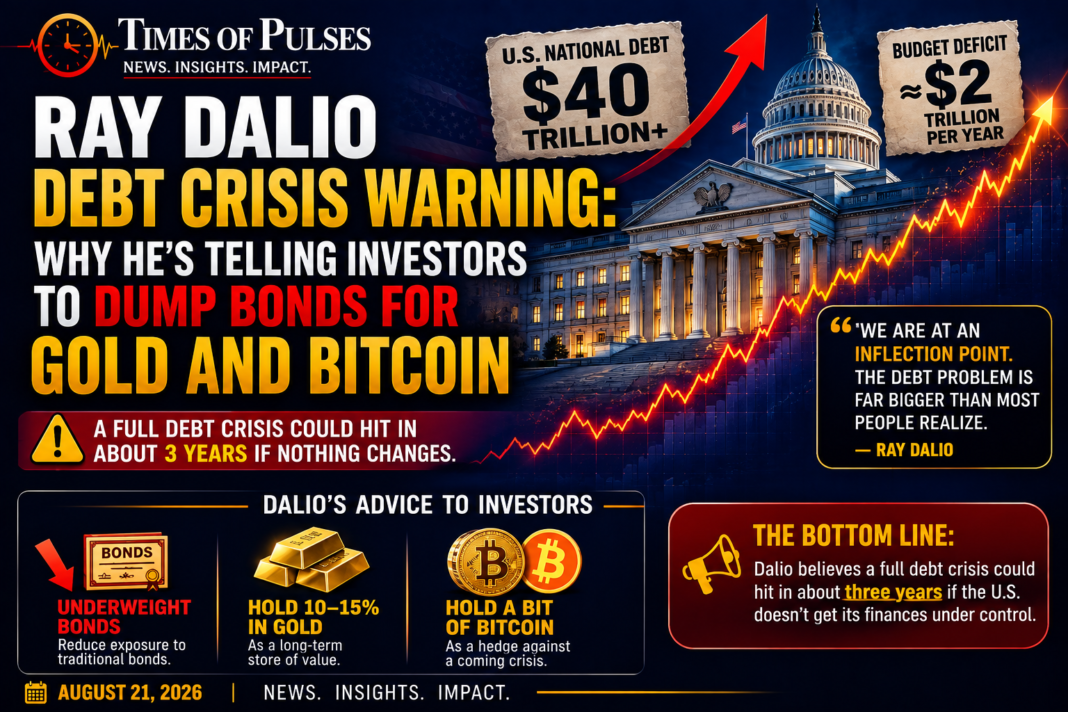
Ray Dalio Debt Crisis Warning: Why He’s Telling Investors to Dump Bonds for Gold and Bitcoin
Billionaire investor Ray Dalio just made one of his boldest public calls in years, and it’s rattling more than just crypto Twitter. The Bridgewater Associates founder says the U.S. government’s finances have hit an “inflection point,” and his solution is blunt: get underweight bonds, and put real money into gold and bitcoin instead. Here’s exactly what the Ray Dalio debt crisis warning says, the numbers behind it, and what it might mean for your own portfolio.
What the Ray Dalio Debt Crisis Warning Actually Says
In a LinkedIn post published Friday, August 21, Dalio said investors should reduce their bond holdings and consider allocating 10% to 15% of their portfolio to gold, plus “a bit” of bitcoin. He didn’t offer a precise bitcoin target, but the direction of his advice was unmistakable. “I am confident that the government’s financial condition is at an inflection point,” Dalio wrote. “If this is not dealt with now, the debts will build up to levels where they can’t be managed without great trauma.”
This isn’t a new theme for Dalio, who has written extensively about sovereign debt cycles in his book How Countries Go Broke: The Big Cycle. What makes this specific Ray Dalio debt crisis warning notable is the timing and the trigger behind it.
The Trigger: Treasury Secretary Bessent’s Bond Buyback Move
Dalio’s warning was sparked by a specific event: Treasury Secretary Scott Bessent’s announcement that his team would sharply increase buybacks of long-dated government bonds, raising the maximum size of certain operations to at least $4 billion, double the previous $2 billion cap. According to CNBC’s report on Dalio’s comments, Bessent told the network his team was going to “make a market” and that the purchases would likely top $4 billion.
Dalio reads it differently. In his view, governments buy back their own debt when investor demand is thinning out, and he noted the Treasury has “only limited capacity” to keep doing it. Combined with Japan, historically America’s largest foreign creditor, selling U.S. bonds to support its own currency, Dalio sees a pattern he’s flagged before in countries approaching serious debt trouble.
The Numbers Fueling the Ray Dalio Debt Crisis Warning
The fiscal picture Dalio is pointing to is genuinely stark:
- U.S. government debt crossed $40 trillion the same week
- The U.S. is spending roughly 40% more than it collects, with expected revenue near $5.5 trillion against expenses near $7.5 trillion
- July’s budget deficit alone topped $432 billion
- If the federal government were a business, Dalio estimates debt-servicing payments would total around $11 trillion, roughly 200% of annual revenue
- The 30-year Treasury yield touched its highest level since 2007, climbing above 5.3%
Dalio’s own estimate is that a full-blown debt crisis could hit “in three years, give or take two,” landing somewhere between one and five years if nothing changes on the current path.
Why Bonds Are the Problem in Dalio’s View
Rising long-term Treasury yields might sound like good news for savers, but for the government, higher yields mean it costs more to keep borrowing at the scale it currently needs. The Ray Dalio debt crisis warning centers on exactly this trap: as investors demand higher returns to keep lending to a government running large, persistent deficits, borrowing costs rise, which worsens the deficit further, which then requires even more borrowing.
He’s not alone in flagging the strain. Other major economies including the U.K., China, and Japan face similar pressures, according to Dalio, which is part of why he expects “non-government-produced monies like gold and bitcoin to do relatively well” if multiple currencies face devaluation pressure at once.
The Market Reaction Confirms the Ray Dalio Debt Crisis Warning Is Landing
Markets moved almost immediately. Bitcoin climbed from around $63,500 to above $78,000 within days, its strongest weekly performance since 2023, while gold jumped to its highest level since May. That combined rally, sometimes called the “debasement trade,” reflects investors positioning for a weaker dollar and more currency-related risk rather than reacting to any single company or sector.
Notably, Dalio was once one of crypto’s most prominent skeptics. His current stance, recommending “a bit” of bitcoin alongside a much larger gold allocation, is a meaningful shift from his 2022 recommendation of just 1% to 2% in bitcoin.
Dalio’s Proposed Fix (Not Just a Warning)
Dalio didn’t only warn, he also laid out what he thinks would actually solve the problem: cutting the budget deficit from around 6% of GDP down to 3%, through a combination of spending cuts, higher tax revenue, and lower interest rates, all done together rather than in isolation. He pointed to America’s own history as a template, noting the deficit was 4.6% of GDP in 1991 and had swung to a surplus by 1998 through exactly that kind of combined approach.
He also cautioned against a shortcut: forcing interest rates artificially lower through the Federal Reserve, which he said would be “very bad” and risks fueling the same currency debasement he’s warning investors to hedge against.
What This Means for Your Own Money
- Don’t treat this as investment advice to copy exactly. Dalio’s 10-15% gold allocation is a specific strategy for his own risk framework, not a universal rule for every portfolio size or age.
- Understand what you’re actually hedging against. Gold and bitcoin are being framed here as protection against currency devaluation and rising government borrowing costs, not as short-term trading plays. If you haven’t done a full portfolio and savings audit recently, a debt-crisis headline like this is exactly the kind of moment that makes it worth revisiting where your money actually sits.
- Watch the 30-year Treasury yield, not just headlines about the debt. As we covered when the 30-year yield hit a 19-year high, this number feeds directly into mortgage and loan costs well before any “crisis” label applies.
- A three-year, give-or-take-two forecast is still just a forecast. Dalio himself has acknowledged making similar warnings for years that appeared premature at the time.
Bottom Line
The Ray Dalio debt crisis warning isn’t a prediction of collapse next month, it’s a structural argument about where U.S. government finances are headed if the current path of $2 trillion annual deficits and $40 trillion in total debt continues unaddressed. Whether or not you agree with his specific gold-and-bitcoin allocation, the underlying numbers behind the warning, record debt, rising long-term yields, and a widening deficit, are real and worth understanding regardless of which assets you personally hold.
This article is for informational purposes only and does not constitute financial advice. Consult a licensed financial advisor before making changes to your investment portfolio.