
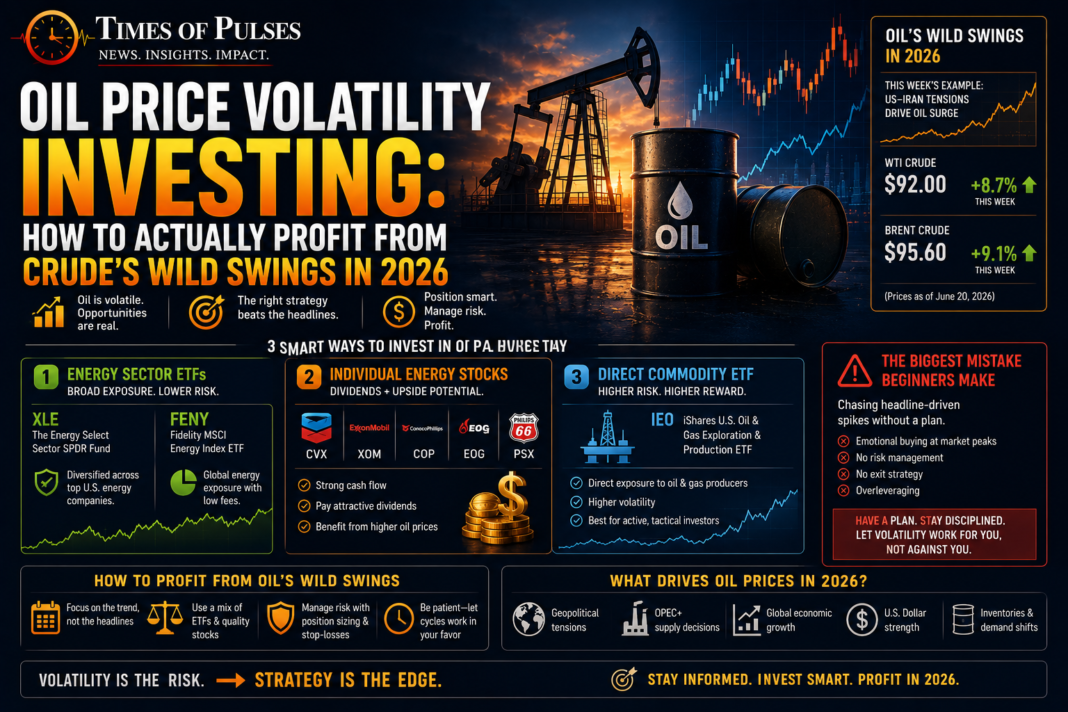
Oil Price Volatility Investing: Everyone’s Losing Money on Crude’s Swings Except These Investors
Every time oil prices spike on fresh Middle East headlines, like the surge we just covered after renewed US-Iran strikes this week, the same question comes up: is there an actual way to benefit from this, or is it just something that costs more at the pump? The honest answer is that oil price volatility investing is a real, accessible strategy, but doing it well means understanding which approach fits your risk tolerance, not just buying the first oil-related ticker you see.
Why Oil Price Volatility Investing Isn’t About Predicting the Next Headline
The biggest mistake people make when they hear “oil is spiking, how do I profit” is trying to time the next geopolitical event. Nobody can reliably predict whether the next round of US-Iran tension eases in a week or escalates further, and we’ve watched that exact story swing both directions repeatedly this year. Real oil price volatility investing isn’t about calling the next headline correctly, it’s about choosing a structure that benefits from the underlying trend, elevated and unstable oil prices, regardless of which specific week the news breaks.
Option 1: Energy Sector ETFs — The Easiest Starting Point
For most people, energy sector ETFs are the simplest and lowest-risk way to get exposure to rising oil prices without picking individual companies. The Energy Select Sector SPDR Fund (XLE) holds major producers like ExxonMobil and Chevron, and it’s returned roughly 31% year-to-date and about 44% over the past year, while charging a tiny 0.08% expense ratio and paying a dividend yield near 2.6%. The Fidelity MSCI Energy Index ETF (FENY) tracks similarly, around 31% year-to-date, but casts a wider net across mid and small cap energy names at an even lower cost.
What makes ETFs like these appealing for oil price volatility investing specifically is that you’re buying real companies with real cash flow, not a bet on the commodity price itself. When oil climbs above roughly $80 a barrel, producers like Exxon and Chevron generate outsized free cash flow that increasingly flows to dividends and buybacks, meaning you get paid to hold through the swings rather than needing to guess the next move perfectly.
Option 2: Individual Energy Stocks for Dividend Income
If you’d rather pick specific companies than buy the whole sector, major integrated oil producers and refiners offer a more direct route into oil price volatility investing, typically with attractive dividend yields on top. This approach requires more research since individual stocks carry company-specific risk on top of oil price risk, a refinery outage or bad earnings quarter can hurt a single stock even while oil prices climb. It’s a reasonable middle ground for investors who want more control than an ETF but aren’t ready for the volatility of direct commodity exposure.
Option 3: Direct Oil ETFs — The Riskier, More Amplified Play
For investors specifically chasing crude price moves rather than company performance, funds like the iShares U.S. Oil & Gas Exploration & Production ETF (IEO) strip out the stable integrated majors and lean almost entirely into upstream producers whose earnings move nearly tick for tick with crude. IEO has returned about 33% year-to-date, ahead of the broader energy ETFs, but Yahoo Finance’s coverage of energy ETFs notes it also carries the sharpest downside risk if oil prices ease back toward the EIA’s longer-term forecasts.
There’s an important caution specific to this corner of oil price volatility investing: futures-based commodity ETFs (funds that track the oil price directly rather than owning company shares) can quietly lose value over time even when oil prices are flat, due to a structural cost called contango from constantly rolling futures contracts. That’s a genuinely important distinction beginners often miss, an ETF holding oil company shares and an ETF holding oil futures contracts can behave very differently even when the news is identical.
The Mistake Most Beginners Make
The most common error in oil price volatility investing is treating every price spike as a trading signal rather than understanding the difference between a short-term news reaction and a genuine multi-week trend. We saw this exact pattern play out when oil surged on renewed Iran conflict this week, prices moved sharply, but shipments through the Strait of Hormuz never actually stopped, meaning the physical supply story hadn’t changed as dramatically as the price action suggested. Chasing every headline-driven spike tends to mean buying near short-term peaks and selling out during the inevitable pullback, the opposite of what actually builds wealth.
What This Means for Your Own Money
- Match your approach to your actual risk tolerance. Energy ETFs like XLE offer steadier, dividend-supported exposure; direct commodity or upstream-heavy funds like IEO amplify both the gains and the losses.
- Don’t put money into oil price volatility investing that you’ll need in the next year or two. Energy remains one of the more cyclical sectors, and a position bought during a spike can sit underwater for months if tensions ease faster than expected.
- Treat this the same way we’ve discussed hedging against broader economic uncertainty. Just as Ray Dalio recommended gold as a portfolio hedge against a specific risk rather than his entire portfolio, energy exposure works best as a measured allocation, not an all-in bet triggered by one news cycle.
- Keep the cash you’re not investing working too. Whatever portion of your portfolio you keep in reserve for opportunities like this deserves to sit in a high-yield savings account rather than earning nothing while you wait.
Bottom Line
Oil price volatility investing is a legitimate, accessible way to turn the same headlines rattling markets into portfolio exposure, but the method matters as much as the timing. Energy ETFs like XLE and FENY offer a steadier, dividend-supported way in; direct commodity-linked funds offer sharper upside and downside for investors who understand the added risk. Whichever route fits your situation, the real edge isn’t predicting the next US-Iran headline, it’s having a structure in place before the next spike happens rather than scrambling to react once it does.
This article is for informational and educational purposes only and does not constitute financial or investment advice. Energy markets and geopolitical events are unpredictable; consult a licensed financial advisor before making investment decisions.