
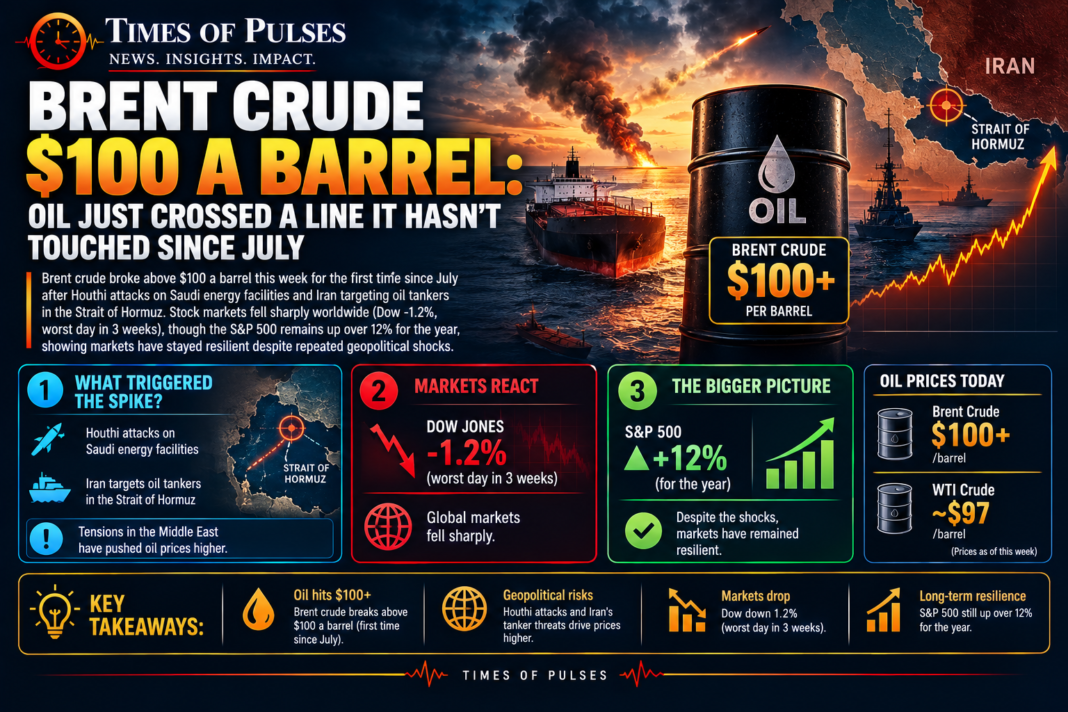
Brent Crude 100 a Barrel: Oil Just Crossed a Line It Hasn’t Touched Since July
Oil just crossed a psychological line that traders have been watching all year. Brent crude 100 a barrel is no longer a hypothetical, the international benchmark broke above that level this week for the first time since July, and the move wasn’t gradual, it jumped more than 2% in a single session as a new wave of Middle East violence hit the headlines. This is the sharpest escalation yet in a story we’ve been tracking for weeks, and it’s rattling stock markets well beyond the energy sector.
Brent Crude 100 a Barrel: What Actually Pushed It There
The latest spike traces back to a fresh round of attacks over the weekend. Houthi forces struck Saudi energy facilities, and Iran said it targeted three oil tankers using an unauthorized route through the Strait of Hormuz, along with several US-linked vessels, in direct retaliation for American strikes on Iranian tankers. That combination, attacks on both Saudi infrastructure and shipping lanes simultaneously, is what pushed Brent crude past the 100 a barrel mark that markets had been watching nervously for months, with West Texas Intermediate, the US benchmark, climbing above $93 in the same move.
Why This Brent Crude 100 a Barrel Move Feels Different
We’ve covered this conflict escalating and cooling repeatedly this year, but Brent crude breaking 100 a barrel specifically matters because of what the International Energy Agency has called it: potentially the largest disruption to global oil supply in history. That’s a notably stronger characterization than earlier phases of this conflict, and it’s part of why this particular move above 100 a barrel is drawing more attention than previous spikes.
This latest chapter picks up directly where our coverage of the initial round of US-Iran strikes left off, prices climbing further and the underlying conflict widening rather than settling down, exactly the pattern that makes this market so difficult to call.
How Stock Markets Reacted
The response in equity markets was immediate and sharp. The Dow Jones Industrial Average dropped 1.2% on the day, its worst single-day performance in nearly three weeks, while the S&P 500 slid 0.6% and the Nasdaq Composite fell 0.3%. The 10-year Treasury yield briefly climbed above the closely watched 4.8% level, as rising oil added fresh concerns about inflation on top of everything else weighing on bond markets this year.
The reaction wasn’t confined to the US either. In Europe, the Stoxx 600 fell 0.69%, with the UK’s FTSE 100 down 0.32%, Germany’s DAX sliding 0.68%, and Italy’s FTSE MIB dropping 1.27%. Asian markets were mixed, Japan’s Nikkei 225 closed 0.19% lower while South Korea’s Kospi actually jumped more than 3%, a reminder that even during a broad risk-off move, reactions vary significantly by region and local market drivers.
The Bigger Picture: Markets Have Stayed Surprisingly Resilient
Here’s the part that might surprise you given how dramatic the Brent crude 100 a barrel headline sounds: despite what the IEA is calling a historic oil supply disruption, this Brent crude 100 a barrel move hasn’t derailed the broader market so far this year. Edward Jones’ market analysis noted that the S&P 500 had still gained more than 12% year-to-date through last week’s close, with international developed markets up over 15% and emerging markets up more than 27%. One investment chief described the current oil-driven volatility as “a little bit of a speed bump” rather than a trend-changing event, reflecting a market that’s been choosing to look past repeated geopolitical shocks so far this year.
That resilience isn’t guaranteed to continue. Analysts have flagged that further escalation, particularly during a seasonally weak month for stocks like September, could produce more volatility than markets have shown so far.
What This Means for Your Own Money
- If you’ve been following our coverage of investing in oil price volatility, this move above 100 a barrel is exactly the kind of scenario that framework was built for, a real supply-side shock rather than a minor headline blip.
- Don’t assume Brent crude 100 a barrel is now the new baseline. This conflict has moved in both directions repeatedly this year, and prices could ease just as quickly if tensions cool.
- Watch your gas and travel budget over the next few weeks. A jump this sharp typically shows up at the pump within days, even if it partially reverses later.
- Keep the bigger portfolio picture in mind. Even with oil spiking, broad market indexes remain up double digits for the year, a reminder not to make dramatic portfolio changes based on a single week’s headlines alone.
Bottom Line
Brent crude 100 a barrel for the first time since July is a genuine escalation, not just another headline in a conflict markets had started to shrug off. Attacks on Saudi energy infrastructure and oil tankers moving through the Strait of Hormuz mark a meaningfully different phase than the tension we’d been tracking in recent weeks. Whether this proves to be a temporary spike or the start of a longer stretch of elevated oil prices likely depends on what happens in the region over the next several days, not on anything markets can price in today.
This article is for informational purposes only and does not constitute financial or investment advice. Consult a licensed financial advisor before making changes to your investment portfolio.