
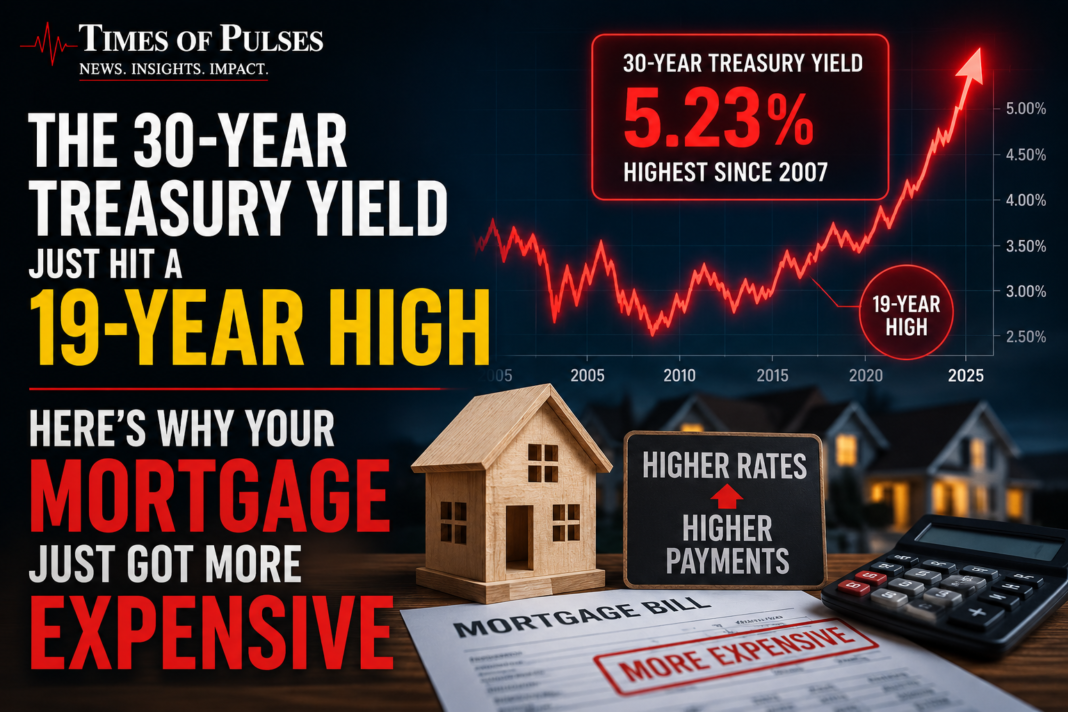
The 30-Year Treasury Yield Just Hit a 19-Year High — Here’s Why Your Mortgage Just Got More Expensive
While headlines chase the latest stock market swing, a quieter number just hit a level not seen since 2007 — and it’s about to cost you more on your next mortgage, car loan, or credit card bill than almost anything the Fed does directly. The 30-year Treasury yield hit 5.32% this week, a genuine 19-year high, and understanding why matters far more than it sounds.
What Actually Happened to Treasury Yields
The yield on the 30-year U.S. Treasury bond touched 5.323% on Tuesday before settling just under 5.3% — its highest level since April 2007. The 10-year Treasury yield, the benchmark that matters most for everyday borrowing, crossed above 4.7%, a sharp jump from below 4% before the Iran war escalated in late February. This wasn’t an isolated U.S. move either: the global bond selloff extended to Japan, where 10-year debt touched its highest yield in three decades, and to Germany and France, where long-term borrowing costs hit levels unseen since before the 2008 financial crisis.
Why the 30-Year Treasury Yield Matters More Than the Fed Right Now
Here’s the part most people misunderstand: your mortgage rate doesn’t directly track the Federal Reserve’s interest rate decisions. Fixed mortgage rates follow the 10-year Treasury yield far more closely, since lenders use it as their pricing benchmark. That means even if the Fed holds rates steady, as we’ve covered throughout its recent divided decisions, mortgage rates can still climb sharply if bond investors are demanding higher returns — which is exactly what’s happening now.
As Capital Economics economist Thomas Ryan put it, rising Treasury yields are “just another drag for households when you’ve got affordability hits elsewhere,” with little relief in sight on the borrowing cost side.
Three Forces Driving Yields to a 19-Year High
1. Persistent inflation concerns. July’s Consumer Price Index rose 3.4% year-over-year, well above the Fed’s 2% target and up sharply from 2.4% back in January before the war began. Energy prices alone climbed 14.7% year-over-year, as Iran’s restrictions on shipping through the Strait of Hormuz have disrupted global oil trade — a story we’ve tracked closely all year.
2. A rapidly growing national debt. The federal government is projected to run a roughly $2.1 trillion budget deficit this fiscal year, with total debt approaching $40 trillion. Investors are demanding higher compensation to keep lending to a government whose debt load keeps expanding, pushing yields higher across the board.
3. Record corporate bond issuance. U.S. companies have issued nearly $1.7 trillion in bonds so far this year, up 27% from the same period last year and already exceeding all of 2025 combined — much of it tied to AI infrastructure spending we’ve covered extensively. That flood of new corporate debt competes directly with Treasurys for investor money, adding further upward pressure on yields.
What This Means for Your Actual Borrowing Costs
The ripple effects are already showing up in real numbers:
- Mortgage rates: The average 30-year fixed mortgage rate climbed to 6.75% this week, up from 6.69% just days earlier, and from 6.66% in late July
- Auto loans: Borrowers financing a new vehicle now face APRs around 7%, while used car buyers are contending with rates near 10.6%
- Credit cards and variable-rate debt: These track more closely to the Fed’s short-term rate, but continue facing pressure from the broader high-rate environment we’ve documented in our coverage of the credit card minimum payment trap
The One Silver Lining: Better Returns for Savers
Rising yields aren’t universally bad news. If you’re a saver rather than a borrower, higher Treasury yields typically translate into better returns on CDs and high-yield savings accounts, since banks compete for deposits against increasingly attractive government-backed alternatives. If you haven’t checked your savings account rate recently against current options, this is a reasonable moment to compare.
What You Should Actually Do About Rising Treasury Yields
- If you’re house hunting, don’t wait for rates to improve on their own. With yields at a 19-year high driven by structural forces (debt, inflation, corporate borrowing) rather than a temporary blip, there’s no strong signal rates will drop meaningfully soon.
- If you’re refinancing, run the actual math before committing. A rate that looked unattractive a year ago may still beat waiting given the current trajectory.
- Shop around aggressively for auto financing. With new car APRs near 7% and used car rates above 10%, even a one-point difference between lenders meaningfully changes your total cost.
- Take advantage of better savings rates if you have cash sitting idle. Higher yields mean this is genuinely a better environment for savers than borrowers.
- Watch the 10-year yield specifically, not just Fed announcements, since it has more direct influence on your mortgage than the Fed’s own rate decisions.
Why This Could Get Worse Before It Gets Better
Bond strategist Ian Lyngen of BMO Capital Markets noted that “the path of least resistance will likely favor higher long-end rates in the near-term” unless there’s a slowdown in new bond supply — something that isn’t showing signs of happening yet given the scale of both government deficits and corporate issuance. That’s a genuinely important signal: this isn’t a one-week story that resolves itself, but a structural trend worth monitoring over the coming months.
Bottom Line
The 30-year Treasury yield hitting its highest level since 2007 might sound like an abstract bond market story, but it’s already translating into real, higher costs for anyone financing a home, car, or major purchase right now. Unlike Fed rate decisions, which get extensive headline coverage, this Treasury yield story has moved with far less attention — even though it’s arguably influencing your monthly payments more directly. Understanding the connection between Treasury yields and your own borrowing costs is the difference between being caught off guard by a higher mortgage quote and actually planning around it.
This article is for informational purposes only and does not constitute financial advice. Consult a licensed financial advisor or mortgage professional for guidance specific to your borrowing decisions.