
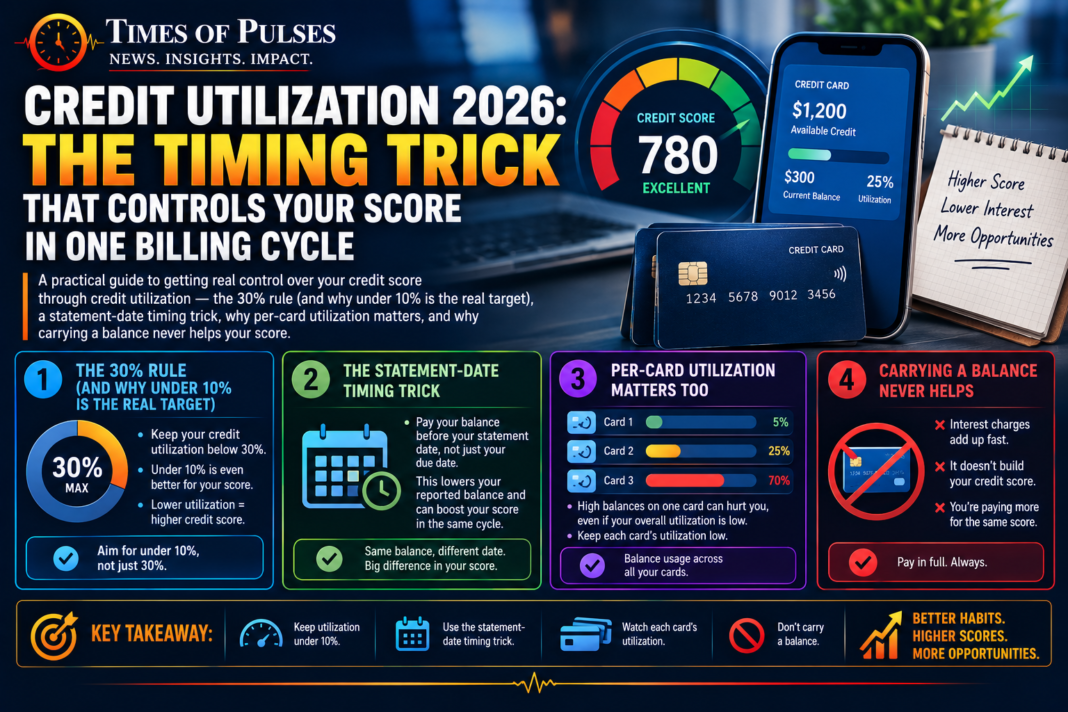
Credit Utilization 2026: The Timing Trick That Controls Your Score in One Billing Cycle
If you’re trying to get real credit control over your finances, credit utilization is the single lever you can move fastest. Unlike payment history, which takes years of consistency to build, credit utilization 2026 can shift your score within a single billing cycle, and most people are managing it the wrong way entirely.
What Credit Utilization 2026 Actually Measures
Credit utilization is simply your revolving credit balance divided by your credit limit, and it accounts for roughly 30% of your FICO score, the second-biggest factor after payment history. If you have a $3,000 balance on a card with a $10,000 limit, your utilization on that card is 30%. This applies only to revolving credit, credit cards and lines of credit, not installment loans like your mortgage or auto loan, which is why credit utilization 2026 strategies focus almost entirely on card balances.
The 30% Rule Is a Floor, Not a Goal
You’ve probably heard that you should keep utilization under 30%. That’s true, but it’s the minimum standard for avoiding real damage, not the target for genuine credit control. FICO’s own data shows that scores above 760 are consistently associated with utilization under 10%. Here’s roughly how the damage scales:
- 1% to 9% utilization: the sweet spot for maximum points
- 10% to 29%: still counts as “low,” minor impact
- 30% to 49%: moderate damage, scores start dropping noticeably
- 50% to 74%: significant damage, 30 to 60 point drops are common
- 75% and above: major damage to your score
Interestingly, 0% utilization isn’t actually optimal either. Lenders want to see that you can use credit responsibly, not that you avoid it entirely, so the real target for credit utilization 2026 is that narrow 1% to 9% band, not zero.
The Statement-Date Timing Trick Most People Miss
Here’s the detail that separates people who understand credit utilization 2026 from people who don’t: card issuers report your balance to the credit bureaus on your statement closing date, not your payment due date. Those are usually two different dates, and most people only think about the due date.
That means you can carry a balance all month, use your card normally, and still show up with low utilization, as long as you pay it down before the statement closes rather than waiting until the due date. According to a detailed breakdown of this strategy, paying a few days before your statement closes is often the single fastest way to lower the number that actually reaches the bureaus, without changing your spending habits at all.
Per-Card Utilization Matters Just as Much as Overall
Real credit control means watching more than just your combined utilization across all cards. Scoring models look at utilization per card as well as your overall ratio, which means one maxed-out card can hurt your score even if your total utilization across every card looks completely fine. If you’re carrying $9,000 on a $10,000-limit card and $200 on a $5,000-limit card elsewhere, your overall utilization might look reasonable at 61%, but that first card’s individual 90% utilization is doing real damage on its own.
This is also why requesting a credit limit increase, without increasing your spending, can meaningfully help your credit utilization 2026 numbers. A higher limit against the same balance immediately lowers your ratio, with no new debt involved.
The Biggest Myth: Carrying a Balance Helps Your Score
This myth costs people real money for zero benefit. Carrying a balance month to month does nothing positive for your credit utilization 2026 or your score, it simply means you’re paying interest, often north of 24% APR on the average card, for no scoring advantage whatsoever. Paying your balance in full every month, ideally before the statement closes, is strictly better for both your score and your wallet. There’s no version of “strategic debt” that helps your credit score.
What This Means for Your Own Credit
- Figure out your statement closing dates for every card you carry, not just the due dates, since that’s the number that actually reaches the bureaus.
- Check per-card utilization, not just your overall number. If you’re working on building credit from no history, a single new card sitting near its limit can undo progress elsewhere.
- Never carry a balance intentionally. If you’re currently working through paying off credit card debt fast, understand that the interest you’re paying isn’t buying you any score benefit at all.
- A credit limit increase request costs nothing and can help immediately, as long as you don’t use it as an excuse to spend more. Any extra cash you free up by managing this well is worth parking in a high-yield savings account rather than letting it sit idle.
Bottom Line
Real credit control comes down to understanding the mechanics most people never bother to learn: the 30% rule is a ceiling, not a goal, per-card ratios matter as much as your overall number, and the date your issuer reports your balance matters more than the date you’re required to pay. Getting credit utilization 2026 genuinely under control isn’t about opening more accounts or dramatically changing your spending, it’s about a handful of specific, low-effort habits applied consistently.
This article is for informational purposes only and does not constitute financial advice. Consult a licensed financial advisor or credit counselor for guidance specific to your situation.