Home Blog Page 6

Microsoft Stock Surge 2026: Why It Just Had the Biggest Single-Day Gain in Market History

Microsoft Stock Surge 2026: Why It Just Had the Biggest Single-Day Gain in Market History

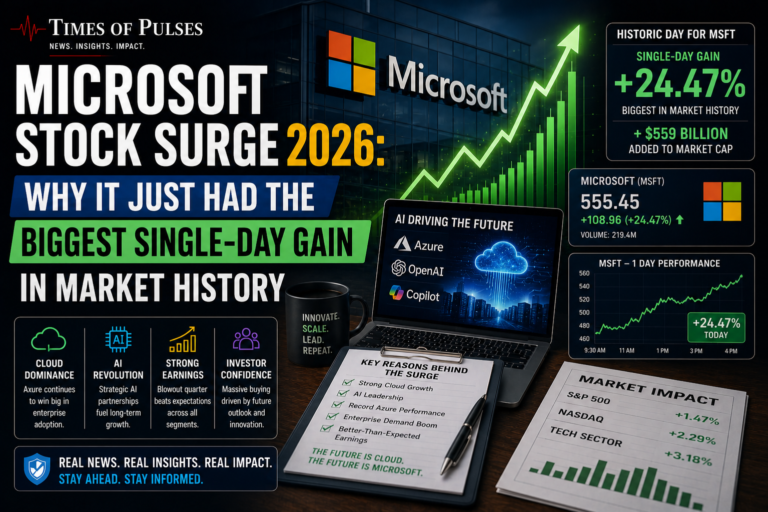
Something genuinely historic happened in the stock market this week. The Microsoft stock surge 2026 added roughly $450 billion in market value in a single trading day — the largest one-day value gain by any company in stock market history. Meanwhile, in the same earnings season, Meta and Apple both fell sharply. Here’s what actually happened, why the reaction was so extreme, and what this reveals about where investors think the AI story is really headed.

The Numbers Behind the Microsoft Stock Surge 2026

Microsoft shares surged as much as 16% after the company reported quarterly revenue of $90.01 billion, comfortably beating analyst estimates of $87.62 billion. The standout number inside that report: Azure, Microsoft’s cloud computing division, grew 43% at constant currency, blowing past StreetAccount estimates of 40.2% growth. For the full 2026 fiscal year, Azure revenue surpassed $100 billion for the first time ever.

That single day added more market value to Microsoft than most entire companies are worth — a genuinely rare moment even by the standards of this year’s volatile market.

A Dramatic Divergence Among the “Magnificent Seven”

The Microsoft stock surge 2026 landed in the middle of a genuinely split earnings season for Big Tech:

  • Meta Platforms tumbled almost 9% after posting earnings per share of $6.18, missing analyst estimates by $1.04, and guiding third-quarter revenue toward the lower end of expectations
  • Apple fell more than 7%, even though its fiscal third-quarter revenue actually topped expectations, helped by a 22% jump in iPhone sales — the stock dropped anyway on a shortfall in services revenue
  • Amazon surged 13% after reporting better-than-expected second-quarter revenue, with strength in its cloud computing business reinforcing investor confidence in AI spending

This is one of the clearest real-world examples this year of a lesson worth remembering: strong headline revenue alone doesn’t guarantee a stock rises, and a genuine miss in one specific area (like Apple’s services shortfall) can outweigh strength everywhere else.

Why This Matters Beyond Microsoft Itself

The Microsoft stock surge 2026 helped trigger a broader market rebound that reversed the sharp selloff we covered just a day earlier, when a hawkish Fed decision sent the Dow down more than 1,100 points and pushed the Nasdaq 100 into a technical correction. This time, the reaction ran the opposite direction: the Nasdaq 100 advanced 3.4%, its best day since April 2025, with a rebound in chip stocks adding to the rally as “dip buyers” emerged on speculation that the AI trade still has room to run.

This rapid reversal — from a technical correction to one of the best days of the year within roughly 24 hours — is a genuinely useful illustration of just how quickly sentiment can swing during this earnings season, especially around anything connected to AI infrastructure spending.

The Bigger AI Spending Question This Answers (For Now)

Microsoft’s Azure growth is significant because it’s a direct, real-world data point in the debate we’ve tracked all month: is the massive AI infrastructure spending by Big Tech translating into actual revenue, or is it running ahead of real demand? Azure crossing $100 billion in annual revenue with accelerating growth is a genuinely strong signal that at least one major cloud provider is converting AI investment into real, measurable business results.

That said, this doesn’t settle the debate entirely — Meta’s weaker guidance the same week shows the picture varies significantly by company, and the market’s own whiplash (correction to rally within a day) suggests investors themselves remain genuinely uncertain about how durable this growth is.

What This Means for Your Portfolio

  1. Don’t treat “Big Tech” as one uniform trade. This week alone shows Microsoft, Amazon, Meta, and Apple moving in dramatically different directions on the same earnings cycle — company-specific results matter more than sector-wide sentiment right now.
  2. Watch cloud computing growth as a genuine AI-spending signal. Azure’s 43% growth and Amazon’s cloud-driven beat are more concrete evidence of AI monetization than broader spending announcements alone.
  3. Expect continued volatility, not a settled direction. Markets went from a technical correction to a 3%+ Nasdaq rally within about a day — a reminder that daily swings this year don’t necessarily represent a lasting trend in either direction.
  4. If you hold broad index funds, you already have exposure to this divergence — a rebalance based on one earnings week is rarely necessary for a genuinely long-term investor.

Bottom Line

The Microsoft stock surge 2026 is a genuinely historic single-day event, and it arrived at exactly the moment markets needed reassurance that AI infrastructure spending is still paying off. But the same week’s sharp Meta and Apple declines are an equally important reminder that this earnings season is rewarding specific, measurable results, not blanket optimism about any company connected to AI. For long-term investors, the smartest response remains the same one we’ve repeated all month: watch the underlying numbers, not just the headline stock moves.


This article is for informational and educational purposes only and does not constitute investment advice or a recommendation to buy or sell any security. Stock market movements are unpredictable, especially around earnings reports; consult a licensed financial advisor before making investment decisions.

August 1 Tariffs 2026: What They Actually Mean for Your Grocery and Gas Bill

0

August 1 Tariffs 2026: What They Actually Mean for Your Grocery and Gas Bill

The August 1 tariffs 2026 deadline has arrived, and it’s genuinely significant for anyone who buys imported goods — which, in practice, is almost everyone. After months of delays and negotiations, new country-specific tariff rates are taking effect, some as high as 50%, on goods from dozens of countries. Here’s what actually changed, why it happened now, and what it means for prices on everyday purchases.

What the August 1 Tariffs 2026 Actually Are

The August 1 tariffs 2026 stem from the Trump administration’s “reciprocal tariff” policy, which imposes country-specific import duties on goods entering the United States. After the original April 2025 “Liberation Day” tariffs were delayed multiple times, Commerce Secretary Howard Lutnick called August 1 a “hard deadline,” and the administration has largely stood behind it, sending formal letters to dozens of countries outlining their specific new rates.

Rates vary significantly by country and product. Brazil faces a notably steep 50% tariff, while other countries face rates ranging from a 10% baseline up toward 46% for some Asian trading partners, depending on the specific trade relationship and ongoing negotiations. China remains under a separate track, with its own updated tariff rates tied to an August 11 deadline if no agreement is reached before then.

Why the August 1 Tariffs 2026 Matter So Much

This isn’t a minor policy adjustment. When similar reciprocal tariffs briefly took effect back in April 2025 before being delayed, the stock market reacted with its worst single-day performance since the COVID-19 pandemic. That reaction reflects how deeply these tariffs touch the broader economy — from import costs for businesses to final prices for consumers.

Legally, this policy has already been through real turbulence: the Supreme Court ruled in February 2026 that the administration’s original legal authority (under the International Emergency Economic Powers Act) didn’t actually authorize these tariffs, forcing the administration to rebuild its tariff structure using different legal authorities, including Section 122 and Section 301 of trade law. That legal back-and-forth is part of why rates and deadlines have shifted so many times over the past year.

What the August 1 Tariffs 2026 Mean for Everyday Prices

Tariffs are ultimately a tax on imported goods, and businesses typically pass at least part of that cost on to consumers. Categories most likely to see price effects from the August 1 tariffs 2026 include:

  • Everyday consumer goods with significant import exposure, from clothing to electronics
  • Food items sourced internationally, particularly from countries facing the steepest new rates like Brazil
  • Vehicles and auto parts, which remain under separate but related Section 232 tariffs
  • Building materials, including lumber and certain metals already facing elevated tariffs from earlier in the year

Some categories carry exemptions worth knowing about — certain agricultural products, civil aircraft parts, and generic pharmaceuticals and their ingredients are excluded from these reciprocal tariffs specifically.

Why the Deadline Kept Moving (And Might Still Change)

If this feels like the tariff deadline that never actually arrives, that’s a reasonable read of the past year. The administration has repeatedly delayed enforcement to allow more time for trade negotiations, and Commerce Secretary lutnick himself acknowledged that “nothing stops countries from talking to us after August 1” — meaning rates could still shift for specific countries even after the deadline technically passes, based on ongoing negotiations.

What You Should Actually Do About the August 1 Tariffs 2026

  1. Expect gradual price increases, not an overnight jump. Businesses typically absorb some tariff costs initially and pass along the rest over weeks or months as existing inventory sells through and new, tariff-affected inventory arrives.
  2. If you’re planning a major purchase with import exposure — electronics, appliances, vehicles — consider whether buying sooner rather than later makes sense, though weigh this against your actual need rather than panic-buying.
  3. Build extra flexibility into your budget for imported goods categories, similar to how we’ve suggested building buffer room for volatile gas prices this year.
  4. Watch which countries you regularly buy from. If a significant share of your typical purchases (coffee, electronics, clothing brands) come from a country facing a steep new rate like Brazil’s 50%, that’s worth specifically tracking in your budget.
  5. Don’t assume today’s rate is permanent. Given how many times these deadlines and rates have shifted over the past year, continued negotiation could still change specific country rates in the coming weeks.

The Bigger Economic Picture

The August 1 tariffs 2026 land at a genuinely complicated moment for the broader economy — arriving the same week as a hawkish Fed decision, a technical correction in the Nasdaq, and elevated bond yields. Tariff-driven price increases add a real wildcard to the inflation conversation the Fed has been wrestling with all year, potentially complicating the path toward the rate cuts many households have been hoping for.

Bottom Line

The August 1 tariffs 2026 represent one of the most significant, and most delayed, trade policy shifts of the past year, with real potential to affect prices on everyday goods from groceries to electronics. Given the legal challenges and repeated deadline extensions this policy has already been through, it’s worth staying informed rather than assuming today’s specific rates are the final word — but the direction is clear enough that building some budget flexibility for imported goods is a reasonable step regardless of how the details continue to evolve.


This article is for informational purposes only and does not constitute financial, legal, or trade advice. Tariff policy continues to evolve and is subject to legal challenges and negotiation; consult official government sources or a trade professional for guidance specific to your situation.

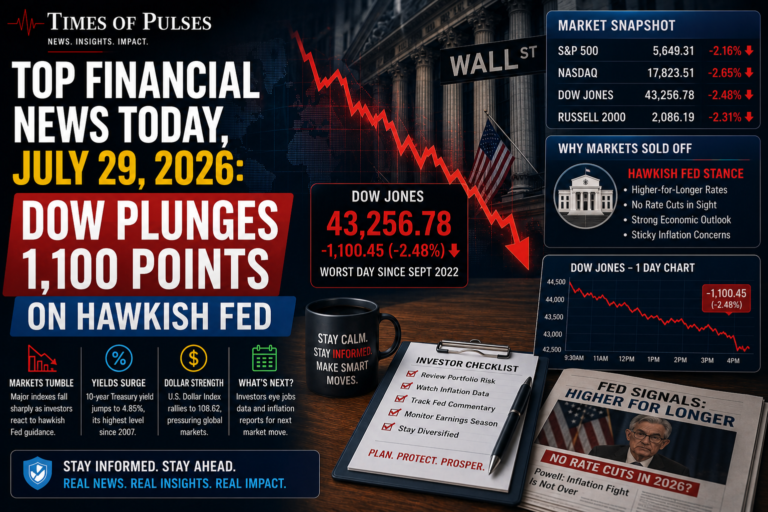
Top Financial News Today, July 29, 2026: Dow Plunges 1,100 Points on Hawkish Fed

0

Top Financial News Today, July 29, 2026: Dow Plunges 1,100 Points on Hawkish Fed

Here’s your roundup of the top financial news today, July 29, 2026 — covering a surprise hawkish turn from the Federal Reserve, a Nasdaq correction, surging bond yields, and rising oil prices. If you only have a few minutes to catch up on the markets, this covers what actually matters.

The Fed Holds Rates Steady, But the Real Story Is the Dissent

The centerpiece of today’s top financial news is the Federal Reserve’s decision to leave interest rates unchanged for a seventh straight month — but the vote itself is what rattled markets. Three Fed officials dissented, voting instead for a rate hike, a genuinely rare and hawkish signal after the internal disagreements we’ve tracked among Fed officials all year.

This is a meaningful shift from the “will they cut” conversation that’s dominated headlines for months. Markets reacted immediately and sharply: the Dow Jones Industrial Average plunged more than 1,100 points, or 2.2%, while the S&P 500 dropped 1.5% and the Nasdaq Composite sank about 1.7%.

The Nasdaq 100 Enters a Technical Correction

Adding to today’s top financial news, the Nasdaq 100 officially entered a technical correction, now down 11% from its recent record high. A chip stock rout — which we’ve been tracking closely following the China chip breakthrough story this week — continued to deepen, dragging the tech-heavy index down further alongside the Fed-driven selloff.

Bond Yields Hit Levels Not Seen Since 2007

One of the more striking numbers in today’s top financial news: 30-year Treasury yields climbed to their highest level in almost two decades, extending an 11-basis-point jump that followed the Fed’s decision. Higher long-term yields typically signal that bond investors are pricing in either stronger inflation expectations or reduced confidence that rate cuts are coming anytime soon — both genuinely relevant given the hawkish dissent from Fed officials today.

Oil Prices Rise Again on Middle East Tensions

Just days after we covered oil prices falling on hopes of an Iran peace deal, today’s top financial news brings a reversal: crude prices climbed again amid renewed hostilities in the Middle East. Brent crude topped $90 a barrel, with energy stocks among the few bright spots in an otherwise rough trading session — ExxonMobil and Chevron both rose as oil prices jumped.

A Mixed Bag From Big Tech Earnings

Big Tech’s earnings rollout, which we previewed earlier this week, delivered a split verdict:

  • Meta Platforms gave a lackluster forecast, adding to pressure on tech sentiment already rattled by the chip stock selloff
  • Microsoft’s cloud computing unit grew at its fastest pace in four years — a genuinely strong signal that AI infrastructure investment is still translating into real business growth for at least one major player

This split outcome captures the broader tension we’ve tracked all month: strong underlying AI business growth colliding with genuine investor anxiety about spending sustainability and valuations.

Other Notable Moves Today

  • Caterpillar tumbled nearly 7% after an analyst downgrade
  • Deere & Co dropped over 4.5% amid falling agricultural commodity prices and cautious guidance
  • Gold gained slightly to $4,048.99, a modest safe-haven move given the broader market stress
  • Industrials fell 3.4% and technology stocks dropped 2.4%, while energy and consumer defensive stocks were among the few sectors posting gains

What This Means for Your Money

  1. A hawkish Fed dissent changes the mortgage and savings math. If three officials are pushing for a hike rather than a cut, don’t assume falling rates are around the corner — it may be worth locking in a good mortgage rate or CD now rather than waiting.
  2. Rising 30-year yields affect more than just bonds. Mortgage rates often track long-term Treasury yields, so this move is worth watching closely if you’re house hunting or refinancing.
  3. Don’t read the chip stock rout as uniform bad news for all of Big Tech. Microsoft’s strong cloud growth alongside Meta’s weak forecast shows this is a story of divergence, not a blanket AI slowdown.
  4. Keep an eye on oil prices again, since the reversal from last week’s decline could bring gas price pressure back into the picture.

Bottom Line

Today’s top financial news centers on a genuine surprise: a Fed that held rates steady but revealed real hawkish appetite among three of its own officials, triggering a sharp selloff, a Nasdaq correction, and the highest long-term bond yields in almost two decades. Combined with resurgent oil prices and a mixed batch of Big Tech earnings, this is a market genuinely searching for direction — worth watching closely rather than reacting to any single day’s headline.


This article is for informational and educational purposes only and does not constitute investment advice. Market conditions change rapidly; consult a licensed financial advisor before making investment decisions based on daily market news.

China Chip Breakthrough 2026: How One Report Triggered a Global Market Crash

China Chip Breakthrough 2026: How One Report Triggered a Global Market Crash

Rarely does a single piece of news move markets on four different continents in the same 48 hours — but that’s exactly what happened this week. The China chip breakthrough 2026 story sent Nvidia, Samsung, SK Hynix, and chip equipment makers in the Netherlands all tumbling together, wiping hundreds of billions of dollars off global markets. Here’s what actually happened, why it genuinely matters worldwide, and what it means for your portfolio.

What Actually Happened

According to reports first surfaced by tech publication The Information, Chinese state-owned company Shanghai Yuliangsheng has begun mass-producing deep ultraviolet (DUV) lithography machines — the critical equipment needed to manufacture advanced microchips used in AI systems. Separately, Chinese memory chip maker CXMT went public on the A-share market with a valuation that topped the entire Chinese stock exchange on debut.

The China chip breakthrough 2026 story matters because DUV lithography equipment has historically been dominated by a small handful of companies, mainly in the Netherlands and Japan, with export restrictions specifically designed to keep this technology out of Chinese hands. If China has genuinely closed that gap faster than expected, it fundamentally challenges the “scarcity pricing” that has supported premium valuations for Korean and Taiwanese chipmakers for years.

How the China Chip Breakthrough 2026 Rippled Across the Globe

The scale of the reaction is genuinely rare in modern markets:

  • South Korea: The Kospi index collapsed nearly 11% in a single session, its worst one-day decline since the early days of the U.S.-Iran conflict in March, and on track for its worst month since 1997. Samsung Electronics posted its worst single-day fall in almost two decades, dropping 13.4%, while SK Hynix fell 14.7% — the two companies together make up nearly half the entire Kospi index.
  • Japan: The Nikkei sank more than 4%, with flash memory maker Kioxia Holdings plunging 18.3%.
  • Taiwan: The Taiex index fell over 4%, with chip designer MediaTek dropping nearly 10%.
  • The Netherlands: Chip equipment makers ASM International and BE Semiconductor — companies whose entire business model depends on controlling this exact lithography technology — fell 7% and nearly 10% respectively.
  • The United States: Nvidia dropped 5% on the prior trading day alone, wiping out $250 billion in market value, while rivals Sandisk and AMD fell 11% and 5%.

Samsung and SK Hynix have now fallen almost 50% from the all-time highs they hit just last month — an extraordinary reversal for stocks that had been powering South Korea’s entire market rally for most of 2026.

Why This Is About More Than Just Chips

The China chip breakthrough 2026 reaction reveals something important about how fragile this year’s AI-driven rally had become. As Stephen Innes of SPI Asset Management explained, the AI trade has been behaving like a flywheel: rising stock prices encouraged more spending, that spending validated higher earnings expectations, and those expectations pushed valuations even higher. This selloff shows that same flywheel can just as easily spin in reverse.

Adding to the unease, Nvidia’s own disclosure of $750 billion in AI infrastructure deals fanned separate concerns about how much of the AI boom is being financed through debt and complex financing arrangements rather than straightforward demand — a worry we’ve touched on before in our coverage of AI stock volatility this year.

This Extends a Pattern We’ve Been Tracking All Month

If this feels familiar, it should — we’ve covered the semiconductor sector’s volatile stretch multiple times this year, from the initial bear-market decline to the brief recovery that followed. The China chip breakthrough 2026 story is the latest, and so far the sharpest, chapter in that ongoing tension between AI infrastructure optimism and genuine questions about whether current valuations can hold.

What Regulators Are Already Doing

South Korea’s Financial Services Commission is reportedly considering tighter leverage controls specifically to help stabilize market sentiment — a sign of how concentrated, and therefore fragile, Korea’s equity market has become around a small handful of AI-linked semiconductor names.

What This Means for Your Portfolio

  1. Don’t assume this reflects collapsing AI demand. Analysts specifically note this isn’t a sign that chip demand has disappeared or that tech giants are abandoning AI infrastructure spending — it reflects a repricing of how much investors are willing to pay for that story today.
  2. Understand your concentration risk. If you hold individual positions in Samsung, SK Hynix, Nvidia, or similar AI-linked names, this is a real-world example of how concentrated a “hot theme” portfolio can become, and how quickly sentiment can reverse.
  3. Watch this week’s Big Tech earnings closely. Results from Microsoft, Amazon, Apple, and Meta this week will offer a genuine read on whether AI infrastructure spending guidance holds steady despite this volatility.
  4. Remember geographic diversification matters too. This selloff shows how interconnected global chip supply chains are — a story originating in China rippled through Korea, Japan, Taiwan, the Netherlands, and the U.S. within days.

What You Should Actually Do This Week

  1. Avoid panic-selling based on a single dramatic news cycle, especially if your original investment thesis for any specific company hasn’t fundamentally changed
  2. Check your actual exposure to concentrated AI/semiconductor names, whether through individual stocks or sector-heavy funds
  3. Watch for confirmation in upcoming earnings calls, not just the initial price reaction, to understand whether this is sentiment-driven or reflects a genuine competitive shift
  4. Keep perspective on position sizing in any single volatile sector, regardless of how compelling the long-term story sounds

Bottom Line

The China chip breakthrough 2026 story is a genuinely rare example of a single technological development shaking markets across four continents simultaneously. Whether this marks a lasting shift in the global chip industry’s competitive balance, or an overreaction that fades as details become clearer, will likely become apparent over the coming weeks as more analysis and company responses emerge. For now, it’s a powerful reminder of just how much of this year’s market gains have rested on a narrow set of AI-linked names, and how quickly that concentration can cut both ways.


This article is for informational and educational purposes only and does not constitute investment advice or a recommendation to buy or sell any security. International stock market movements are unpredictable and can shift rapidly; consult a licensed financial advisor before making investment decisions.

Top Financial News Today, July 28, 2026: Chip Stocks Crash, Big Tech Earnings Loom

0

Top Financial News Today, July 28, 2026: Chip Stocks Crash, Big Tech Earnings Loom

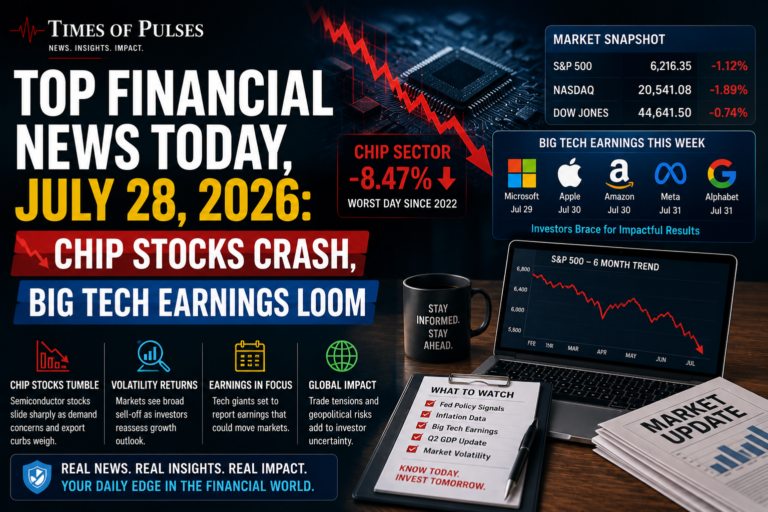
Here’s your roundup of the top financial news today, July 28, 2026 — covering a dramatic overseas chip stock selloff, a rotation into safer sectors, and a jam-packed week ahead with Big Tech earnings and a Fed rate decision. If you only have a few minutes to catch up on the markets, this covers what actually matters.

Chip Stocks Crash Overseas, Dragging the Sector Further

The biggest shock in today’s top financial news came from Asia. South Korea’s Kospi index tumbled as much as 10.84% to 6,023.66, triggering a 20-minute trading halt after a circuit breaker was activated. Samsung Electronics and SK Hynix — two of the world’s largest memory chip makers — dropped 13.4% and nearly 14.7% respectively. Japan’s Nikkei 225 also fell almost 4%.

This extends the volatile stretch we’ve been tracking in the semiconductor sector all month. Investors who poured into memory chip stocks earlier in 2026 have grown noticeably more skeptical in recent weeks, triggering repeated sell-offs across the group. Even with the pullback, Sandisk remains the best-performing stock in the S&P 500 this year, still up more than 360%.

Wall Street Rotates Into Safer Ground

While chip stocks struggled, U.S. markets told a different story in today’s top financial news. The Dow Jones Industrial Average rose 0.5%, closing at 52,210.08, while the S&P 500’s equal-weighted version — which strips out the outsized influence of mega-cap tech stocks — actually hit a record high. Healthcare and financial stocks hit fresh intraday all-time highs, with the Health Care Select Sector SPDR ETF up 2.7% and the Financial Select Sector SPDR ETF gaining 0.5%.

This rotation — investors moving money out of high-flying chipmakers and into steadier, more economically sensitive sectors — has been picking up speed as the Nasdaq 100 sits on the brink of a technical correction.

Oil Prices Fall on Iran Peace Deal Hopes

Adding a genuinely positive note to today’s top financial news, oil prices dropped to a one-week low after President Trump indicated there are chances of a peace deal with Iran, with Washington reportedly having “good talks” with Tehran. Brent crude settled at $88.36 a barrel, down 8.7%, while WTI crude ended at $82.61, down 7.5% — a sharp reversal after the run toward $100 a barrel we covered just days ago. Trump did caution that the U.S. could resume attacks if negotiations fail, so this relief remains conditional.

The Week Ahead: Big Tech Earnings and a Fed Decision

Two major events are set to dominate the top financial news this week:

  • Big Tech earnings from Microsoft, Amazon, Apple, and Meta are all due this week, with investors specifically watching for guidance on AI spending following the volatility in chip stocks and the mixed reaction to Alphabet and Tesla’s own earnings last week
  • The Federal Reserve’s FOMC meeting concludes Wednesday, with traders currently pricing in roughly a 30% chance of a rate increase — a genuinely different signal than the rate-cut expectations we’ve tracked for most of this year, reflecting how much the inflation and jobs data conversation has shifted

What This Means for Your Money

  1. Don’t overreact to overseas chip stock volatility alone. Sharp single-day moves in South Korean and Japanese markets don’t automatically translate to the same losses in U.S.-listed positions, though sentiment can spill over.
  2. Watch this week’s Big Tech earnings closely. Given how much of this year’s market story has centered on AI infrastructure spending, guidance from Microsoft, Amazon, Apple, and Meta could meaningfully move sentiment either direction.
  3. The Fed’s Wednesday decision matters more than usual. A 30% priced-in chance of a hike, rather than a cut, is a real shift worth watching if you have a mortgage, savings account, or credit card debt tied to rate movements.
  4. Falling oil prices are good news for your gas budget, but treat it as conditional given the ongoing Iran negotiations rather than a guaranteed trend.

Bottom Line

Today’s top financial news captures a market in genuine transition: a dramatic overseas chip selloff, a rotation toward safer sectors at home, falling oil prices on peace deal hopes, and a pivotal week ahead with Big Tech earnings and a Fed decision that could go either direction. As always, the goal isn’t to react to every headline, but to understand which threads are likely to matter for your budget and portfolio over the coming days.


This article is for informational and educational purposes only and does not constitute investment advice. Market conditions change rapidly; consult a licensed financial advisor before making investment decisions based on daily market news.

Tax Planning With AI 2026: What ChatGPT and Claude Can (and Can’t) Do for Your Taxes

0

Tax Planning With AI 2026: What ChatGPT and Claude Can (and Can’t) Do for Your Taxes

Tax planning with AI has exploded this year — 26% of people used AI to help with their 2025 tax returns, up dramatically from just 11% the year before. But experts are sending a clear warning alongside that growth: these tools can genuinely help you understand your taxes, while also being risky enough to cost you your refund if you trust them with the wrong task. Here’s exactly where tax planning with AI actually helps, and where it can get you into real trouble.

Why Tax Planning With AI Has Grown So Fast

The appeal is obvious. Instead of digging through IRS publications or waiting for a callback from an overbooked accountant, you can ask ChatGPT or Claude a tax question and get an instant, plain-language answer. It’s no surprise that Adobe’s polling found AI tax usage nearly doubled in a single filing season, and separate reporting found 62% of Gen Z Americans specifically turn to AI before filing.

Where Tax Planning With AI Actually Works Well

According to multiple 2026 reports, general-purpose AI chatbots are genuinely useful for a specific set of tasks:

  1. Explaining concepts in plain language. Understanding the difference between standard and itemized deductions, how tax brackets actually work, or what counts as taxable income are things AI explains clearly and immediately.
  2. Catching math errors before you file. The IRS finds nearly 2.5 million math errors on tax returns in a typical year, according to TurboTax. Asking an AI to sanity-check your numbers is a reasonable second pass, though it shouldn’t be your only check.
  3. Summarizing new tax law changes. With provisions from the One Big Beautiful Bill Act rolling out this year, AI can help explain what changed and roughly how it might affect your situation.
  4. Preparing better questions for your tax professional. One recommended workflow: describe your full tax year to an AI first — job changes, freelance income, major purchases — and use its response to build a list of deductions and documents to bring to your actual filing software or accountant.
  5. Explaining confusing tax software prompts. When TurboTax or another filing tool asks something unclear, AI can translate the question into plain English while you file.

Where Tax Planning With AI Gets Genuinely Risky

The warnings from tax professionals are consistent and specific:

AI models get real tax math wrong at a concerning rate. One 2026 study found AI chatbots got a basic capital gains tax question wrong about two-thirds of the time. That’s not a minor error rate — it’s a coin flip you shouldn’t be making with your actual refund.

General AI isn’t trained specifically on current tax code. Danny Werfel, the former IRS commissioner from 2023 to 2025, told CBS News that general chatbots “haven’t been tested for accuracy” on tax matters the way dedicated tax software has, which is built on hundreds of millions of real returns and validated by tax professionals.

AI cannot access your actual financial accounts. It only knows what you manually type in, meaning any figure it calculates is only as accurate as the information you provide — and it won’t catch a document you forgot to mention.

Never share sensitive personal information with a general AI chatbot. Tax experts specifically warn against pasting your Social Security number, full account numbers, or other sensitive identifiers into any AI conversation.

A Notable 2026 Development: AI and Tax Software Are Merging

Rather than staying entirely separate, Intuit TurboTax launched direct integrations inside both ChatGPT and Claude in 2026, allowing users to estimate federal taxes, explore filing options, and connect with live tax experts directly within their AI chat. This is a meaningfully different situation than asking a general chatbot to calculate your taxes from scratch, since the underlying tax logic comes from validated, purpose-built software rather than a general language model’s training data alone. Even so, professionals note this still isn’t the same as a completed, filed return — it’s an estimation and guidance tool, not a substitute for actually filing correctly.

The Practical Workflow Tax Professionals Actually Recommend

  1. Have a pre-filing conversation with AI first. Describe your full tax year — job situation, life changes, freelance work, major purchases or sales — and ask what deductions or forms might apply.
  2. Use that output to gather your documents before opening any filing software, so you’re not scrambling mid-filing to find paperwork.
  3. File with dedicated, validated tax software or a professional, using AI only for clarification along the way, not as the actual filing mechanism.
  4. Re-run any specific number AI gives you through a dedicated tax calculator before acting on it, especially for capital gains, cost basis, or anything involving specific dollar figures.
  5. Never paste sensitive identifying information into a general AI chatbot, regardless of how convenient it feels.

What You Should Actually Do This Tax Season

  1. Use AI to understand concepts and prepare questions, not to calculate your final numbers
  2. Treat any specific dollar figure from a general AI chatbot with real skepticism until verified elsewhere
  3. If your taxes involve anything beyond a simple W-2 filing — freelance income, investment sales, multiple deductions — lean more heavily on dedicated tax software or a professional rather than general AI
  4. Read our related coverage on tax changes 2026 under the One Big Beautiful Bill Act to understand this year’s specific rule changes before relying on any tool, AI or otherwise, to explain them to you

Bottom Line

Tax planning with AI genuinely earns its growing popularity for the right tasks: explaining concepts, catching obvious errors, and helping you prepare smarter questions before you file. But the same tools that explain your standard deduction clearly can get a real tax calculation wrong roughly two-thirds of the time on questions with actual dollar stakes. The safest approach mirrors what we found researching AI financial advice more broadly: treat AI as a knowledgeable starting point, not a final answer, and let dedicated tax software or a qualified professional handle anything that touches your actual refund.


This article is for informational purposes only and does not constitute tax or legal advice. AI chatbot outputs can be inaccurate or outdated; consult a licensed tax professional or CPA before filing your return.

Paychecks Under Pressure 2026: Why 93% of Americans Say Their Raise Isn’t Enough

0

Paychecks Under Pressure 2026: Why 93% of Americans Say Their Raise Isn’t Enough

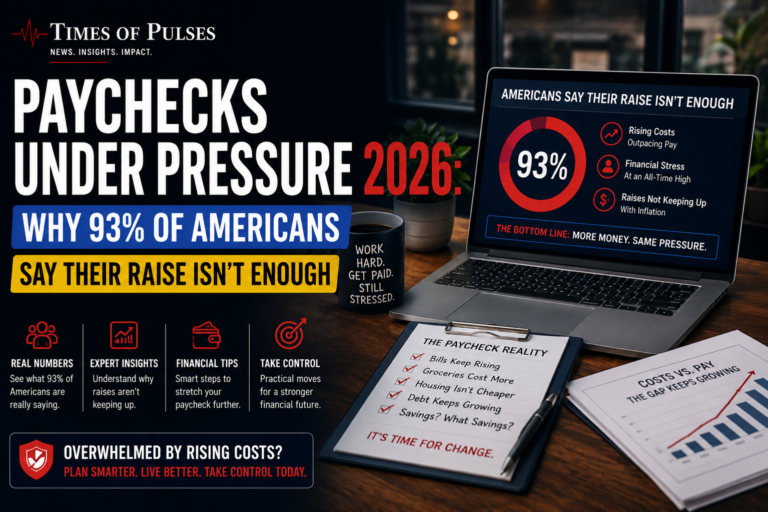
If your paycheck feels like it’s stretching less than it used to, the data backs you up. Paychecks under pressure 2026 is now a defining financial story, with a new Monster survey finding that 93% of workers say their pay isn’t keeping up with the cost of living — a number that’s barely moved in three years. Here’s what’s actually happening with wages this year, and what you can realistically do about it.

The Numbers Behind Paychecks Under Pressure 2026

According to Monster’s 2026 Cost of Living Report, only 7% of workers received an inflation-related pay bump this year — continuing a steady decline from 9% in 2025 and 11% in 2024. Even more telling: paychecks under pressure 2026 isn’t just a feeling. Bureau of Labor Statistics data confirms that annual inflation-adjusted average hourly wage growth turned negative earlier this year for the first time since April 2023, ending a three-year streak where worker pay had actually been outpacing inflation.

There was a brief bright spot in June, when real wages rose 0.8% — the best one-month gain in over a year. But that improvement came from falling gas prices, not stronger paychecks, and with oil prices climbing again amid renewed Iran-related tensions, that relief may not last into the next report.

Why Paychecks Under Pressure 2026 Is Hitting Frontline Workers Hardest

The pain isn’t distributed evenly. Production and nonsupervisory workers — roughly four-fifths of private payrolls — saw their real hourly earnings rise 0.8% in June too, but their real weekly earnings rose less, just 0.6%, because their average workweek actually shrank slightly. Over the full past year, this group’s real hourly earnings are still down 0.1%, meaning the typical frontline worker has lost ground compared to a year ago, even with the recent monthly improvement.

Why Employers Aren’t Keeping Pace

A few structural reasons explain why paychecks under pressure 2026 has become so widespread:

  • Salary budgets have gone flat. According to Payscale, U.S. salary budget increases are expected to hold at 3.5% in 2026 — barely changed from 2025 — as employers face their own cost pressures and economic uncertainty.
  • More employers are actively cutting pay budgets than raising them. Over one-fifth of employers reported decreasing their pay budgets this cycle, citing cost management, weak financial results, and inflationary pressure on their own operations.
  • The labor market has cooled. As hiring has slowed, workers have less leverage to negotiate raises or switch jobs for better pay than they did during the tighter labor market of recent years.

The Ripple Effect on Savings and Job Searching

Monster’s data reveals a genuinely difficult bind: while many workers say they’re actively searching for higher-paying roles because their current pay isn’t enough, few report actually landing one. This is squeezing household finances from multiple directions — separate CNBC reporting found Americans’ savings rate has fallen to its lowest level since 2022, as inflation continues outpacing paychecks and essentials like groceries, utilities, and gas eat further into monthly budgets.

What You Can Actually Do About Paychecks Under Pressure 2026

  1. Know your actual market value before asking for a raise. Use sites like Glassdoor, Levels.fyi, or Payscale’s own salary tools to see what your specific role and experience level command right now, rather than guessing.
  2. Time your ask strategically. Companies typically set annual budgets months in advance — understanding your employer’s review cycle helps you make your case before the budget is already locked in.
  3. Consider whether switching employers makes more sense than waiting for an internal raise. With salary budgets broadly flat at 3.5%, a new employer facing a talent gap in a growing area may offer meaningfully more than an internal cost-of-living adjustment.
  4. Revisit your budget around what’s actually rising. As we’ve covered in our guide on rising gas prices, energy costs remain a genuine wildcard — build some flexibility into your monthly budget rather than assuming today’s numbers hold steady.
  5. If you’re behind on debt payments due to squeezed pay, prioritize the highest-interest balances first rather than spreading thin payments across everything evenly.

What This Means for the Broader Economy

Paychecks under pressure 2026 also complicates the Federal Reserve’s rate decisions, a tension we’ve tracked closely all year. Weak real wage growth is often read as a sign of a cooling economy, which could support the case for rate cuts — but if energy-driven inflation picks back up as oil prices climb again, the Fed faces the same difficult balancing act between supporting workers and controlling prices.

What You Should Actually Do This Week

  1. Check your actual inflation-adjusted raise, not just the percentage number on your paystub — a 3% raise during 3.8% inflation is technically a pay cut in real terms
  2. Research your market rate before your next performance review or job search
  3. Build extra flexibility into your budget for volatile costs like gas, rather than assuming recent relief will hold
  4. If considering a job change, weigh the total compensation picture, not just the headline salary number, against your current role’s stability

Bottom Line

Paychecks under pressure 2026 reflects a genuine, data-confirmed squeeze: wages have essentially stopped outpacing inflation after three years of modest gains, and employers show little appetite for meaningfully larger raises given their own cost pressures. The most practical response isn’t waiting for the numbers to improve on their own — it’s actively understanding your market value, timing your ask, and building enough budget flexibility to absorb the volatility that’s likely to continue through the rest of the year.


This article is for informational purposes only and does not constitute financial or career advice. Consult a licensed financial advisor or career counselor for guidance specific to your situation.

Small Business Loans 2026: Real Approval Rates and How to Actually Get Approved

Small Business Loans 2026: Real Approval Rates and How to Actually Get Approved

If you’re researching small business loans 2026, the honest first thing to know is that approval rates vary dramatically depending on where you apply — and most business owners apply at exactly the wrong lender for their situation. Here’s a clear, data-backed breakdown of what small business loans 2026 actually look like, real approval odds by lender type, and practical steps to become the applicant who gets a yes.

The Real Approval Rates for Small Business Loans 2026

This is the number most guides skip, but it matters enormously for where you should actually apply:

  • Large banks approve roughly 13-15% of small business loan applications
  • Community banks approve 19-22%
  • Credit unions approve 20-24%
  • Online lenders approve 26-30%

According to the Federal Reserve’s 2026 Report on Employer Firms, 42% of applicants received the full financing they sought, 36% received some or most, and 22% received none at all. The takeaway for anyone researching small business loans 2026: matching your application to the right lender type for your credit profile matters as much as the strength of your business itself.

What Lenders Actually Want to See

Across nearly every type of small business loans 2026, approval comes down to four core factors:

  1. Credit score — both business and personal credit matter, especially for owners with 20% or greater ownership stake
  2. Time in business — most traditional lenders want at least two years in business; alternative lenders typically accept three to six months
  3. Monthly revenue and cash flow — lenders want to see consistent deposits, not just a strong month here and there
  4. Documentation — clean tax returns, financial statements, and a clear explanation of how you’ll use the funds

Notably, NerdWallet’s 2026 Business Loan Study found that 78% of approved borrowers operating for four years or less had a personal credit score of 660 or higher — a useful benchmark if you’re a newer business owner wondering where you stand.

Types of Small Business Loans 2026 and What They’re Actually For

  • SBA loans — government-backed loans issued by approved lenders (SBA 7(a) loans are the most common), offering better terms since the government guarantee reduces lender risk. Funding typically takes 30-90 days.
  • Term loans / working capital loans — best for managing cash flow gaps or unexpected expenses
  • Equipment financing — uses the equipment itself as collateral, making approval easier with lower down payments
  • Commercial real estate loans — for purchasing, constructing, or renovating owner-occupied business property
  • Invoice factoring — turns unpaid invoices into immediate cash, useful for B2B businesses waiting on net-30 or net-60 payment terms, and since approval depends partly on your customers’ credit, even newer businesses can qualify

Important SBA Rule Changes for 2026

If you’re specifically considering an SBA loan, a few recent rule changes are worth knowing:

  • As of December 19, 2025, the SBA now requires 100% of business owners to be entered into ETRAN, and all owners must reside within the United States
  • The SBA updated its standard operating procedures in 2025 to require explicit checks for unpaid federal debt and prior SBA losses — these now function as hard disqualifiers rather than discretionary concerns
  • Collateral documentation requirements have expanded to smaller loan sizes, shifting away from purely cash-flow-based approvals

Which Industries Get Approved Most (And Which Struggle)

According to NerdWallet’s 2026 data, the largest share of approved loans went to general contractors, health services businesses, and restaurants/cafes/bar-lounges. On the other hand, certain industries are considered higher-risk by lenders — including restaurants (despite also appearing among top approved categories, risk varies by specific business strength), retail, entertainment, and cannabis-related businesses — which can reduce approval odds or increase rates even for otherwise strong borrowers.

How to Actually Improve Your Approval Odds

  1. Apply before you’re desperate, not after. Most business owners apply for a loan exactly when cash is tightest, walking in with months of stressed financials — the hardest possible time to get approved. Apply while your numbers still look healthy.
  2. Ask for less than the maximum you think you need. A smaller loan is easier to approve, and successfully repaying it makes your next loan application significantly easier.
  3. Match your application to the right lender type. If a large bank isn’t a fit for your credit profile, community banks, credit unions, or online lenders may approve files that big banks decline, since they often underwrite with more local or holistic judgment.
  4. If declined, treat it as a timing problem, not a permanent verdict. Six months of clean bank statements, an improved credit score, or paying down existing debt can flip a “no” into a “yes” on your next application.
  5. Gather documentation before you apply, not during. Two years of tax returns, financial statements, and a clear use-of-funds explanation reduce errors and give you a chance to catch discrepancies before a lender does.
  6. If your credit is weak, look into SBA microloans or CDFIs. These are specifically built to serve borrowers with lower credit scores (SBA microloans can work with FICO scores below 575) and underwrite more holistically than traditional banks.

What to Avoid

Be cautious with merchant cash advances while your business is in a weak cash position — this is exactly when they tend to do the most financial damage, given their high effective costs and daily or weekly repayment structures.

What You Should Actually Do This Week

  1. Check your personal and business credit scores before applying anywhere, since 78% of approved newer-business borrowers had scores of 660 or higher — if yours needs work, see our guide on how to improve your credit score fast
  2. Identify which lender type actually matches your profile — don’t default to your regular bank if your credit or time-in-business doesn’t fit their typical approval pattern
  3. Gather two years of financial documentation now, rather than scrambling once you’ve decided to apply
  4. If you’re a startup with limited credit history, research SBA microloans or your local Small Business Development Center for hands-on guidance

Bottom Line

Small business loans 2026 remain genuinely accessible, but approval hinges heavily on applying to the right lender type for your specific credit and business profile, not just having a solid business idea. The data is clear: large banks approve the fewest applications, while online lenders, community banks, and credit unions approve meaningfully more. Understanding where you actually fit, and preparing your documentation before you’re under financial pressure, dramatically improves your odds of hearing yes.


This article is for informational purposes only and does not constitute financial or lending advice. Loan terms, rates, and approval criteria vary by lender; consult a lending professional or your local Small Business Development Center for guidance specific to your business.

Tax Changes 2026: Everything the One Big Beautiful Bill Act Means for Your Tax Return

0

Tax Changes 2026: Everything the One Big Beautiful Bill Act Means for Your Tax Return

If you’ve heard about the “One Big Beautiful Bill” but aren’t sure what it actually means for your wallet, you’re not alone. Tax changes 2026 stemming from this legislation are genuinely significant, affecting everything from your standard deduction to whether tips and overtime pay get taxed at all. Here’s a clear breakdown of what actually changed, and what you should do before filing season.

What the One Big Beautiful Bill Actually Is

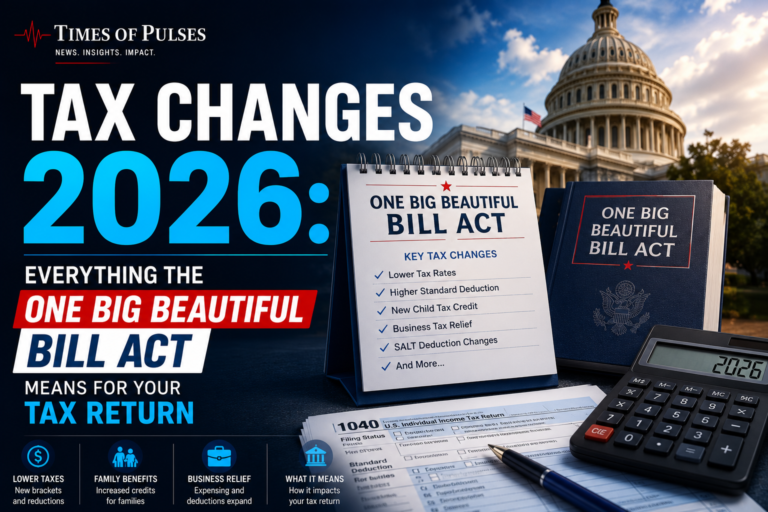
Signed into law on July 4, 2025, the One Big Beautiful Bill Act (OBBBA), also known as the Working Families Tax Cut, makes most of the 2017 Tax Cuts and Jobs Act’s individual tax provisions permanent, while adding a mix of new temporary and permanent rules. Some tax changes 2026 provisions actually apply retroactively to your 2025 taxes (which you file in early 2026), while others don’t kick in until the 2026 tax year itself, so it’s worth knowing which category affects you.

The Biggest Tax Changes 2026 for Individuals

Tax brackets made permanent. The seven tax rates from the 2017 tax law — 10%, 12%, 22%, 24%, 32%, 35%, and 37% — are now permanent, with an inflation adjustment applied to the two lowest brackets starting in 2026.

No tax on tips and overtime (temporary). One of the most talked-about tax changes 2026 brings is a new deduction eliminating federal tax on qualified tip income and overtime compensation for eligible workers. The IRS has already issued guidance and FAQs on how this deduction actually works, and it applies to both 2025 and 2026 tax years.

Child Tax Credit increased. The credit rose by $200 per child under 17, from $2,000 to $2,200, for both the 2025 and 2026 tax years.

A new deduction for car loan interest. Starting with tax year 2025, taxpayers can deduct interest paid on qualifying vehicle loans — a genuinely new benefit that didn’t exist before this legislation.

Extra deduction for seniors. Taxpayers 65 and older can now take an additional $6,000 deduction on top of their standard or itemized deduction, running from 2025 through 2028. This benefit phases out for those with a Modified Adjusted Gross Income over $75,000 (single) or $150,000 (joint), and isn’t available if you file as Married Filing Separately.

SALT deduction cap increased. The cap on how much state, local, sales, and property tax you can deduct was raised significantly compared to prior years — a meaningful change for taxpayers in high-tax states.

Tax Changes 2026 That Specifically Start This Year

A few provisions specifically take effect with the 2026 tax year, rather than applying retroactively to 2025:

  • A new cap on itemized deductions for the highest tax bracket. Starting in 2026, the OBBBA limits the overall amount of itemized deductions available to top-bracket filers.
  • A new educator expense deduction for certain unreimbursed classroom expenses.
  • Gambling loss deductions reduced. Previously, you could deduct wagering losses up to the amount of your winnings. Starting in 2026, only 90% of those losses are deductible.
  • Clean energy credits eliminated. The Energy Efficient Home Improvement Credit, Residential Clean Energy Credit, and Alternative Fuel Vehicle Refueling Property Credit are all eliminated starting with the 2026 tax year.
  • Charitable deduction for non-itemizers. If you don’t itemize, you can now deduct up to $1,000 in cash charitable contributions ($2,000 for joint filers) — a new benefit for people who take the standard deduction.

Business Tax Changes 2026 Worth Knowing

If you run a small business, a few provisions are directly relevant:

  • 100% bonus depreciation restored for business investments made after January 19, 2025, allowing full expensing in the year of purchase rather than spreading it over several years
  • Increased Section 179 expensing limits, effective for all of 2025, letting small businesses deduct more equipment costs upfront
  • Form 1099-K reporting threshold reverted back to $20,000, undoing a lower threshold that had been set to take effect

What About Trump Accounts?

The same legislation also created Trump Accounts, the new child savings program we’ve covered in detail before. As of March 2026, the IRS reported 4 million children had been signed up, with 1 million families already claiming the $1,000 pilot program contribution — worth revisiting if you have young kids and haven’t looked into it yet.

What You Should Actually Do Before Filing

  1. Check if you qualify for the tips or overtime deduction. If you work in a tipped occupation or regularly earn overtime, this could meaningfully reduce your taxable income for 2025 and 2026.
  2. Recalculate your withholding. The IRS specifically released an updated Tax Withholding Estimator to help account for these changes — using it can prevent an unexpected tax bill or a smaller-than-expected refund.
  3. If you’re 65 or older, confirm you’re claiming the new $6,000 senior deduction, assuming your income falls under the phase-out thresholds.
  4. If you itemize and live in a high-tax state, revisit your SALT deduction calculation given the increased cap.
  5. Small business owners should talk to a tax professional about bonus depreciation and Section 179 changes before making any major equipment purchases this year, since timing can affect how much you can deduct.

Bottom Line

Tax changes 2026 under the One Big Beautiful Bill Act are genuinely wide-ranging — some already affecting your current tax filing, others just starting to phase in this year. The provisions worth prioritizing are the ones with real dollar impact for your specific situation: the tips and overtime deduction if you qualify, the senior deduction if you’re 65+, and the SALT cap increase if you itemize in a high-tax state. When in doubt, a qualified tax professional can help you sort through which of these changes actually apply to your return.


This article is for informational purposes only and does not constitute tax or legal advice. Tax rules are complex and continue to be clarified by the IRS; consult a licensed tax professional or CPA for guidance specific to your situation.

Top Financial News Today, July 26, 2026: Oil Hits $100, Tesla Slides Further

0

Top Financial News Today, July 26, 2026: Oil Hits $100, Tesla Slides Further

Here’s your roundup of the top financial news today, July 26, 2026 — covering oil crossing a major psychological threshold, another sharp drop for Tesla, and a surprising shift in how Americans are investing their money. If you only have a few minutes to catch up on the markets, this covers what actually matters.

Oil Prices Cross $100 a Barrel for the First Time Since May

The biggest story in today’s top financial news is energy. Brent crude futures topped $100 a barrel this week for the first time since late May, closing up about 7% at $100.69 before holding steady near $100.26 in the following session. West Texas Intermediate crude sat close to $92.26 a barrel.

The trigger: Houthi forces attacked oil tankers in the Red Sea, adding a fresh supply-route disruption on top of the ongoing U.S.-Iran tensions that have kept energy markets on edge for weeks. This is a genuinely important threshold — oil hasn’t traded this high since the spring, and a sustained move above $100 tends to ripple through gas prices, inflation data, and Fed rate-cut expectations, all threads we’ve been tracking closely this month.

Tesla Stock Slides Another 18% on Investment Plan Concerns

Tesla remains one of the most volatile stories in today’s top financial news. Shares fell as much as 18% after the company disclosed a new investment plan exceeding $25 billion, which raised fresh concerns among investors about cash flow. This comes on top of Tesla’s already sharp post-earnings decline covered earlier this month, extending the stock’s July drop to roughly 26% and pushing shares down to around $308.

Notably, prominent investor Michael Burry disclosed he shorted Tesla back in late June near $416, and has continued holding bearish positions on other high-profile tech names, arguing that a meaningful share of current AI infrastructure demand is being financed through complex, off-balance-sheet arrangements rather than genuine end-customer demand — a thesis worth watching given how much of this year’s market story has centered on AI spending sustainability.

Crypto Ownership Is Actually Declining, Despite the Hype

One of the more counterintuitive threads in today’s top financial news: crypto ownership among Americans has actually fallen, dropping to just 9% from 17% previously, even as Bitcoin ETFs have become more accessible and government-level crypto initiatives have expanded. Bitcoin lost roughly half its value after peaking in 2025, and stock ownership (at 62% of Americans) continues to vastly outpace crypto adoption.

Meanwhile, in a reminder of how speculative pockets of the crypto market remain, Shiba Inu jumped 36% in a single session, adding roughly $1 billion to its market value — a level of volatility that stands in sharp contrast to the broader ownership decline.

What This Means for Your Money

  1. If gas prices climb further, budget for it now. As we’ve covered before, pump prices tend to lag behind crude oil moves, so a sustained run above $100 a barrel could keep gas prices elevated for weeks even if oil eventually pulls back.
  2. If you’re holding Tesla, separate the noise from the signal. An 18% single-stock swing reflects genuine investor concern about a specific spending plan, not necessarily a verdict on the company’s entire long-term thesis — read the actual investment plan details before reacting.
  3. Don’t mistake crypto headlines for widespread adoption. The ownership data is a useful reality check against social media hype — most Americans’ investment exposure remains in traditional stocks, not crypto.
  4. Watch oil’s effect on the broader inflation and Fed conversation. A sustained move above $100 a barrel adds a genuine wildcard to the rate-cut debate we’ve been tracking all month.

Bottom Line

Today’s top financial news centers on energy markets crossing a significant threshold, continued volatility in one of the market’s most-watched individual stocks, and a data point that quietly challenges the crypto adoption narrative. As always with daily market moves, the goal isn’t to react to every headline, but to understand which threads — like oil’s climb above $100 — are likely to matter for your budget and portfolio over the coming weeks, not just today.


This article is for informational and educational purposes only and does not constitute investment advice. Market conditions change rapidly; consult a licensed financial advisor before making investment decisions based on daily market news.