
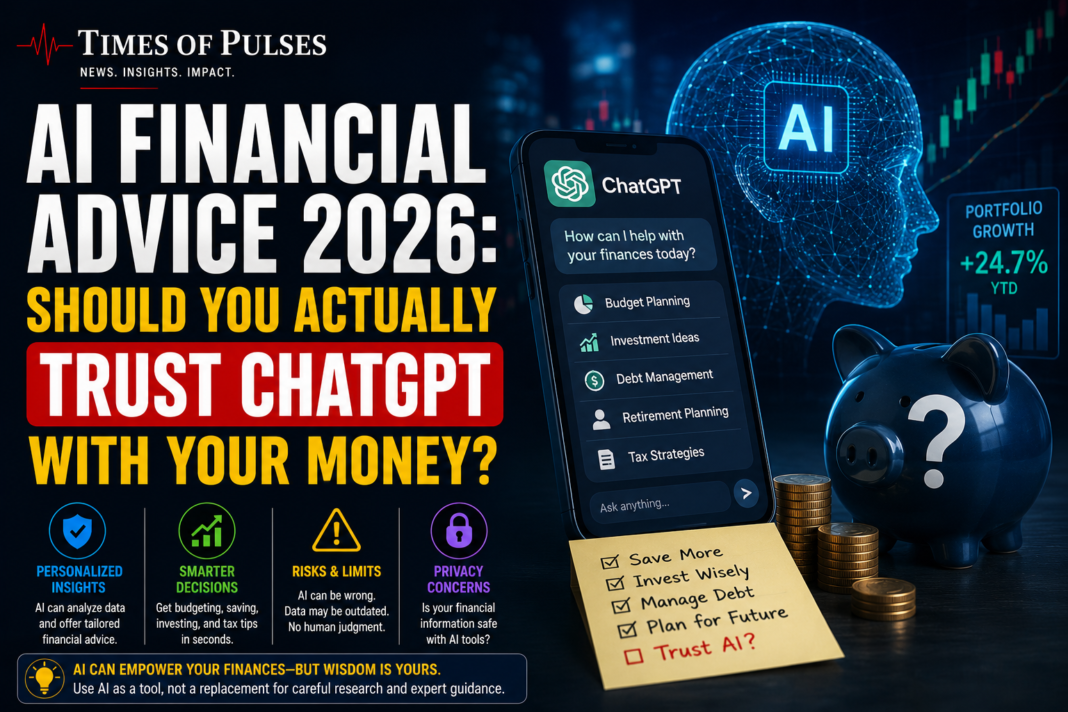
AI Financial Advice 2026: Should You Actually Trust ChatGPT With Your Money?
AI financial advice 2026 has quietly become mainstream — nearly 6 in 10 Americans have now asked a chatbot like ChatGPT, Claude, or Gemini a money question, and two-thirds of GenAI users say they’ve leaned on it for financial guidance. But a wave of new research this month reveals a genuine gap between how confident these tools sound and how reliable their advice actually is. Here’s what the data really shows about AI financial advice 2026, and how to actually use it without getting burned.
How Widespread AI Financial Advice 2026 Has Become
According to CNBC’s reporting on recent research, 66% of Americans who have used generative AI say they’ve leveraged it for financial advice. A separate NerdWallet survey found 26% of Americans have specifically asked an AI chatbot personal finance questions, with usage skewing heavily toward younger generations — 74% of Gen Z respondents have used a chatbot, compared to 40% of Baby Boomers.
This isn’t a fringe behavior anymore. AI financial advice 2026 is becoming a genuine first stop for a meaningful share of people managing their money, right alongside or even instead of traditional resources like a bank representative or financial advisor.
The Real Problem: Confident, But Not Always Right
Here’s the core finding across multiple 2026 studies: AI financial advice 2026 tends to sound authoritative even when it’s incomplete or wrong. A study published in the Journal of Financial Planning, testing ChatGPT, Claude, Copilot, DeepSeek, Gemini, Meta AI, and Perplexity, found that “GenAI-driven responses may sound confident but can still be incomplete, misleading, or incorrect.”
NerdWallet’s own testing backs this up in practical terms: 25% of Americans who’ve used AI chatbots for financial advice reported getting helpful, accurate answers — but 9% reported receiving inaccurate information, sometimes due to what’s called an AI “hallucination,” where the tool generates information that’s fabricated or simply wrong.
A Real Example of Where AI Financial Advice 2026 Falls Short
LendingTree’s testing of AI chatbots surfaced a genuinely revealing example: when asked about retirement planning for a 50-year-old couple with just $100,000 saved, ChatGPT recommended saving over $30,000 annually to catch up within 17 years — without first asking about their actual income or why they were behind. For most households, saving $30,000 a year is simply not realistic, making the advice technically calculated but practically useless.
This illustrates the core limitation well: AI financial advice 2026 is often mathematically sound but contextually blind. It doesn’t know your full financial picture unless you explicitly provide every detail, and it rarely asks clarifying questions the way a human advisor naturally would.
Why This Happens: AI Doesn’t Know What It Doesn’t Know
A few structural reasons explain why AI financial advice 2026 has these blind spots:
- AI has no fiduciary duty. Unlike a licensed financial advisor, AI chatbots aren’t legally required to act in your best interest, since they’re not regulated as financial advisors.
- Output depends heavily on your prompt. Small differences in how you phrase a question can lead to meaningfully different recommendations, which academic researchers have specifically flagged as a consistency problem.
- AI only knows what you type in. It has no access to your actual account balances, credit history, or spending patterns unless you manually provide that information (some newer tools, like ChatGPT’s personal finance feature launched in 2026, are starting to change this by allowing secure account connections).
Where AI Financial Advice 2026 Actually Performs Well
To be fair, the research isn’t entirely negative. A working paper covered by CEPR found that on the decisions that matter most for long-run wealth — like investing in diversified funds or building a savings buffer, similar to what we’ve covered in our guide on how to start investing online — today’s leading AI models generally give advice broadly consistent with what economists would actually recommend. The tools tend to do well on big-picture, well-established financial principles; they struggle more with nuanced, highly personal situations that require judgment calls.
How to Actually Use AI for Your Finances (Without Getting Burned)
- Use it as a starting point, not a final answer. Treat AI financial advice 2026 the way researchers suggest: a “first stop” for general concepts, not a substitute for verifying important decisions.
- Give it complete context. Include your actual income, timeline, existing debts, and specific constraints in your prompt — vague questions produce vague, sometimes unrealistic answers, as the retirement example above showed.
- Cross-check big decisions. For major moves — how much house you can afford, how to allocate retirement savings, whether to consolidate debt — verify AI suggestions against a second source or a human professional before acting.
- Be skeptical of unusually confident-sounding numbers. If an AI gives you a highly specific recommendation without asking follow-up questions about your situation, that’s a signal to dig deeper rather than accept it at face value.
- Remember it has no legal obligation to protect your interests. Unlike a fiduciary financial advisor, there’s no regulatory requirement that the advice you receive is actually in your best interest.
Bottom Line
AI financial advice 2026 has moved from novelty to mainstream habit remarkably fast, and the underlying technology genuinely handles broad financial principles reasonably well. But the research is consistent on one point: confidence in tone doesn’t equal reliability in substance, and the tools are far better at general concepts than at your specific, messy financial reality. Used as a well-informed starting point rather than a final verdict, AI can genuinely help you think through your money — just don’t let a confident-sounding answer replace the judgment call only you, or a qualified professional, can really make.
This article is for informational purposes only and does not constitute financial advice. Consult a licensed, fiduciary financial advisor before making major financial decisions, whether or not AI tools were part of your research process.