
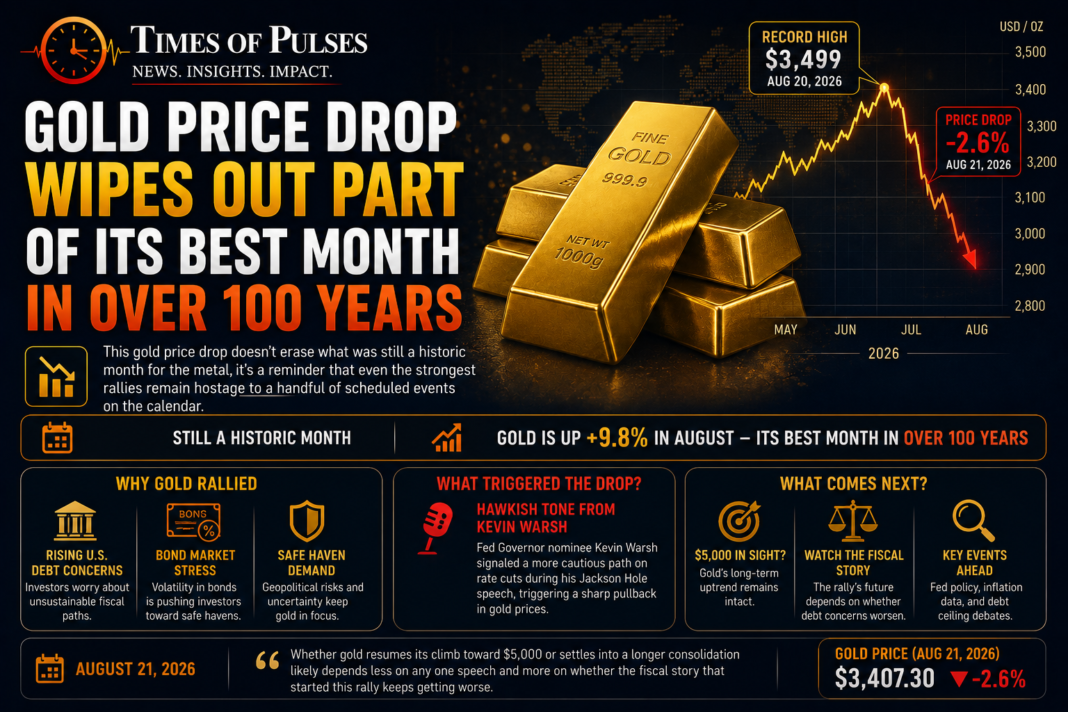
Gold Price Drop Wipes Out Part of Its Best Month in Over 100 Years
Gold was on track for something historic this August. Then Federal Reserve Chair Kevin Warsh opened his mouth at Jackson Hole, and roughly 3% of the gain vanished within a day. This gold price drop after the Jackson Hole speech is a reminder of just how sensitive even a record-breaking rally can be to a single sentence from the right person.
The Gold Price Drop Followed a Historic August Run
Heading into this week, gold was up about 14% for the month of August alone, on pace to be the metal’s strongest single month in more than a century. On Tuesday, spot gold touched a three-month high of $4,696.18 an ounce, putting it within striking distance of the psychologically huge $5,000 level that bulls have been eyeing for months. For a metal that typically moves in single-digit percentages over an entire year, a 14% monthly gain is an extraordinary move, and it had investors, including billionaire Ray Dalio, pointing to gold as one of the few places to hide from a deteriorating fiscal picture in Washington.
What Triggered the Rally in the First Place
The spark behind gold’s run wasn’t random. It traces back to the same story we covered when Ray Dalio issued his debt crisis warning: the U.S. Treasury’s announcement that it would sharply increase buybacks of long-dated government bonds. Investors read that move as a sign of stress in the bond market, and money poured into gold as a hedge against a weakening dollar and a widening federal deficit. That single policy announcement is largely what pushed gold from its already-elevated levels up to Tuesday’s three-month high.
The Warsh Speech Behind the Gold Price Drop
Then came Friday, August 28, and the main event of the entire Jackson Hole symposium: Kevin Warsh’s first speech as Federal Reserve Chair since taking office in May. Markets had been bracing for this moment for weeks, and the gold price drop that followed shows why. CNBC’s coverage of the speech noted that gold had already been drifting lower in the hours before Warsh even stepped up to the podium, as traders positioned defensively against the risk of a hawkish tone. Warsh told the audience that despite recent inflation readings coming in better than feared, he wasn’t convinced underlying price pressures had meaningfully improved, adding that the Fed still has “work to do” on returning inflation to its 2% target. He also said price stability was a bigger concern to him right now than the slowing labor market, a notable shift in emphasis for a Fed that had spent much of the past year focused on employment data.
Warsh stopped short of giving explicit forward guidance on interest rates. But the tone alone was enough. The dollar strengthened immediately on his comments, and gold, which pays no yield and becomes less attractive when rates stay higher for longer, slid as much as 1.2% in the minutes after he spoke. By the end of the day, spot gold had fallen further, down around 3% to roughly $4,455 an ounce, a sharp pullback from Tuesday’s high just three days earlier.
Why One Speech Can Cause a Gold Price Drop This Sharp
This kind of gold price drop makes more sense once you understand what Warsh represents right now. He’s leading a Fed that, under his direction, no longer telegraphs its next move ahead of time the way previous chairs did, so every public appearance carries outsized weight. His own July policy meeting ended in a 9-3 vote to hold rates steady, with three committee members dissenting in favor of an immediate hike, an unusually high level of internal disagreement this early in a new chair’s term. With July’s core inflation reading still running around 3.3% to 3.7%, well above the Fed’s target, markets were primed to react to any hint that Warsh leans hawkish, and that’s exactly what his Jackson Hole remarks delivered.
Silver and palladium fell alongside gold on the same news, down roughly 1% and 0.8% respectively, underscoring that this wasn’t a gold-specific story so much as a broad reaction across every asset that benefits from a weaker dollar and lower rates.
What This Means for Your Own Money
- A double-digit monthly gain in gold is not the new normal. August’s 14% move was described by market commentators as the strongest month for gold in over a century, precisely because moves like this are rare, not routine.
- Understand what you’re actually holding gold for. The same Treasury buyback story that fueled this rally is the debt-related concern Ray Dalio flagged in his own portfolio recommendations — gold here is functioning as a hedge against fiscal and currency risk, not a short-term trading vehicle.
- Fed commentary will keep moving this trade. With Warsh’s Fed no longer pre-announcing its intentions, expect gold, along with rate-sensitive assets more broadly, to react sharply to future speeches and press conferences rather than settling into a calm trend.
- Zoom out before reacting to any single day. Even after this gold price drop, the metal remains up sharply for the month and has posted a roughly 95% gain over the past year, context that matters more than any single Friday afternoon swing. If you haven’t reviewed how much of your own portfolio sits in gold or cash versus stocks, a move this size is a reasonable prompt to check.
Bottom Line
This gold price drop doesn’t erase what was still a historic month for the metal, it’s a reminder that even the strongest rallies remain hostage to a handful of scheduled events on the calendar. Gold’s run higher was driven by real concerns about U.S. government debt and bond market stress, and those concerns haven’t disappeared just because Kevin Warsh sounded hawkish for one afternoon in Wyoming. Whether gold resumes its climb toward $5,000 or settles into a longer consolidation likely depends less on any one speech and more on whether the fiscal story that started this rally keeps getting worse.
This article is for informational purposes only and does not constitute financial advice. Consult a licensed financial advisor before making changes to your investment portfolio.