
Split Pay Credit Score: What Changed in 2026 (And Which Apps Actually Report)
You split a $200 purchase into four payments through Klarna or Affirm, paid every installment on time, and assumed it had nothing to do with your credit score. For years, that assumption was correct. Split pay credit score reporting has quietly changed in 2026, and the honest answer to “does this affect my credit” now depends entirely on which app you used, a split pay credit score question with a genuinely different answer for each major provider.
What Is Split Pay, Exactly?
Split pay, more formally known as Buy Now, Pay Later or BNPL, lets you break a purchase into smaller installments, typically four payments spread over six weeks, often with no interest if you pay on time. It’s exploded in popularity: an estimated 91.5 million Americans now use BNPL services, and nearly two-thirds of consumers report being offered a split pay option within the past year. The US BNPL market hit roughly $70 billion in 2025 alone, according to Richmond Fed data, with global transaction volume reaching $560.1 billion.
Split Pay Credit Score: Why 2026 Changed Everything
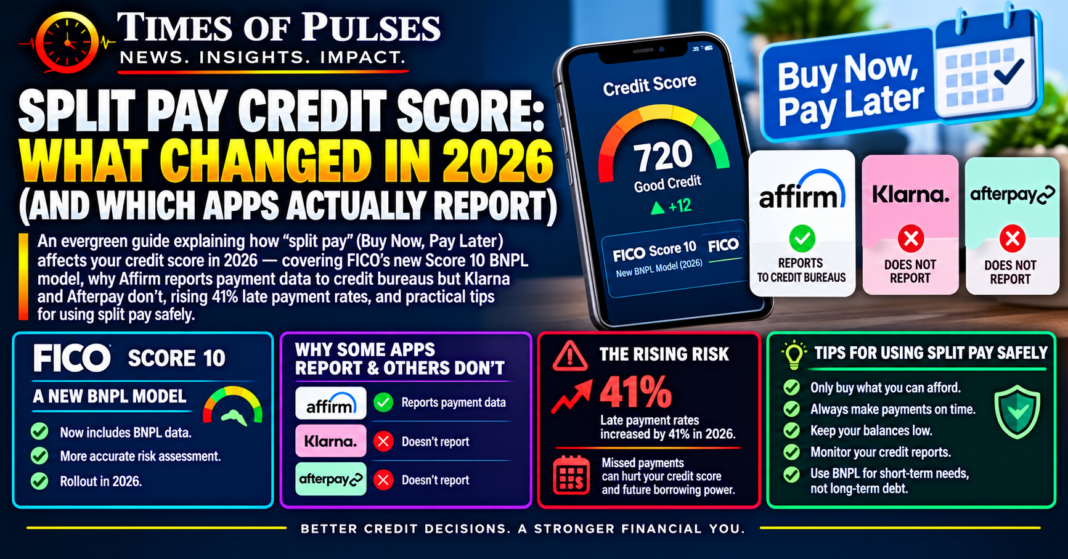
Here’s the core split pay credit score shift: FICO began incorporating BNPL payment data into a new scoring model, FICO Score 10 BNPL, starting in fall 2025. Before this model existed, split pay activity mostly stayed invisible to standard credit scores, meaning on-time payments didn’t help you and, in many cases, missed payments didn’t directly hurt you either. That blind spot is closing, but unevenly, which is exactly what makes this more complicated than a simple yes-or-no answer.
Not Every App Reports the Same Way
This is the detail that trips up most people researching split pay credit score questions: the major BNPL providers handle credit reporting completely differently.
- Affirm began reporting customer repayment data to Experian and TransUnion in early 2025, meaning Affirm loans can now factor into the new FICO Score 10 BNPL calculation, for better or worse depending on your payment history.
- Klarna and Afterpay do not currently report payment data to the three nationwide credit bureaus. Afterpay has stated publicly it won’t start reporting until it sees evidence that doing so helps rather than hurts its users.
In practice, this means the exact same split pay habit, four on-time payments for a $200 purchase, could be quietly building your credit history through one app and remaining completely invisible through another.
The Real Split Pay Credit Score Risk Hiding in the Data
While the split pay credit score story sounds relatively low-stakes on the surface, the underlying usage data tells a more concerning story. Late payment rates on BNPL loans climbed to 41% of users in the past year, up from 34% the year before, according to research compiled by DontPayFull. That’s a significant jump, and it matters more now than it used to: once a delinquent split pay account gets sent to collections, it can show up on your credit report and drag your score down regardless of which app you used, since collections agencies report independently of whether the original BNPL provider does.
Deep-subprime borrowers, those with credit scores below 580, are disproportionately exposed here: this group defaulted at a 3.5% rate while making up 45% of all BNPL originations in recent data, suggesting split pay usage skews heavily toward borrowers who can least afford a ding to their credit.
Adding to the risk, the Consumer Financial Protection Bureau rescinded its BNPL consumer protection rule in May 2025, removing dispute rights that had been roughly equivalent to what credit card users receive. That means fewer built-in safety nets if something goes wrong with a split pay purchase.
When Split Pay Actually Makes Sense
None of this means split pay is inherently bad. Used deliberately, for a planned purchase you could pay for outright but prefer to spread across a few weeks, with zero risk of missing a payment, split pay can be a genuinely interest-free way to manage cash flow. The risk profile changes dramatically once you’re juggling multiple overlapping split pay plans across different apps, which is exactly the pattern that correlates with the rising late-payment rates in the data.
What This Means for Your Own Credit
- Know which app you’re using before you assume anything about your score. If you’re using Affirm, treat it more like a traditional installment loan for credit purposes; if you’re using Klarna or Afterpay, assume it currently won’t help your score, but a missed payment sent to collections still can hurt it.
- Don’t stack multiple split pay plans at once. Losing track of overlapping payment schedules across different apps is the single biggest driver of the missed-payment risk in this data.
- This connects directly to broader credit management. The same discipline that matters for managing your credit utilization applies here: predictable, on-time payments protect your score regardless of which specific credit product you’re using.
- If you’re still building credit from scratch, split pay isn’t a shortcut. Unlike strategies focused on establishing credit history from zero, most split pay activity still won’t help build your score under current reporting practices, so don’t rely on it as a credit-building tool.
- This is part of a bigger shift in how credit scoring itself works. Just as VantageScore’s entry into mortgage lending changed how homebuyers get evaluated, FICO’s new BNPL-aware scoring model is part of a broader modernization of credit scoring that’s still actively evolving.
Bottom Line
Money Under 30’s coverage of this shift captured it precisely: split pay credit score reporting is no longer a settled, ignorable question, it depends entirely on which app you’re using and how disciplined you are about tracking multiple plans. With late payment rates climbing and reduced consumer protections following the CFPB’s rule rescission, the smartest approach is treating every split pay purchase with the same seriousness as a credit card charge, not as a casual checkout feature that exists outside the credit system. Because for a growing number of users, it no longer does.
This article is for informational purposes only and does not constitute financial advice. Consult a licensed financial advisor or credit counselor for guidance specific to your situation.