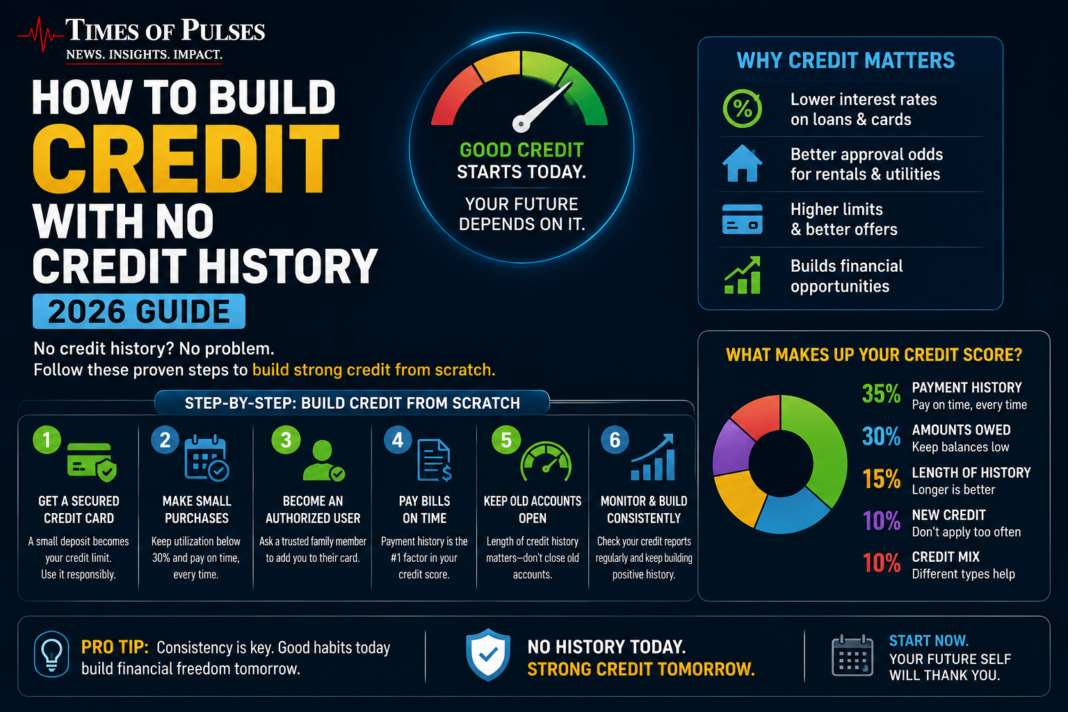
This guide shows you exactly how to build credit with no credit history in 2026, starting with tools that cost almost nothing.
If you’ve never borrowed a dollar in your life, you don’t have a credit history — and without one, lenders can’t see whether you’re trustworthy. It’s a frustrating catch-22: you need credit to get credit. The good news is that this exact situation is more common than you think, and there’s a proven, step-by-step way out of it. This guide shows you exactly how to build credit with no credit history, starting with tools that cost almost nothing.
Why No Credit History Is a Real Problem (Not Just Inconvenient)
In the United States, your credit history is the record lenders, landlords, and sometimes even employers use to judge your financial reliability. The most common scoring model, the FICO Score, ranges from 300 to 850, and your score is built almost entirely from how you’ve handled borrowed money in the past.
Here’s what the latest data shows: the average American’s FICO Score was 713 at the end of 2025, and 70% of consumers now hold a “good” score of 670 or higher .That means roughly 30% of Americans — nearly 100 million people — have fair or poor credit, and a significant share of those are stuck with no history at all: young adults, recent immigrants, and people who have simply never used credit.
The cost of having no history (or a thin file) is real. People without established credit often face higher interest rates, larger security deposits on apartments, and sometimes outright rejection. As we covered in our coverage of record-high credit rejection rates, credit applications in 2025 saw the highest rejection rates in years — and being invisible to lenders is often worse than having a mediocre score.
How Credit Scores Actually Work: The 5 Ingredients
Before building credit, you need to know what you’re building. A FICO Score has five components, and their weightings matter more than most people realize:
Notice that payment history and utilization together make up 65% of your score. That’s the good news: you don’t need to be rich to build credit. You need to be consistent.
The 6-Step Plan to Build Credit with no credit history From Scratch
Step 1: Check Your Credit Report First (It’s Free)
Before building anything, confirm you actually have no history — and no errors. Under federal law, you’re entitled to a free credit report from all three bureaus (Experian, Equifax, and TransUnion) every week at AnnualCreditReport.com, the official site run under CFPB authorization .
Why does this matter before you start? Because roughly 1 in 4 consumers have found an error on their credit report at some point, and errors on a thin file are devastating — a single false late payment on a three-account file does far more damage proportionally than on a thirty-account file. Disputing errors early is the cheapest credit repair you’ll ever do. (For a deeper look at fixing errors, see our guide on how to improve your credit score fast.)
Step 2: Become an Authorized User (The Fastest Start)
If a parent, spouse, or trusted family member has a credit card with a long, clean history, ask them to add you as an authorized user. Their account’s positive history appears on your report, effectively letting you “inherit” years of good payment behavior overnight .
Two rules for this to work: the card issuer must report authorized users to the credit bureaus (most major issuers do — call and confirm), and the primary cardholder must keep paying on time, because their late payments would now hurt your score too.
Step 3: Get Your First Card — and Pick the Right Type
If no family option exists, apply for a student credit card (if you’re in school) or a secured credit card. A secured card requires a refundable deposit — typically $200 to $500 — which becomes your credit limit. It looks and works like a normal card, and after 12–18 months of good behavior, most issuers return your deposit and convert it to an unsecured card .
When choosing, check three things: no annual fee (or a very low one), that it reports to all three bureaus, and that it offers a path to graduation into an unsecured card. The CFPB’s guidance on secured cards is a good starting point for comparing your options .
Step 4: Use the Card Like It’s a Debit Card
This is where most people fail. The formula is embarrassingly simple, yet millions blow it every month:
1.Charge one small recurring bill (Netflix, phone plan) — around $20–30
2.Set up autopay for the full statement balance
3.Never let utilization cross 30% — with a $300 limit, that means never owing more than $90 at statement time
A quick calculation shows why the 30% rule matters. On a $500 secured card, carrying a $450 balance (90% utilization) signals distress to scoring models and can hold your score down by 50+ points. Keep it at $50–100 and the same payment history builds your score roughly twice as fast. As we detailed in our breakdown of the credit card minimum payment trap, paying only the minimum on a revolving balance is how solid credit habits quietly turn into a years-long debt cycle.
Step 5: Add a Credit-Builder Loan (Optional but Powerful)
Once your card is 6+ months old, consider a credit-builder loan — small loans ($500–$1,500) where the money sits in a savings account while you make payments, and those payments get reported to the bureaus. Credit unions and fintech lenders like Self offer these specifically for people building credit from scratch .
This adds the installment-loan component to your credit mix (that 10% factor) and reinforces the payment-history component at the same time. Interest is usually modest, and some products even return most of it as savings.
Step 6: Monitor and Protect What You’ve Built
Set a calendar reminder to pull your three reports at AnnualCreditReport.com every few months during your first two years. Watch for: accounts you didn’t open (identity theft), balances you already paid, and late payments you made on time. Each dispute takes minutes online and can protect months of your building work.
Also remember that checking your own credit never hurts your score — only lender inquiries do. You can monitor freely through your bank’s app or free services like Experian’s free tier.
Realistic Timeline: What to Expect
Managing expectations matters, so here’s an honest roadmap based on how scoring models actually behave:
The single biggest mistake people make is quitting at month 4 because “nothing is happening.” Credit history is a length-of-time game — which is exactly why starting now beats starting “someday.”
How This Fits Into Your Bigger Money Picture
Building credit isn’t a standalone project — it locks in with the rest of your financial foundation. A good score eventually unlocks cheaper auto loans and mortgages, which directly lowers the record-high car payments squeezing American households right now. And while you’re building credit, don’t neglect the other side of the ledger: the guide we published on building an emergency fund on a tight budget shows how even $5 a week compounds into a real safety net — because the fastest way to wreck new credit is an emergency that forces you back onto a card.
Frequently Asked Questions
Can I build credit without a credit card?
Yes. Credit-builder loans, rent-reporting services (like Experian RentBureau, which adds rent payments to your report), and being an authorized user all build history without you ever carrying a card balance.
How long does it take to go from no credit to a 700 score?
Typically 18–24 months with one well-managed card. There are no shortcuts — anyone promising a “700 in 30 days” fix is selling something.
Does my income affect my credit score?
No. Income isn’t part of the FICO formula at all. Lenders check income separately when you apply, but your score only reflects how you’ve handled credit.
Will applying for a card hurt my score?
A single application causes a small, temporary dip (usually under 5 points). The damage comes from many applications in a short window — so pick one good card and apply once.
Can bad credit be fixed, or is it permanent?
Negative marks fade. Late payments drop off after 7 years, and newer positive history pushes them down in influence far sooner. Our step-by-step credit repair guide covers the full recovery process.
Disclaimer
This article is for informational purposes only and does not constitute financial advice. Consult a licensed financial advisor for guidance specific to your debt situation.