
Jobs Report Rate Hike Odds: Why a “Great” Jobs Report Just Made Wall Street Panic
Here’s something that confuses almost everyone the first time they see it happen: the US just posted a genuinely strong jobs report, and the stock market fell anyway. That’s not a typo. On Friday, jobs report rate hike odds jumped sharply, and it’s exactly why good economic news can sometimes be bad news for your portfolio.
What the Jobs Report Actually Showed
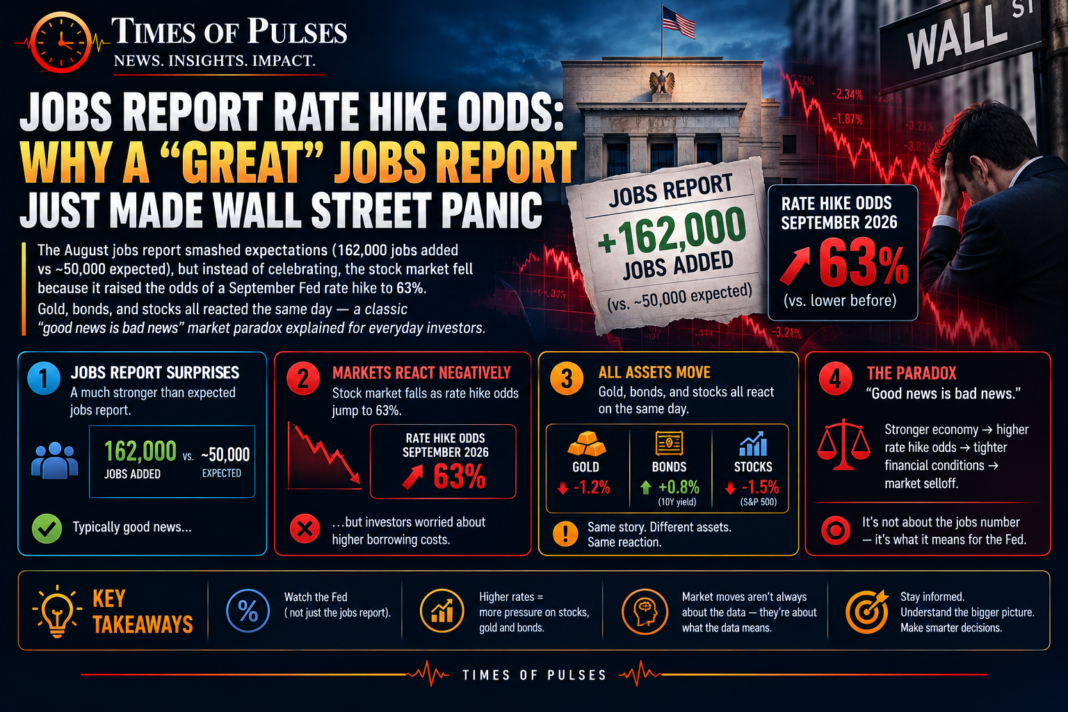
The August jobs report was, by almost any measure, strong. US employers added 162,000 jobs, more than three times what economists were expecting, with forecasts sitting in the 45,000 to 55,000 range. Unemployment held steady at 4.1%, and the government also revised July’s initially negative reading up into positive territory, meaning the labor market wasn’t just strong in August, it was stronger throughout the summer than initially reported.
Normally, a report like this would be pure good news. Instead, it triggered the jobs report rate hike odds spike that sent stocks lower on the same day.
Why a Strong Jobs Report Sent Stocks Falling
This is the part that trips people up: a hot jobs report makes the Federal Reserve less likely to cut interest rates, and in some cases, more likely to consider raising them. Treasury yields jumped immediately after the report, and Schwab’s market update noted that jobs report rate hike odds for the Fed’s September meeting climbed to 63%, according to Bloomberg data, reversing a decline in those odds that had been building earlier in the week.
Higher rate-hike odds work against stocks for a straightforward reason: higher interest rates make borrowing more expensive for companies, make bonds more competitive with stocks for investor money, and reduce what future company earnings are worth in today’s dollars. That’s exactly why the S&P 500 fell 0.38% to 7,719, the Dow dropped 0.51% to 53,414, and the Nasdaq slipped 0.29% to 26,507 on a day when the actual economic data was unambiguously positive.
The Fed Pressure Angle Making This Louder Than Usual
This jobs report rate hike odds shift is landing amid a specific backdrop worth knowing about: President Trump has been publicly turning up pressure on Fed Chair Kevin Warsh as a potential rate hike looms, adding a political dimension to what would otherwise be a purely data-driven Fed decision. That pressure doesn’t change the underlying economics, but it does mean this particular Fed decision is getting more public attention than a typical rate call.
Gold, which tends to fall when rates are expected to rise, dropped 1.14% to $4,429 an ounce the same day, continuing the pattern we covered when gold’s record rally partly reversed after Fed Chair Warsh’s Jackson Hole speech. The 10-year Treasury yield, which had already been climbing for weeks, rose further to 4.789%, and the dollar index strengthened to 99.157 as traders priced in a higher chance of tighter monetary policy ahead.
Why This “Good News Is Bad News” Pattern Keeps Happening
The jobs report rate hike odds reaction makes more sense once you separate two different questions markets are constantly weighing: is the economy doing well, and is monetary policy about to get tighter or looser? For most of this year, investors have been hoping for a cooling labor market specifically because it supports the case for rate cuts. A report this strong flips that calculus, and markets react to the policy implication, not just the standalone economic headline.
This isn’t a new pattern, it’s one of the most consistent dynamics in how markets process economic data, but it catches new investors off guard nearly every time a “good” report causes a “bad” market day.
What This Means for Your Own Money
- Don’t read market direction as a verdict on the economy itself. A falling stock market on a strong jobs report doesn’t mean the economy is weakening, it means investors are repricing how the Fed might respond.
- Rate-sensitive parts of your finances are worth watching closely right now. With jobs report rate hike odds elevated, mortgage and borrowing costs could stay higher for longer than markets had been hoping just a week ago.
- A single data point rarely determines the actual Fed decision. The September meeting is still weeks away, and additional inflation and employment data will factor in before anything is finalized.
- Keep an eye on long-term yields, not just the headline stock move. The 10-year Treasury yield’s climb toward multi-year highs has been a recurring theme all year, and jobs data like this is a direct input into where that yield goes next.
Bottom Line
The jobs report rate hike odds jump this week is a textbook example of why “the economy is strong” and “stocks are up” aren’t the same statement. A genuinely good August jobs report pushed the odds of a September rate hike to 63%, and that shift, not the jobs number itself, is what sent stocks, gold, and bond prices moving on Friday. Understanding that distinction is one of the more useful mental models for making sense of market reactions that otherwise look completely backwards.
This article is for informational purposes only and does not constitute financial or investment advice. Consult a licensed financial advisor before making changes to your investment portfolio.