
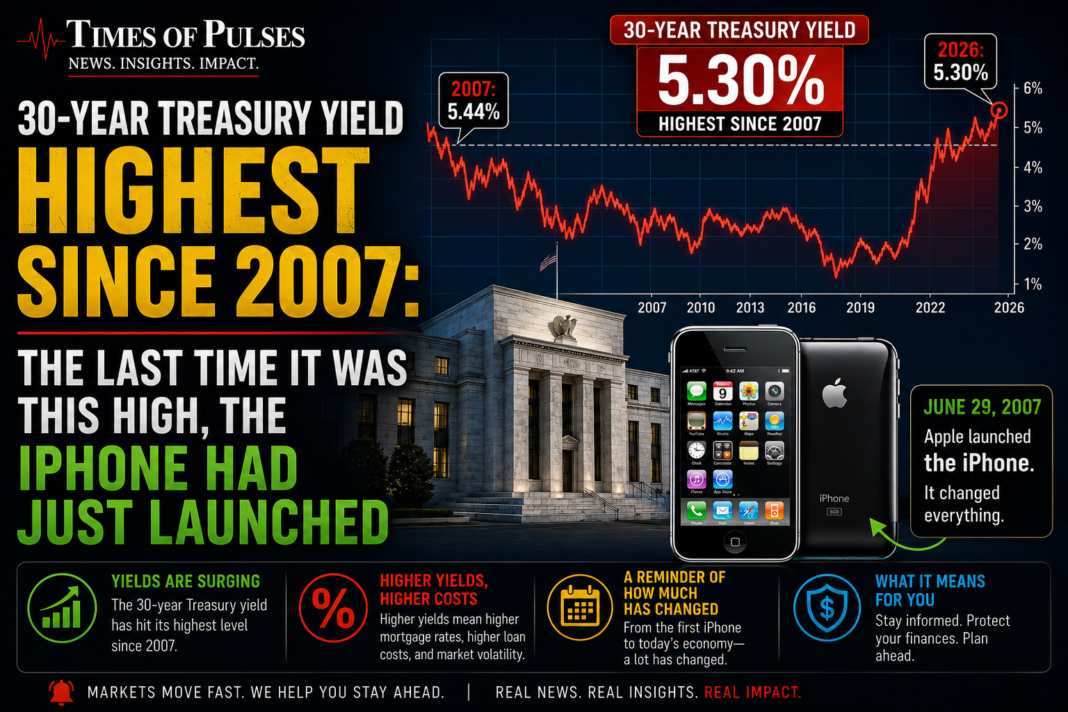
30-Year Treasury Yield Highest Since 2007: The Last Time It Was This High, the iPhone Had Just Launched
The 30-year Treasury yield highest since 2007 milestone just hit, and the comparison analysts keep reaching for says everything: the last time long-term borrowing costs sat at this level, the first iPhone had just gone on sale and the word “subprime” was only beginning to enter everyday conversation. The benchmark long bond touched roughly 5.3% this week, a level unseen since the summer of 2007 — and unlike a lot of financial headlines, this one has a direct line to your mortgage, your car payment, and your credit card bill.
What Actually Happened
The yield on the 30-year U.S. Treasury bond climbed above 5.3% this week, its highest level since April 2007, when yields touched 5.44%. For most of the decade following the 2008 financial crisis, this same yield sat comfortably below 3% — meaning the jump to 5.3% isn’t a minor wiggle, it’s what one deVere Group executive called a warning “about the true cost of government borrowing,” not just a footnote to whatever the stock market is doing that day.
The move has been building for months. After dipping slightly early in the year, the 30-year yield has climbed steadily since late February, pushed higher by a combination of persistent inflation, mounting concerns over the federal deficit, and an unusually large wave of new government bond issuance competing for investor demand.
Why 30-Year Treasury Yield Highest Since 2007 Matters to You Directly
Treasury yields act as a benchmark that ripples through nearly every other borrowing rate in the economy. Here’s what’s already moving because of it:
- Mortgage rates: the average 30-year fixed mortgage has been hovering around 6.65-6.67%, and Zillow’s senior economist noted this week that even though the Treasury stepped in to calm bond markets, the underlying forces pushing rates up — the deficit, the oil shock, and AI-related corporate debt — “haven’t faded and will likely put a floor under how far mortgage rates can fall.”
- Auto loans: buyers financing a new vehicle are currently facing APRs around 7%, while used-car buyers are contending with rates closer to 10.6%.
- Credit cards: variable-rate cards, which track closely with the prime rate, face similar upward pressure as the broader rate environment stays elevated.
- Home equity borrowing: anyone considering a HELOC or home equity loan is facing the same higher-for-longer backdrop.
The Part That Should Actually Concern You
A Bank of America survey of global hedge fund managers found 62% believe 30-year yields could climb all the way to 6%, potentially approaching their 2007 peak, with 40% of managers still anticipating further inflation surges. That’s a meaningful signal — professional money managers aren’t betting on quick relief.
The U.S. Treasury did respond this week by doubling the size of its long-term bond buyback program specifically to support prices and pull yields back down, and yields did fall sharply in immediate response — before climbing right back up the very next day. That whiplash is worth sitting with: even a direct government intervention only bought a brief pause, not a reversal.
What This Means for Your Mortgage or Car Purchase
If you’re house-hunting or shopping for a car right now, the 30-year Treasury yield highest since 2007 headline isn’t background noise — it’s the mechanism setting the rate you’ll actually be quoted. Mortgage rates have already climbed from 6.66% in late July on the back of this same pressure. As we covered in our breakdown of why the Fed can’t agree on rates, policymakers themselves are genuinely split on the path forward, which adds another layer of uncertainty on top of what the bond market is already pricing in.
Practical takeaway: if you’ve been waiting for mortgage or auto loan rates to drop meaningfully before making a purchase, this week’s data doesn’t offer much encouragement for a quick reversal. A modest, temporary dip (like the one triggered by the Treasury’s buyback announcement) is not the same as a sustained trend down.
What You Should Actually Do Right Now
- Don’t assume today’s mortgage quote is temporary. With 62% of surveyed fund managers expecting yields to climb further, not fall, locking in a rate you can genuinely afford now may be more useful than waiting for a drop that isn’t clearly coming.
- If you’re carrying variable-rate credit card debt, treat this as added urgency to pay it down — rates tracking the prime rate aren’t likely to ease alongside these Treasury moves.
- Reconsider stretching an auto loan term to lower the monthly payment. With APRs already elevated, a longer loan term compounds the total interest paid even more than usual right now.
- If a large purchase can wait, build your emergency fund in the meantime rather than rushing into a loan at today’s elevated rates purely out of fear they’ll rise further — a stronger financial cushion gives you more flexibility either way.
Bottom Line
30-year Treasury yield highest since 2007 is one of those headlines that sounds abstract until you connect the dots: it’s the reason mortgage rates haven’t meaningfully dropped, why auto loans feel more expensive than they used to, and why credit card debt is getting harder to shake. The government’s own attempt to calm the bond market only bought a day of relief before yields climbed back. Until the deficit concerns, inflation pressure, and heavy bond issuance driving this move genuinely ease, the smartest response is the practical one: don’t bank on rates dropping soon, and make borrowing decisions based on what you can afford today, not what you’re hoping will be available next year.
This article is for informational and educational purposes only and does not constitute financial or investment advice. Bond markets and interest rates are unpredictable and can change rapidly; consult a licensed financial advisor for guidance specific to your situation.