
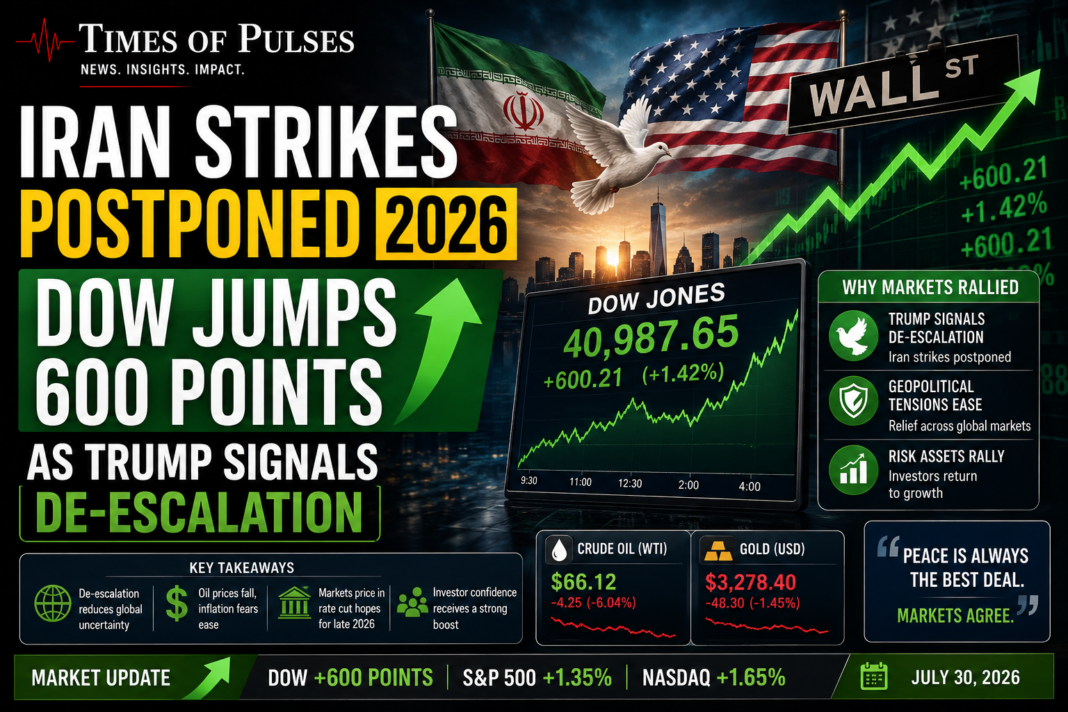
Iran Strikes Postponed 2026: Dow Jumps 600 Points as Trump Signals De-Escalation
Markets just delivered one of their sharpest relief rallies of the year. The Iran strikes postponed 2026 decision — President Trump pulling back from threatened attacks on Iran’s power infrastructure — sent the Dow Jones Industrial Average surging over 600 points, while oil prices tumbled double digits in a single session. Here’s what actually happened, and why markets reacted so strongly to a pause rather than a resolution.
What Actually Happened
After a tense weekend that saw Trump issue an ultimatum — threatening to strike Iran’s power facilities if the Strait of Hormuz remained closed for 48 hours — the Iran strikes postponed 2026 story took a genuinely surprising turn. Trump announced early in the week that he had instructed the military to postpone strikes on Iran’s energy infrastructure, citing “very good and productive” talks between the U.S. and Tehran that were expected to continue.
This came despite Tehran having launched fresh attacks in the region just before the announcement — a reminder of how quickly this conflict has swung between escalation and de-escalation in recent weeks, following the earlier wave of U.S. strikes and Iranian retaliation we’ve covered extensively this month.
The Market Reaction Was Immediate and Dramatic
The Iran strikes postponed 2026 news triggered a sharp, broad-based rally:
- The Dow Jones Industrial Average rose 1.4%, gaining over 600 points
- The S&P 500 jumped roughly 1.2%
- The Nasdaq Composite climbed about 1.4%
Oil prices told an even more dramatic story. West Texas Intermediate crude sank 10%, trading near $89 a barrel, while global benchmark Brent crude pulled back below $100 after briefly topping $113 in premarket trading — one of the sharpest single-day oil price reversals we’ve tracked throughout this entire conflict.
Why a “Postponement” Moved Markets So Much
This is worth understanding clearly: markets didn’t react to a peace deal or a resolved conflict — they reacted to reduced near-term escalation risk. The Iran strikes postponed 2026 decision specifically removed the immediate threat to Iran’s power and energy infrastructure, which had been the trigger for the weekend’s ultimatum. Trump reportedly told reporters that the Strait of Hormuz — the critical oil shipping corridor we’ve discussed at length this year — could reopen “very soon” if the ongoing talks continue to bear fruit.
Given how much of this year’s oil price volatility has centered specifically on Strait of Hormuz risk, any credible signal of that corridor reopening carries outsized weight for energy markets, which explains the double-digit single-day move in crude prices.
This Fits a Pattern We’ve Tracked All Year
If the market’s whiplash reaction feels familiar, it should. We’ve now covered multiple cycles of escalation and de-escalation in this conflict — oil spiking above $100 a barrel, then falling on peace deal hope, then rising again on renewed hostilities, and now this sharp reversal following the Iran strikes postponed 2026 announcement. Each cycle has triggered genuine, tradeable volatility across equities, oil, chip stocks, and even crypto markets, underscoring just how sensitive this specific conflict has become for portfolios far beyond direct energy exposure.
What This Means for Your Money
- Don’t treat this as a resolved conflict. A postponement tied to “productive talks” is meaningfully different from a peace agreement — the same de-escalation cycle has reversed multiple times already this year.
- Gas price relief may follow, but cautiously. If oil prices hold near these lower levels, pump prices could ease in the coming weeks — though as we’ve covered before, gas prices tend to lag crude oil moves in both directions.
- Expect continued volatility around Strait of Hormuz headlines. Given how directly tied oil prices have become to this specific chokepoint, any shift in the talks’ progress is likely to keep moving energy markets sharply.
- Resist chasing the rally in either direction. Markets have swung dramatically on Iran-related headlines multiple times this year alone — a single day’s relief rally doesn’t guarantee the trend holds.
Bottom Line
The Iran strikes postponed 2026 decision delivered a genuine, sharp relief rally across stocks and a dramatic pullback in oil prices, but it’s worth reading this correctly: markets rewarded reduced immediate risk, not a resolved conflict. Given how many times this specific situation has escalated and de-escalated throughout the year, the most useful response remains what we’ve suggested throughout this ongoing story — stay informed on the Strait of Hormuz talks specifically, and avoid making major financial decisions based on any single day’s dramatic swing.
This article is for informational and educational purposes only and does not constitute investment advice. Geopolitical developments are unpredictable and can reverse quickly; consult a licensed financial advisor before making investment decisions.