
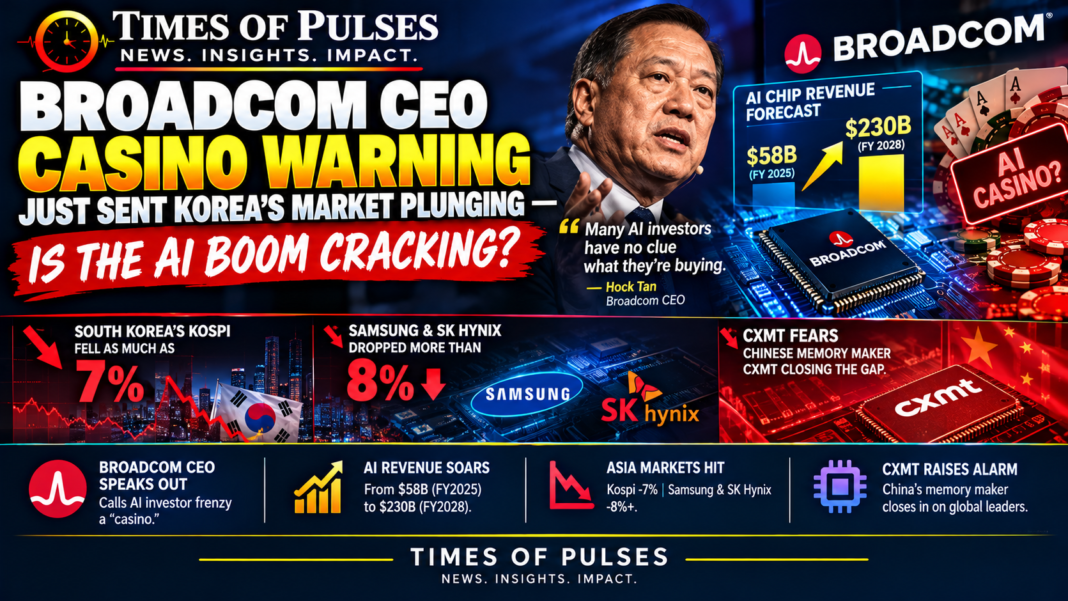
Broadcom CEO Casino Warning Just Sent Korea’s Market Plunging — Is the AI Boom Cracking?
One of the biggest winners of the AI boom just compared a chunk of the AI investing crowd to casino gamblers, and markets reacted within hours. The Broadcom CEO casino warning, delivered at an event in Singapore on Monday, helped set off a chip-stock selloff that rolled through Asia on Tuesday, pushing South Korea’s benchmark index down as much as 7% in a single session. It’s the second time in about a month that executives’ own words have rattled the AI trade, after the AI leaders’ slowdown call that hit chip stocks in September. Here’s exactly what was said, why it landed so hard, and what it does and doesn’t mean for your money.
The Broadcom CEO Casino Warning: What Hock Tan Actually Said
Broadcom CEO Hock Tan told the audience in Singapore that many investors piling into AI “have no clue what they are investing in,” according to Bloomberg’s report, carried by Yahoo Finance. He said those investors set extremely high expectations and then discover the experience feels a lot like gambling in a casino.
He didn’t stop there. Tan argued that AI model developers need customers who can earn real returns from the technology, rather than companies burning budgets on tokens while they experiment, likening it to a kid who spends a handful of arcade tokens in minutes and learns nothing. He also said OpenAI reaching $50 billion in annualized revenue in September shows a viable business model but says little about long-term profitability, and he warned that financing, not chip supply, could become the industry’s biggest constraint.
Korea Pays the Price for the Broadcom CEO Casino Warning
South Korea took the hardest hit because its market leans so heavily on chipmakers. The Kospi fell more than 6%, and by as much as 7% at its worst. Samsung Electronics and SK Hynix each dropped more than 8% and were both heading for a fifth straight losing session, and Seoul’s exchange briefly paused automated program trading. Japan’s Nikkei slid nearly 3%, Kioxia Holdings shed more than 12%, and MSCI’s Asia Pacific gauge was on track for its weakest close since August. Foreign investors have now sold more than $6 billion of Kospi shares on a net basis in October alone.
Back in the US, Monday’s session looked calmer on the surface. The Dow rose 0.38% to 51,850.55, while the S&P 500 slipped 0.06% to 7,807.24 and the Nasdaq fell 0.44% to 27,245.90, with chipmakers weighing on the tech-heavy indexes just ahead of a busy earnings week.
The Second Trigger: A Chinese Rival Closes In
The Broadcom CEO casino warning wasn’t acting alone. The selloff deepened after Chinese memory maker CXMT announced progress on a next-generation DRAM design known as 4F², which packs more storage into less space, with plans for a server DDR5 product built on it by the end of 2026. Samsung, SK Hynix, and Micron together control roughly 90% of the global DRAM market, so any credible challenger gets attention fast. Even Samsung’s record preliminary third-quarter profit last week barely lifted the sector, a sign that fear of future competition and doubts about AI spending are currently outweighing strong earnings today.
The Twist: The Man Sounding the Alarm Is Betting Big on AI
Here’s what makes this story more interesting than a simple “bubble” headline: Tan’s own company forecasts AI chip revenue rising roughly fourfold, from about $58 billion this fiscal year to $230 billion in fiscal 2028. His message isn’t that AI is fake. It’s that proven returns and speculative expectations are very different things, and many investors are treating them as the same.
The same panel offered a counterpoint. Intel CEO Lip-Bu Tan, a different executive from Broadcom’s Hock Tan, said the rapid AI buildout means hardware will stay in short supply for the next two to three years, the same scarcity theme we covered when chip stocks erased an entire week’s selloff in just three days. Real demand and real speculation can exist at the same time, which is exactly why this corner of the market is so jumpy.
Why the Broadcom CEO Casino Warning Matters Beyond Chip Stocks
The sharpest part of Tan’s message may be the financing point. It shifts the spotlight from whether enough chips can be built to whether the money to pay for them will keep flowing, putting AI-linked debt deals and the balance sheets of capital-hungry model developers under closer scrutiny. That’s worth reading alongside Treasury yields sitting near multi-year highs, because a buildout that depends on borrowed money gets harder to fund as borrowing costs rise. That connection is our own reading, not something Tan said.
It also fits a pattern we flagged when AMD crossed $1 trillion: rallies led by a handful of AI names can look stronger than the market underneath them, which means one comment can move far more than one sector. And it isn’t even the first chip scare of 2026. In late July, a similar selloff wiped more than $1 trillion from the biggest chip stocks before they recovered.
What This Means for Your Own Money
- A Broadcom CEO casino warning is a sentiment shock, not a change in earnings. It can still move prices for days, so don’t ignore it, but one rough session isn’t proof the AI buildout is over.
- Check how much chip and AI exposure you already hold. Broad index funds now carry heavy AI weight, so you can feel days like this even if you never bought a chip stock. If you’ve been following Micron or SanDisk from our October stocks to watch list, treat this as a reminder of how volatile that corner can be.
- Separate proven returns from big expectations. Tan’s own test is worth borrowing: for any AI-linked stock you own, ask what real revenue supports the valuation.
- Watch financing and yields, not just headlines. If credit gets tighter or yields climb further, the companies most dependent on borrowing tend to feel it first.
Bottom Line
The Broadcom CEO casino warning doesn’t say AI is a fad. It says the market may be paying for expectations faster than companies can prove returns, and when that message comes from someone who sells the chips powering the boom, investors listen. Add a rising Chinese challenger in memory chips and a Korean market that’s heavily tied to two stocks, and you get a selloff that feels bigger than any single headline. Whether this fades like July’s scare or becomes a longer reset will likely depend on earnings, financing conditions, and whether CXMT’s progress turns into real products.
This article is for informational purposes only and does not constitute financial or investment advice. Consult a licensed financial advisor before making changes to your investment portfolio.