
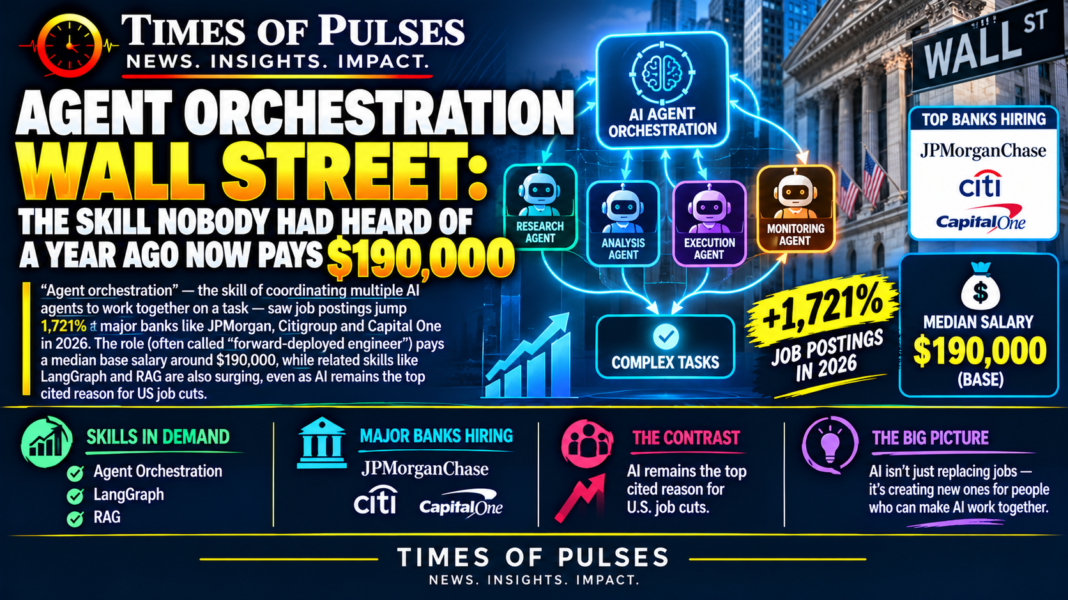
Agent Orchestration Wall Street: The Skill Nobody Had Heard of a Year Ago Now Pays $190,000
Picture this: a skill barely existed on Wall Street’s radar a year ago. Today, it’s being called “arguably the hottest skill on Wall Street,” job postings mentioning it have exploded by a jaw-dropping 1,721%, and the people who have it are commanding salaries north of $190,000. If that sounds like clickbait, it isn’t, this is a real, verified hiring trend sweeping through the biggest banks in America right now.
Agent Orchestration Wall Street: What Is This Skill, Exactly?
The skill is called agent orchestration, and once you understand what it actually means, the hype makes a lot more sense. It’s the ability to design a system where multiple AI agents work together on one task, each handling a different piece and passing results along to the next. Picture a loan application: one AI agent verifies the input data, a second analyzes the supporting documents, and a third checks everything against banking regulations before a human ever sees it. That’s agent orchestration Wall Street banks are racing to hire for, moving past simple chatbots into coordinated teams of specialized AI.
The Eye-Popping Growth Numbers
According to hiring data firm Draup, job postings mentioning agent orchestration jumped 1,721% in 2026 compared to the year before. Worth noting honestly: that growth started from a genuinely small base, references climbed from just 108 mentions in 2025 to 1,967 this year, so the percentage looks more dramatic than the raw numbers alone. Still, that doesn’t make it any less real. Overall AI-related job postings at major banks including JPMorgan Chase, Citigroup, and Capital One reached 139,819 listings, a 49% jump from 2025. Draup CEO Vijay Swaminathan didn’t mince words about where this agent orchestration Wall Street trend stands relative to everything else: “this is arguably the hottest skill on Wall Street.”
Why Agent Orchestration Wall Street Demand Grew So Badly, So Fast
Banks have spent the last couple of years hiring data scientists to build individual AI models. What’s changed is that a single AI model handling one task in isolation isn’t enough anymore, banks need entire workflows where several specialized agents hand tasks off to each other reliably, securely, and in compliance with financial regulations. That’s created a new role entirely: the “forward-deployed engineer,” someone who figures out which agents are needed for a given business process, what each one should do, and how they should communicate, then actually builds and embeds that system directly into trading desks, compliance units, and back-office operations.
What It Actually Pays
Here’s the number that makes this agent orchestration Wall Street story worth paying attention to beyond the headline growth stat: generative AI managers, the kind of role overseeing this work, earn a median base salary of roughly $190,000, according to Draup’s data. That’s a genuinely strong income for a skill set that, for most people, didn’t even exist as a formal job category two years ago.
The Skills Riding Along With It
Agent orchestration isn’t growing in isolation, it’s pulling a whole ecosystem of related skills up with it. Mentions of LangGraph, a framework for building multistep AI workflows, rose 679% to 5,300 references. Retrieval-augmented generation, commonly known as RAG, a technique for grounding AI responses in real company data, climbed 259%. And prompt engineering, despite not growing as fast percentage-wise, still leads in raw volume with 11,368 mentions, a reminder that the most explosive growth rate and the most total demand aren’t always the same skill.
Oversight roles are expanding right alongside the builders too. Mentions of responsible and safe AI use jumped 657%, AI governance and policy references rose 394%, and risk-management-related postings climbed 359%. Banks aren’t just hiring people to build these agent systems, they’re hiring just as aggressively to make sure someone’s watching them.
The Twist: AI Is Also Cutting Jobs
Here’s the irony worth sitting with: even as agent orchestration Wall Street demand explodes, AI remains the single most commonly cited reason for job cuts across the US this year. The same technology creating this new, highly paid career path is simultaneously eliminating other roles, often the exact kind of repetitive analytical work that AI agents are now being built to automate. It’s a genuinely two-sided story, AI isn’t just taking jobs or just creating them, it’s doing both, often within the same industry and sometimes the same company, at the same time.
What This Means for Your Own Career
- If you’re in finance, tech, or analytics, this is worth a real look. A skill growing this fast with salaries this strong is a legitimate signal, not hype, even accounting for the small starting base.
- You don’t need to become an AI researcher to benefit. Forward-deployed engineer roles value people who understand both the business process and how to coordinate the tools, not just raw technical depth.
- Think of this as part of your broader career and financial planning, not an isolated gamble. Upskilling toward an in-demand area fits the same long-term thinking we’ve covered in year-round financial planning, deliberate moves made before you’re forced into them.
- Watch how this connects to the AI infrastructure trade more broadly. The same AI buildout driving chip stock volatility and swings in AI-linked stocks is the underlying force creating this hiring surge, it’s one connected story playing out across markets and the job market simultaneously.
Bottom Line
CNBC’s reporting on this trend captured something genuinely rare: a brand-new, highly specific, highly paid skill category emerging almost overnight inside one of the most competitive job markets in the world. Agent orchestration Wall Street demand went from a rounding error to “arguably the hottest skill” in the industry within a single year. Whether or not it’s the right career pivot for you personally, it’s a useful real-time example of how quickly the value of a specific skill can shift when an entire industry decides it needs it, and a reminder to keep watching where that kind of demand shows up next.
This article is for informational purposes only and does not constitute financial or career advice. Consult a licensed career counselor or financial advisor for guidance specific to your situation.