
Warren Buffett Steps Down: 56 Years, $397 Billion in Cash, and One Brutal Truth He Left Behind
Some retirements are routine. This one isn’t. Warren Buffett steps down as chairman of Berkshire Hathaway after 56 years in the role, closing out one of the longest and most successful runs in American business history. But the real story here isn’t just the handoff, it’s what Buffett’s final moves and parting words actually mean for anyone trying to invest wisely today.
Warren Buffett Steps Down: What Actually Happened
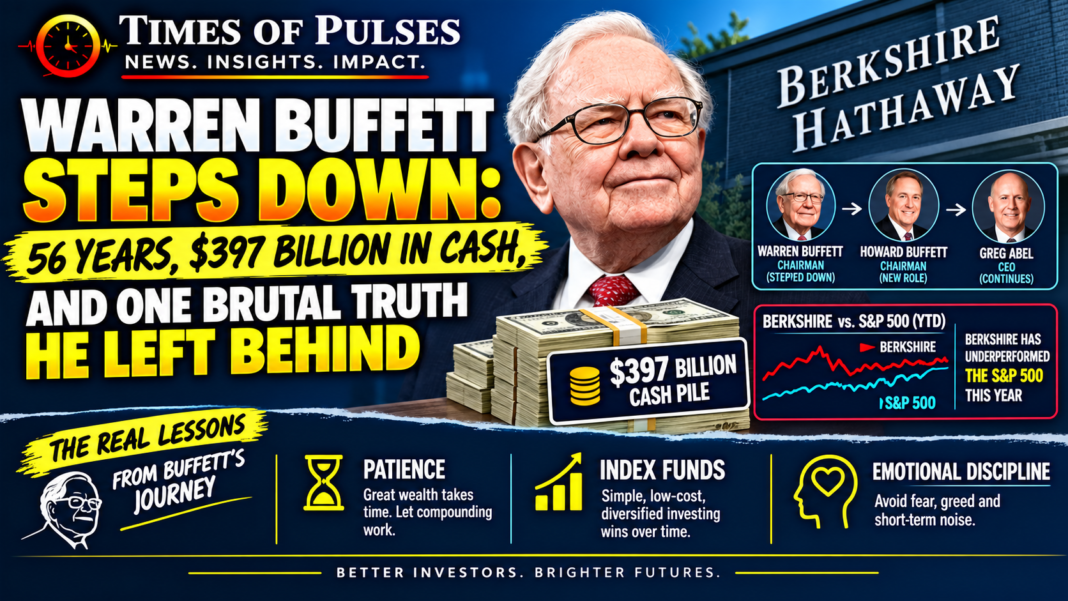
On September 18, 2026, Berkshire Hathaway announced that Warren Buffett, 96, would step down as chairman, a role he’d held since 1970. His son Howard Buffett, a Berkshire board member since 1993, was elected as the new chairman. Warren will remain on the board as Chairman Emeritus, a largely advisory position, while Greg Abel, who took over as CEO at the start of 2026, continues running the company’s day-to-day operations. This Warren Buffett steps down announcement is the third major step in a multi-year succession plan Buffett has carefully executed to make sure Berkshire doesn’t lose its identity once he’s fully gone.
Buffett explained the timing simply in his letter to shareholders: “Father Time always wins.” He described the arrangement plainly, noting that Abel runs the company while Howard protects its culture and values.
Why Buffett’s $397 Billion Cash Pile Matters Right Now
One detail makes the Warren Buffett steps down story more than just a leadership change: Berkshire is currently sitting on roughly $397 billion in cash, an enormous reserve that Buffett built up gradually rather than deploying into acquisitions during a period when he judged most assets overpriced. That’s not indecision, it’s the same discipline that’s defined his entire career: waiting patiently for genuinely attractive opportunities rather than feeling pressured to constantly deploy capital. Nobody, including Buffett himself, has said what specific conditions would trigger that cash finally getting put to work.
The Uncomfortable Truth Warren Buffett Steps Down News Is Glossing Over
Here’s a detail many headlines about Warren Buffett steps down news are glossing over: Berkshire’s stock has actually underperformed this year, rising just 1% compared to roughly 12% for the S&P 500. If that gap holds through year-end, it would mark the fifth time in the last ten years Berkshire has trailed the index. Rising oil prices have been cited as one factor weighing on the company’s recent performance, a dynamic we’ve tracked closely in our own coverage of oil price volatility and how to actually invest around it.
It’s worth keeping this in perspective, though: since 1965, Berkshire has still beaten the S&P 500 by nearly 10 percentage points annually on average, an extraordinary long-term record that a rough recent decade doesn’t erase.
The Real Lesson Behind “Father Time Always Wins”
Buffett’s core investing philosophy has always centered less on picking hot stocks and more on managing your own psychology as an investor, especially when markets get frightening. He’s repeated a version of the same message throughout his career: current market swings, however unsettling they feel in the moment, are minor compared to the actual crashes he’s lived through and invested through over seven decades. That perspective, treating short-term volatility as background noise rather than a crisis, is arguably more valuable to an everyday investor than any specific stock he’s ever picked.
Buffett’s Most Practical Advice for Everyday Investors
Despite being one of history’s greatest individual stock pickers, Buffett has spent decades publicly recommending that most people simply buy a low-cost S&P 500 index fund rather than try to pick winners themselves. In 2007, he famously bet that an S&P 500 index fund would outperform a handpicked group of hedge funds over the following decade, and he won convincingly. That’s a genuinely useful, evidence-backed piece of advice worth remembering: the investor most associated with beating the market has spent years telling ordinary people not to try.
What This Means for Your Own Portfolio
- Cash isn’t a wasted asset while you wait for opportunity. Berkshire’s $397 billion cash pile reflects patience, not fear, a reminder that holding cash during uncertain periods is a legitimate strategy, not a failure to invest.
- A rough year doesn’t erase a strong long-term record, or the reverse. Berkshire’s recent underperformance is real, but so is its 60-year track record; judge any investment, including your own portfolio, on the right time horizon.
- Simple, boring advice often beats sophisticated strategy. If you’re deciding how to build a portfolio from scratch, Buffett’s own preferred answer for most people remains a low-cost index fund, not stock picking.
- Managing your emotions matters more than managing your trades. The single habit Buffett has emphasized most consistently, staying calm through volatility, is free, available to every investor, and arguably harder to master than any specific investment strategy, a theme worth revisiting alongside broader year-round financial planning.
Bottom Line
NPR’s coverage of the transition captured the moment plainly: after more than 50 years in the role, Warren Buffett steps down as chairman, handing the position to his son while remaining involved as an advisor. The succession itself was carefully planned and long telegraphed, but the timing offers a genuine moment to revisit the investing principles that built Berkshire in the first place: patience, discipline, comfort with cash, and the humility to recommend index funds to people who don’t have his decades of experience. Those lessons don’t retire, even as the man who taught them steps back from the chairman’s seat.
This article is for informational purposes only and does not constitute financial or investment advice. Consult a licensed financial advisor before making changes to your investment portfolio.