
Stocks Fall Third Straight Session 2026: What Happens Now, and How Bad Could This Get?
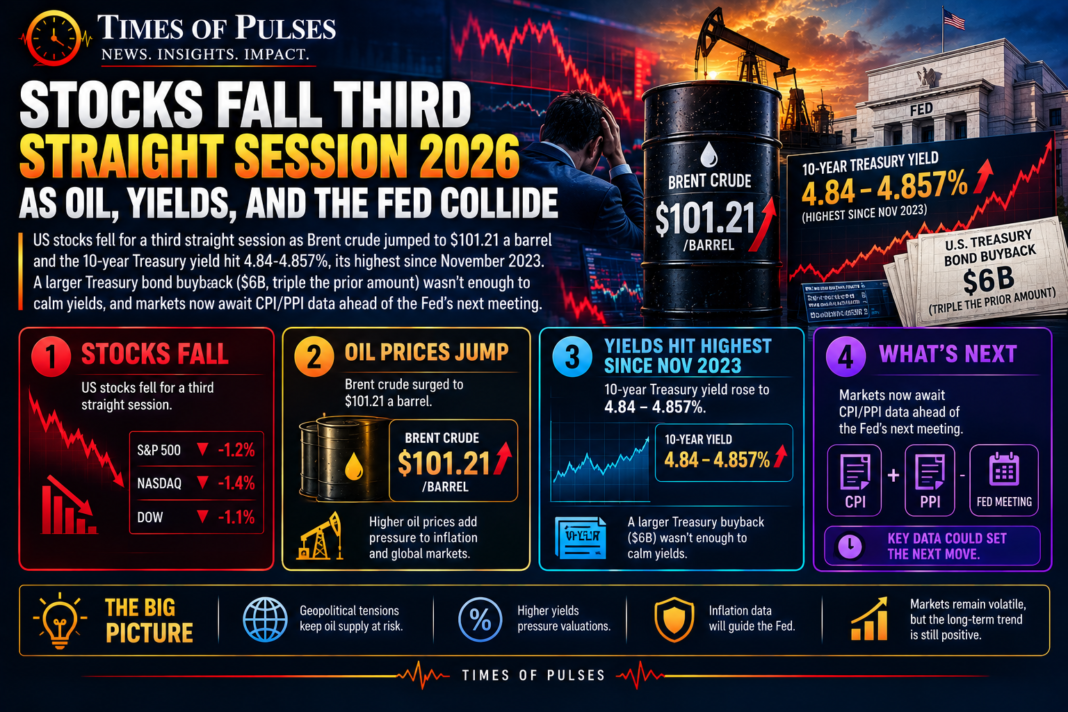
Wall Street just booked its third consecutive losing day, and the reason isn’t a mystery, it’s the same two forces colliding at once. Stocks fall third straight session territory now includes Wednesday’s close, with rising oil prices and climbing Treasury yields squeezing markets from both directions simultaneously.
The Numbers Behind This Stocks Fall Third Straight Session Stretch
Wednesday’s losses were broad. Kiplinger’s market coverage confirmed the Dow Jones Industrial Average dropped 405.41 points, or 0.77%, to close at 52,380.66. The S&P 500 slipped 0.48% to 7,636.36, and the Nasdaq Composite fell 0.64% to 26,253.34. This stocks fall third straight session run follows Tuesday’s decline, which itself came after the Dow’s worst single day in nearly three weeks, meaning the market has now given back ground in three consecutive sessions without a real bounce in between.
The Two Forces Driving This Stocks Fall Third Straight Session Pattern
The first pressure point is oil. Brent crude jumped 3.36% to settle at $101.21 a barrel, extending the move above $100 we covered earlier this week amid ongoing US-Iran tensions. The second pressure point is bonds. The 10-year Treasury yield climbed to 4.84%, touching as high as 4.857% intraday, its highest level since November 2023 and closing in on the psychologically significant 5% mark. Higher oil raises inflation expectations, and higher yields raise borrowing costs and make bonds more competitive with stocks, a combination that’s exactly why this stocks fall third straight session stretch has been so difficult for the market to shake off.
The Treasury’s Bond Buyback Wasn’t Enough to Calm Markets
Adding a new wrinkle to this stocks fall third straight session story, the Treasury Department announced a repurchase of longer-dated debt totaling $6 billion, triple the amount from its previous operation. This continues the same buyback strategy we covered when Ray Dalio warned about the debt crisis behind these Treasury moves, but this time the larger buyback still wasn’t enough to stop yields from climbing. Some market participants had actually expected an even bigger operation, with estimates ranging from $7 billion to $8 billion, according to market analyst Peter Boockvar, meaning the announcement itself may have disappointed traders hoping for a stronger signal.
An “Unusual Standoff” Between Stocks and Rates
Thomas Martin of Globalt Investments described the current moment as “an unusual standoff in market sentiment,” noting that optimism about stocks and expectations for higher interest rates were both running at extremes simultaneously, a combination he suggested is unlikely to persist together for long. That tension captures why this stocks fall third straight session run feels different from an ordinary pullback: investors haven’t given up on the market’s longer-term direction, but they’re increasingly uneasy about how much higher rates can climb before something has to give.
This uncertainty connects directly to the rate hike odds shift we covered after the last jobs report, where stronger-than-expected employment data pushed the odds of a September Fed rate hike higher. Markets are now watching for upcoming CPI and PPI inflation data, due before the Fed’s next policy meeting, for a clearer signal on where rates go from here.
What This Means for Your Own Money
- Three days of losses isn’t automatically a correction. A stocks fall third straight session stretch of roughly 2% combined across major indexes is a pullback worth watching, not yet the kind of drop that should trigger a portfolio overhaul.
- Rate-sensitive parts of your finances deserve attention right now. With yields at their highest since 2023, the save-or-pay-off-debt math we walked through is shifting further in favor of paying down high-rate debt rather than parking cash.
- Watch the CPI and PPI releases closely. Whichever way inflation data comes in over the next week will likely determine whether this stocks fall third straight session pattern extends into a fourth or fifth day, or reverses.
- Don’t try to time a bottom based on headlines alone. Both oil and Treasury yields have moved sharply and unpredictably in both directions this year; a sudden de-escalation in the Middle East or a cooler inflation print could reverse this pattern just as quickly as it started.
Bottom Line
This stocks fall third straight session stretch is being driven by two forces reinforcing each other: oil above $100 a barrel keeping inflation fears alive, and Treasury yields near their highest levels since 2023 raising the cost of capital across the entire market. Neither the Treasury’s larger bond buyback nor any single day’s trading has been enough to break the pattern yet. Whether Thursday brings a fourth straight decline or a reversal likely depends less on any one headline and more on whether oil prices and yields can both find some stability at the same time, something that hasn’t happened in over a week.
This article is for informational purposes only and does not constitute financial or investment advice. Consult a licensed financial advisor before making changes to your investment portfolio.