
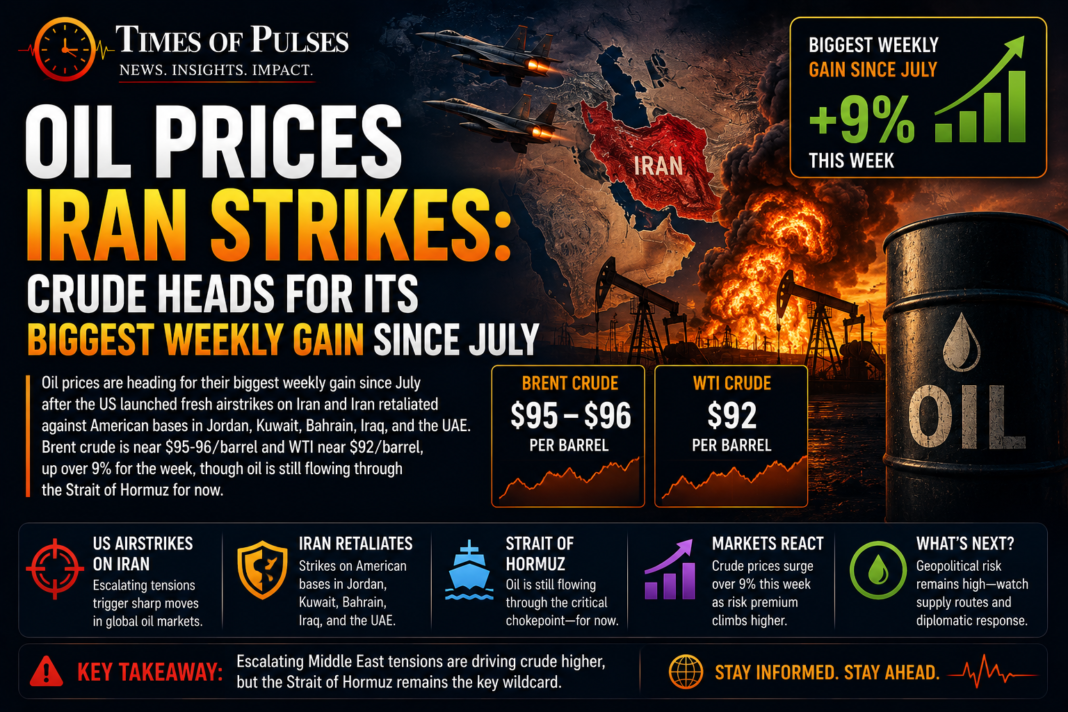
Oil Prices Iran Strikes: Crude Heads for Its Biggest Weekly Gain Since July
Just when the Strait of Hormuz standoff seemed to be settling into an uneasy calm, it flared up again, and this time oil prices are moving harder than they have in weeks. Oil prices Iran strikes headlines are back at the top of financial news this week after the US carried out a fresh wave of airstrikes against Iranian targets, and crude is now on pace for its biggest weekly gain since July.
What Actually Happened This Week
After roughly a month of relative calm following the deadlock we covered when Iran’s demands clouded the outlook for reopening the Strait of Hormuz, the US launched a new round of airstrikes against Iranian targets over the weekend and into this week. Iran’s Revolutionary Guard retaliated by targeting American military positions across the region, including bases in Jordan, Kuwait, Bahrain, Iraq, and the UAE. This oil prices Iran strikes escalation marks a genuine reescalation of a conflict that markets had, for a few weeks, started to price as cooling off.
President Trump said the latest attacks on Iran would be “short-lived,” but also reiterated that the US remains prepared for further strikes and maintained that the US controls access through the Hormuz waterway. That combination, a promise of restraint alongside a readiness for more action, is exactly the kind of uncertainty that keeps this oil prices Iran strikes story moving markets day to day.
The Numbers: How Far Oil Has Actually Moved
The price action has been sharp. Bloomberg’s oil market coverage this week noted that Brent crude, the global benchmark, climbed to around $95 to $96 a barrel this week. West Texas Intermediate, the US benchmark, pushed toward $92 a barrel and was up more than 9% for the week alone, putting oil on track for its largest weekly gain since July. Over the past month, crude prices are up close to 13% to 20% depending on the benchmark, and prices now sit more than 40% higher than this time last year.
Adding to the pressure, US crude inventories fell by 4.5 million barrels last week, the first inventory drop since late July, a sign that supply is tightening even as the oil prices Iran strikes conflict adds fresh uncertainty on top of already-reduced stockpiles.
Why the Strait of Hormuz Keeps Driving This Story
The Strait of Hormuz carries roughly a fifth of the world’s oil supply, which is exactly why any renewed hostility near it moves prices more sharply than most other geopolitical headlines. Despite this week’s exchange of strikes, crude shipments have continued passing through the strait at an estimated average of 8 million barrels a day, meaning actual physical supply hasn’t been cut off, even as the oil prices Iran strikes conflict raises the risk that it eventually could be.
That distinction matters. Markets aren’t just pricing in what’s happening today, they’re pricing in the probability of a worse disruption tomorrow. As long as shipments keep flowing despite the fighting, prices can remain volatile without spiking into true crisis territory, but that calculation can change quickly if either side escalates further.
Why This Keeps Happening in Cycles
If this pattern feels familiar, that’s because it is. We’ve now tracked this same dynamic multiple times this year: prices spike on fresh hostilities, ease when diplomatic hope resurfaces, then spike again when that hope fades or fighting resumes. The oil prices Iran strikes situation this week is simply the latest cycle in a conflict that has repeatedly refused to settle into either a clean resolution or a sustained crisis.
Forecasters are reflecting that same uncertainty in their outlooks. Current 30-day projections for WTI crude range anywhere from roughly $70 to $102 a barrel for September 2026, an unusually wide band that reflects just how much depends on factors still very much in motion, including the trajectory of the Iran conflict, the Federal Reserve’s increasingly hawkish tone, and the possibility of a September rate move.
What This Means for Your Wallet
- Don’t treat this week’s gas price as a stable baseline. With oil prices Iran strikes headlines shifting sentiment day to day, the price at the pump this week may look meaningfully different in two or three weeks, in either direction.
- Build a buffer into your fuel and travel budget rather than trying to time it. We’ve covered this exact approach before when gas prices were swinging earlier this year, and the same logic applies now: a small cushion beats trying to guess which week will be cheap.
- Watch your broader budget, not just gas. Energy costs ripple into everything from grocery delivery fees to airfare, and if your household is already feeling paycheck pressure, rising fuel costs are one more variable worth planning around rather than being surprised by.
- If you hold energy stocks or broad index funds, expect continued volatility, not a clean trend in either direction, for as long as this conflict stays unresolved.
Bottom Line
The oil prices Iran strikes story is back at the center of energy markets this week, with crude on pace for its biggest weekly gain since July after a fresh round of US airstrikes and Iranian retaliation. Actual oil shipments through the Strait of Hormuz haven’t stopped, which is keeping this a volatility story rather than a full supply crisis for now, but the wide range in current forecasts shows just how much uncertainty remains. As with every earlier chapter of this conflict, the safest financial move isn’t trying to predict the next headline, it’s building enough flexibility into your budget to absorb whichever way prices move next.
This article is for informational and educational purposes only and does not constitute financial or investment advice. Geopolitical events and energy markets are unpredictable and can change rapidly; consult a licensed financial advisor before making investment decisions.