
Save or Pay Off Debt First? Why September 2026 Makes This an Unusually Easy Call
If you’ve got some extra cash and you’re not sure whether to stash it in savings or throw it at debt, the numbers right now actually make this decision clearer than it’s been in years. The question of whether to save or pay off debt first always depends on the math, and this September, that math has a real gap in it worth understanding before you decide where your next dollar goes.
The Rate Gap Driving This Question in 2026
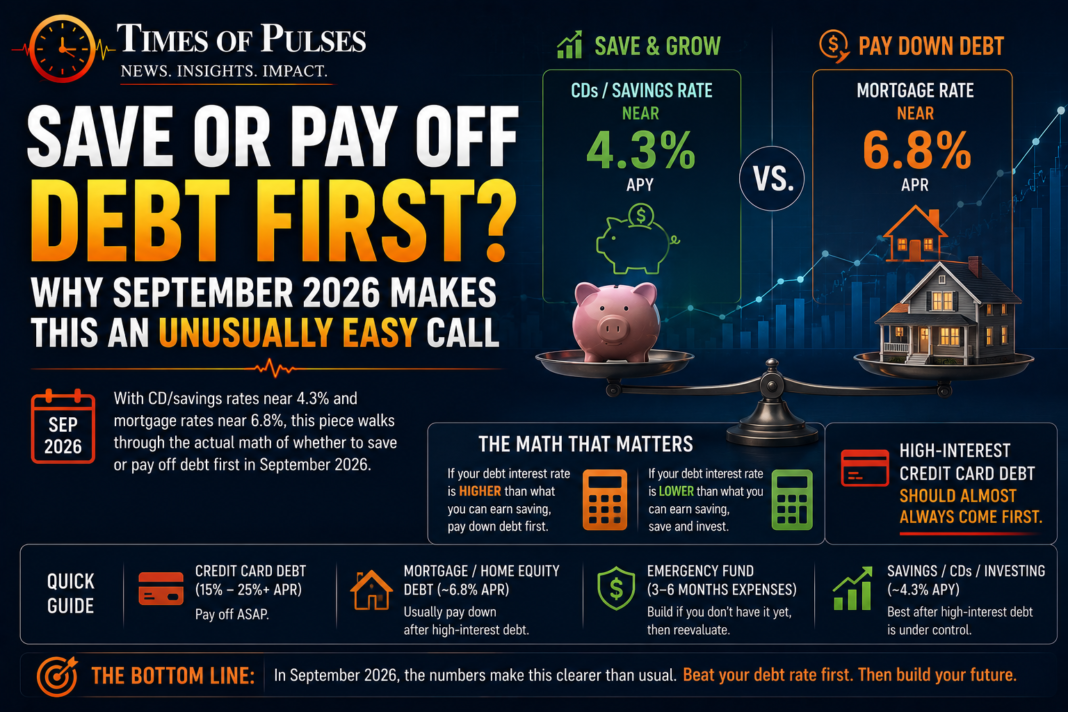
Two things are true at the same time right now, and together they’re exactly why the save or pay off debt question matters more than usual. First, savings accounts and CDs are paying some of the best rates in years, with top 18-month CDs currently offering up to 4.35% APY. Second, borrowing costs on things like mortgages haven’t come down nearly as much, with the average 30-year fixed mortgage sitting around 6.76% APR as of early September. That’s a real gap between what you can earn on cash and what you’re paying to borrow it, and it’s the whole reason the save or pay off debt calculation isn’t as simple as “debt is always bad.”
Why Savings Accounts Are Paying More Than Usual
Right now, some of the strongest CD offers include an 18-month CD from Bread Savings at 4.35% APY and comparable 18-month and 2-year CDs from Marcus by Goldman Sachs at 4.3% APY, according to Yahoo Finance’s roundup of current CD rates, both well above what savings accounts paid just a few years ago. These elevated rates are a direct result of where the Federal Reserve has kept its benchmark rate this year, and they’re part of why the save or pay off debt decision genuinely depends on what kind of debt you’re comparing it to.
Why Borrowing Costs Are Also Climbing
At the same time, borrowing has gotten more expensive on the mortgage side specifically. The average 30-year fixed mortgage rate was running around 6.759% (6.819% APR) in early September, with 20-year fixed loans near 6.65% and 15-year fixed loans closer to 6.12%. Part of what’s pushing rates up is the bond market: the 10-year Treasury yield, which mortgage rates track closely, climbed to around 4.81% this week, its highest level since November 2023, driven by renewed geopolitical tensions and concerns about government borrowing. That combination is exactly why the save or pay off debt question doesn’t have one universal answer, it depends entirely on which specific rate you’re comparing your savings yield against.
When It Actually Makes Sense to Save or Pay Off Debt
Here’s the actual rule of thumb: compare the interest rate on your debt to what you can earn on savings. If a CD is paying 4.3% and your mortgage is at 6.76%, you come out ahead paying down the mortgage faster in strict interest-rate terms, since you’re avoiding a 6.76% cost rather than earning a 4.3% return. But that math flips for lower-rate debt. If you have a car loan or an older mortgage locked in below 4%, parking extra cash in a high-yield CD or savings account instead of paying that debt down early is often the better move mathematically, since you’re earning more than you’d save.
This is really the core of the save or pay off debt decision: it’s not about debt being good or bad in the abstract, it’s about which number is bigger.
The Exception: High-Interest Debt
There’s one place where the save or pay off debt question isn’t close at all: credit cards and other high-interest consumer debt. With average credit card APRs still running well above 20%, no CD or savings account anywhere is going to out-earn that. If you’re carrying a credit card balance, that debt should come before building savings almost every time, regardless of how attractive today’s CD rates look.
We’ve written before about how a growing share of Americans can only manage their credit card minimum payments, and this rate gap is part of why that trap is so costly, high-interest debt compounds against you faster than almost any savings account can compound in your favor.
What This Means for Your Own Money
- Line up your actual interest rates side by side. The save or pay off debt decision isn’t guesswork, it’s a direct comparison between your debt’s interest rate and your best available savings yield.
- Don’t ignore the bigger economic backdrop. With Treasury yields sitting at levels not seen since 2007 on the long end and mortgage rates following suit, borrowing costs across the board are elevated right now, not just on new mortgages.
- Job market softness adds a reason to keep some cushion. Private payroll growth slowed to just 38,000 jobs in August, the weakest reading since January, a reminder that an emergency fund still matters even while you’re weighing the save or pay off debt tradeoff.
- Remember this ties into the bigger affordability picture. We’ve covered how housing costs have become the top financial worry for young Americans, and today’s mortgage rates are a direct part of that story if you’re weighing paying down an existing home loan faster.
Bottom Line
The save or pay off debt question isn’t a matter of financial philosophy, it’s simple math that changes based on the specific rates in front of you. Right now, with CDs paying north of 4% and mortgage rates near 6.8%, higher-rate debt still generally wins the comparison, while low-rate debt and healthy savings can comfortably coexist. The one rate that changes nothing about this calculation is high-interest credit card debt, which should almost always come first no matter what today’s savings accounts are offering.
This article is for informational purposes only and does not constitute financial advice. Consult a licensed financial advisor before making changes to your personal finances.