
SBA Loan Rates 2026 Just Hit Their Lowest Level Since 2022 — Here’s What That Means for Your Business
If you’ve been putting off financing your small business because of high interest rates, the math just changed. SBA loan rates 2026 have dropped to their lowest ceiling in years, and a separate fee waiver could make borrowing even cheaper for certain business owners. Here’s exactly where the numbers stand right now, why they fell, and what the tariff headlines happening at the same time mean for your bottom line.
SBA Loan Rates 2026: The Numbers Right Now
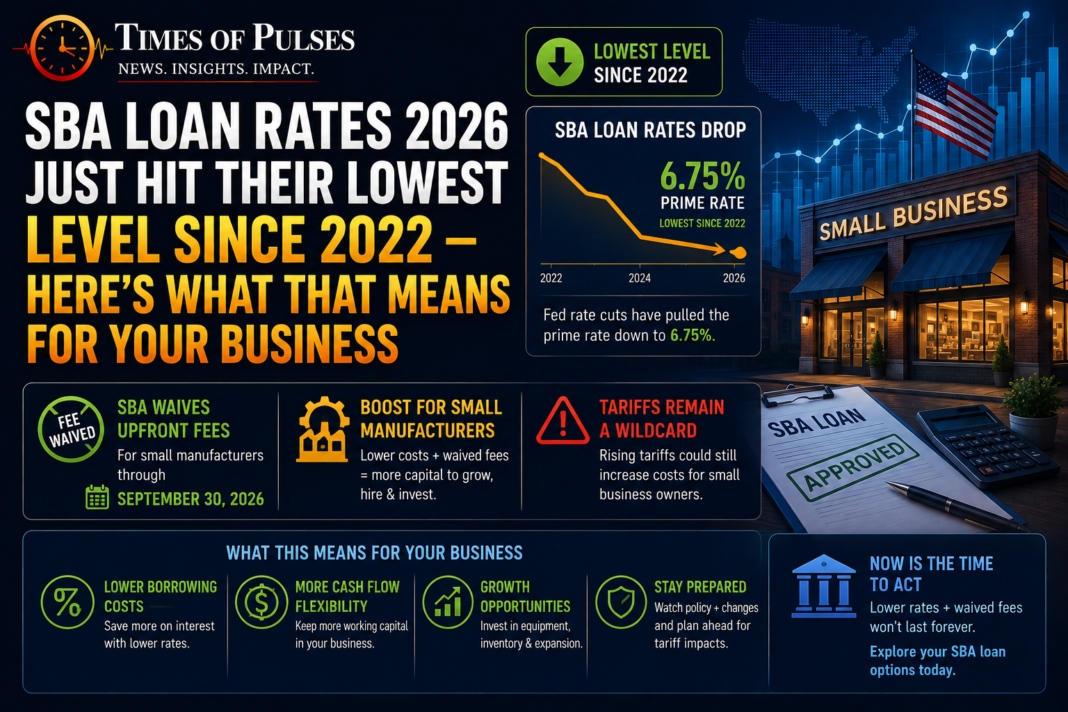
The prime rate, the benchmark most business loans are priced against, currently sits at 6.75%, the lowest level since late 2022. That’s a meaningful drop from the 8.50% prime rate that held for roughly 15 months through early 2024.
Here’s how that translates into actual SBA loan rates 2026:
- SBA 7(a) variable loans over $350,000: capped at 9.75%, down from around 11.50% in 2024
- SBA 7(a) variable loans $50,000 to $350,000: capped at 10.75%
- SBA 7(a) fixed-rate loans: 11.75% to 14.75%
- SBA 504 loans: 5% to 7%
- SBA microloans: 8% to 13%
For comparison, a standard bank term loan currently runs 6.80% to 11.00%, and a business line of credit typically falls between 8.00% and 14.00%. SBA-backed products remain some of the cheapest financing small business owners can access, and SBA loan rates 2026 are now at their most favorable point in roughly three years.
Why SBA Loan Rates 2026 Fell This Much
The drop traces directly back to the Federal Reserve. The Fed cut rates three times in September, October, and December of 2025, bringing the federal funds target down to 3.50%–3.75% and pulling the prime rate down alongside it. Since then, the Fed has held steady through its January, March, April, and June 2026 meetings, meaning SBA loan rates 2026 have stayed at this lower level for months rather than being a brief dip.
Because SBA 7(a) loans are priced as prime plus a lender spread, capped at specific percentage points depending on loan size, that 175-basis-point decline in the prime rate flows fairly directly into what business owners actually pay. This is the lowest SBA rate environment since 2022, according to lender data tracking these products.
A New Fee Waiver on Top of Lower Rates
Small manufacturers got an additional break layered on top of falling SBA loan rates 2026. The SBA has waived upfront fees for manufacturing-related loans through September 30, 2026: 7(a) manufacturing loans up to $950,000 now carry a 0% upfront fee, and 504 manufacturing loans have both the upfront fee and annual service fee reduced to 0%. SBA Administrator Kelly Loeffler framed the move as part of an effort to help “job creators expand production and train and hire more U.S. workers,” according to the agency’s announcement.
For a manufacturer taking out a loan near that $950,000 ceiling, skipping the upfront guarantee fee alone, which NerdWallet notes can otherwise run up to 3.75% of the loan amount, adds real savings on top of the already-lower SBA loan rates 2026.
Tariffs Are the Wildcard
Cheaper financing is only half the picture for small business owners right now. On the cost side, the picture is murkier. We recently covered the semiconductor tariff framework the Commerce Department is developing, and that’s just one piece of a broader tariff environment that’s been raising input costs across manufacturing, retail, and import-dependent small businesses throughout 2026.
Lower SBA loan rates 2026 make it cheaper to borrow, but tariffs can raise the cost of the equipment, materials, and inventory that loan is meant to finance in the first place. We’ve also written about how tariff-related savings and refunds have tended to land with large companies rather than flowing back down to smaller businesses or consumers, which is worth keeping in mind if you’re counting on tariff relief to offset rising costs.
What This Means for Your Small Business
- If you’ve been waiting for a better rate environment, this is close to as good as it’s been in years. SBA loan rates 2026 sitting near a three-year low is a real, structural change, not just short-term noise.
- Manufacturers specifically should look at the fee waiver before it expires. The 0% upfront fee window closes September 30, 2026, so timing matters if this applies to your business.
- Don’t finance a purchase without factoring in tariff exposure. If your business imports equipment, components, or inventory, price in the possibility of higher costs on the other side of the loan, not just the interest rate itself.
- Shop the loan type, not just the headline rate. SBA 504 loans (5-7%) can be meaningfully cheaper than SBA 7(a) loans depending on what you’re financing, and eligibility rules differ between the two.
Bottom Line
SBA loan rates 2026 falling to their lowest point since 2022, combined with a temporary fee waiver for manufacturers, genuinely improves the financing side of running a small business right now. But it’s only one half of the equation. With tariff policy still evolving and input costs an open question for many industries, the smarter move is to treat cheaper borrowing as an opportunity to plan carefully, not a green light to spend without checking how the cost side of your business might shift over the next year.
This article is for informational purposes only and does not constitute financial advice. Consult a licensed financial advisor before making changes to your business’s finances.