
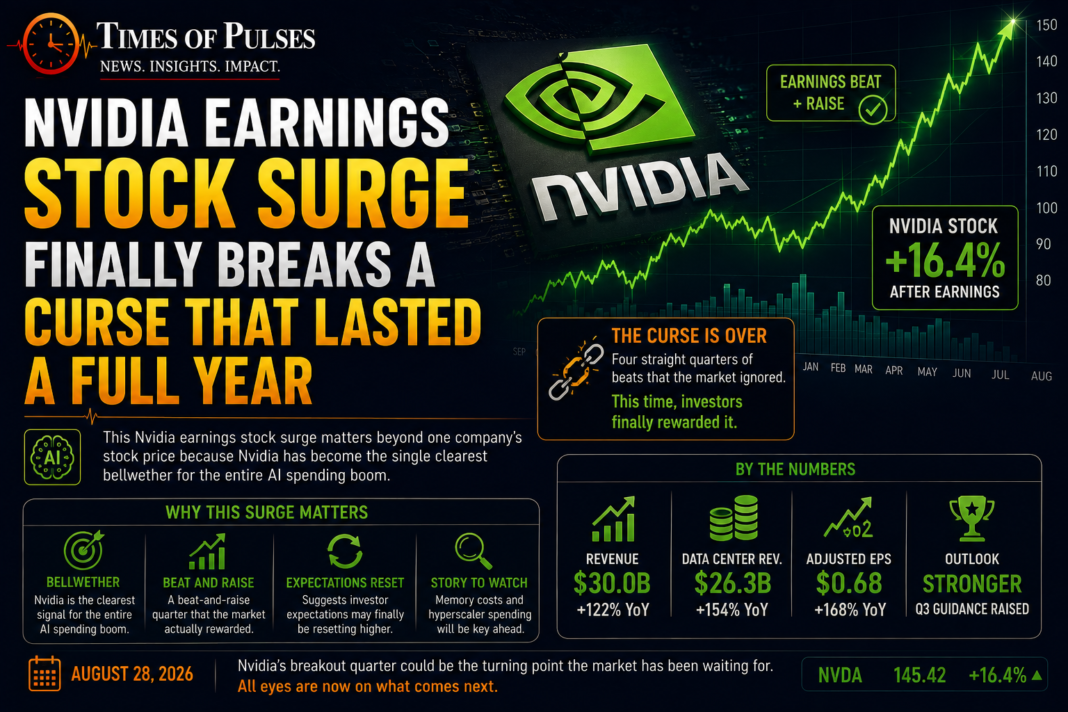
Nvidia Earnings Stock Surge Finally Breaks a Curse That Lasted a Full Year
For the last four straight quarters, Nvidia did something strange: it beat Wall Street’s earnings estimates every single time, and its stock fell anyway. That streak just ended. The Nvidia earnings stock surge that followed Wednesday’s report wasn’t just another beat, it was the first genuinely positive reaction the market has given Nvidia in about a year, and the numbers behind it explain why this quarter finally felt different.
The Numbers Behind the Nvidia Earnings Stock Surge
Nvidia reported its fiscal second-quarter 2027 results after the market closed on August 26. Revenue came in at $96.2 billion, up 106% year over year, comfortably ahead of the company’s own $91 billion guidance and above most Wall Street estimates that had clustered in the $92 billion to $95 billion range. Earnings per share landed at $2.22, more than double what Nvidia reported in the same quarter a year earlier.
The bigger surprise came in the forward guidance. Nvidia told investors to expect $108 billion in revenue for the current quarter, well above the roughly $104 billion Wall Street had been modeling. Hitting that number would make Nvidia only the tenth S&P 500 company in history to post $100 billion or more in quarterly revenue. On the earnings call, CEO Jensen Huang went further, forecasting close to 70% revenue growth for fiscal 2028, a figure that came in noticeably above what analysts had already baked into their models.
Shares jumped 4.4% in after-hours trading once Huang finished speaking, marking the start of the broader Nvidia earnings stock surge that carried into Thursday morning, with Nasdaq 100 futures rising roughly 1% as traders processed the report. CNBC’s live coverage of the earnings call noted that Nvidia’s outlook assumed zero data center sales from China, meaning the beat came without any help from that market.
Why the Nvidia Earnings Stock Surge Didn’t Happen Before This
To understand why this Nvidia earnings stock surge is such a big deal, you have to look at what happened the last four times. Despite beating EPS estimates in every one of its previous five quarterly reports, Nvidia’s stock fell after four of them, with single-day reactions ranging from roughly -0.8% to as sharp as -5.5%. The pattern had become so consistent that Wall Street strategists were openly predicting a fifth straight decline heading into this report, arguing that the market had grown numb to Nvidia simply beating already-sky-high expectations.
The reason wasn’t the headline numbers, it was guidance. With Nvidia trading at a market capitalization near $5 trillion, investors had already priced in near-flawless execution. A quarter that merely matched whispered expectations wasn’t enough to move the stock higher; only guidance that meaningfully exceeded the bar could do that. For four quarters in a row, it didn’t. This time, the $108 billion guide and Huang’s 70% growth forecast finally cleared that bar, which is exactly what triggered the Nvidia earnings stock surge investors had been waiting a year to see.
The Memory Chip Connection Behind the Nvidia Earnings Stock Surge
One detail buried in the report matters for more than just Nvidia shareholders. The company said its gross margin, which held at 75% this past quarter, will slip to 74% in the current quarter. Analysts pointed directly to rising costs for memory chips and wafers as a key reason. This lines up with the broader memory chip shortage that has been rattling stocks like Micron and Sandisk in recent weeks, the same “chipflation” dynamic that’s driving DRAM prices sharply higher industry-wide. Even a company as dominant as Nvidia isn’t fully insulated from that pressure, which tells you how widespread the memory squeeze has become across the entire AI supply chain.
Nvidia also confirmed a major new deal with Amazon Web Services, which agreed to buy 2 million Nvidia GPUs alongside the company’s new Vera CPU. Management said capital spending among the five largest hyperscalers is expected to climb to $1.3 trillion next year, up from $800 billion in 2026, a signal that the AI infrastructure buildout driving this Nvidia earnings stock surge still has real momentum behind it rather than fading.
What This Means for Your Own Portfolio
- A single earnings report doesn’t confirm a trend reversal. This Nvidia earnings stock surge is one positive reaction after four negative ones, which is meaningful, but it’s still one data point, not proof the pattern is permanently broken.
- You likely have exposure whether you meant to or not. Nvidia sits in nearly every major index fund and tech ETF, so a move like this Nvidia earnings stock surge ripples through many portfolios beyond direct shareholders. If you haven’t checked how your money is actually allocated recently, an event this size is a reasonable prompt to look.
- Rising rates change how growth stocks get valued. Companies priced for decades of future growth, like Nvidia, are more sensitive to shifts in Treasury yields than most other stocks, since higher borrowing costs reduce what those future earnings are worth today.
- Watch margins, not just revenue. The dip from 75% to a guided 74% gross margin is small on paper but signals a real cost pressure, rising memory and component prices, that’s worth tracking across the whole tech sector, not just Nvidia.
Bottom Line
This Nvidia earnings stock surge matters beyond one company’s stock price because Nvidia has become the single clearest bellwether for the entire AI spending boom. A beat-and-raise quarter that the market actually rewarded, after four quarters of shrugging off similar beats, suggests investor expectations may finally be resetting to a level Nvidia can consistently clear. Whether that holds through the next earnings cycle, especially as memory costs and hyperscaler spending both keep climbing, is the story to watch from here.
This article is for informational purposes only and does not constitute financial advice. Consult a licensed financial advisor before making changes to your investment portfolio.