
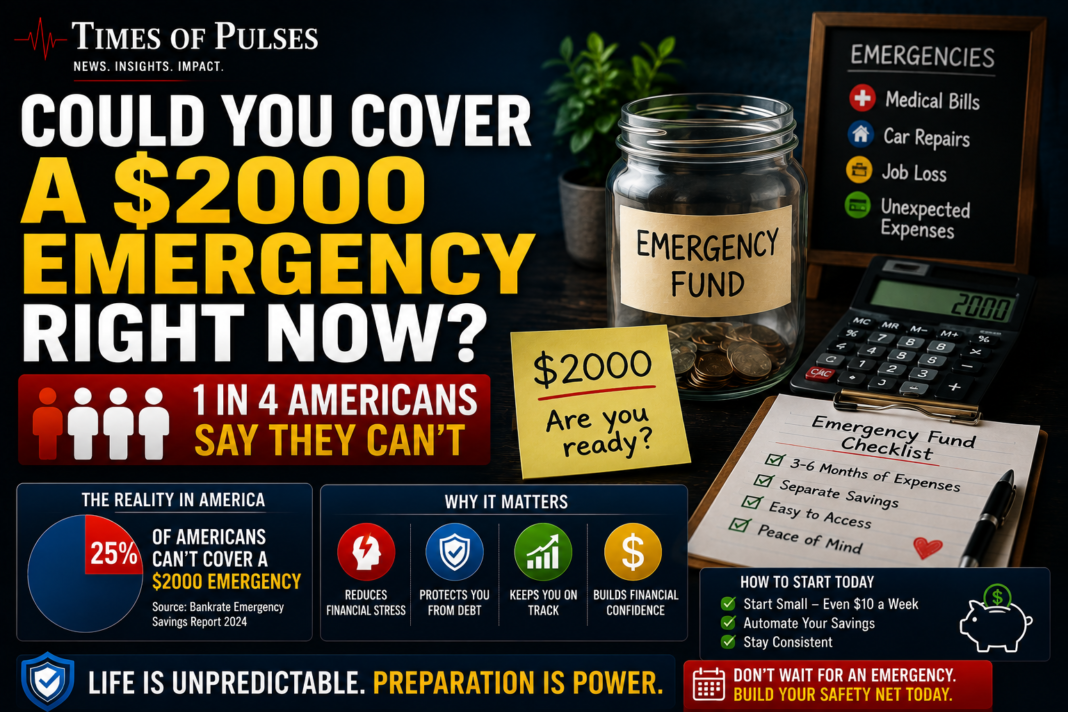
Could You Cover a $2000 Emergency Right Now? 1 in 4 Americans Say They Can’t
Here’s an uncomfortable question worth asking yourself honestly: if your car broke down tomorrow, or you had a sudden medical bill, could you cover a $2000 emergency without going into debt? According to new 2026 polling, a full quarter of Americans would say no — and another chunk aren’t confident either way. If that question made you pause even for a second, you’re far from alone, and understanding why this gap exists is the first step to closing it.
The Real Numbers Behind the $2000 Emergency Question
When Gallup specifically asked Americans about their confidence in handling a $2000 emergency, the answers revealed a genuine national vulnerability: only 36% said they’re “certain” they could cover it, 19% said they “probably could,” 13% said “probably could not,” and a striking 26% said they’re “certain they could not.” Add those last two groups together, and nearly 4 in 10 Americans are staring down real financial danger the moment an unplanned expense hits.
This isn’t a fringe problem. It’s showing up across nearly every measure of financial well-being right now. A record 55% of Americans say their financial situation is getting worse — the highest share since the Great Recession, according to Gallup’s annual survey. And 88% report feeling some form of financial stress heading into 2026, per polling from the National Endowment for Financial Education.
Why So Many People Are One Emergency Away From Trouble
A few forces are compounding at once to create this $2000 emergency gap:
Affordability concerns dominate everything else. Inflation and the high cost of living remain the single biggest financial worry for Americans, cited by a wide margin over every other concern — housing, healthcare, energy, and transportation costs are all squeezing the same monthly budget simultaneously, leaving less room to build a cushion.
Debt is quietly eating into people’s ability to save. 40% of households say paying down debt is their biggest anticipated expense this year, and 28% report specifically worrying about making minimum credit card payments — up from just 17% back in 2021. When more of your paycheck goes toward debt service, less is available to build the emergency fund that would prevent needing that debt in the first place.
Real income growth hasn’t kept pace. Median household income has seen minimal real growth once adjusted for inflation, while the cost of essentials — housing, food, transportation — has climbed steadily, shrinking the disposable income households would otherwise use to build savings.
Unexpected setbacks are common, not rare. 51% of U.S. adults report experiencing an unexpected money emergency within just the last five years, and that rate is substantially higher for households already carrying debt or raising children — meaning the people least equipped to handle a shock are also the most likely to face one.
Why This $2000 Number Specifically Matters
Financial experts frequently use the $2000 threshold because it represents a realistic, common emergency — a car repair, an ER visit copay, a broken appliance, or a plane ticket for a family emergency. It’s deliberately not an extreme, rare catastrophe; it’s the kind of expense most households will genuinely face within any given year or two. That’s exactly what makes the 26% “certain they could not” figure so significant: this isn’t about surviving something rare, it’s about handling something common.
What Happens When You Can’t Cover the Emergency
When a household can’t absorb a $2000 shock from savings, the money has to come from somewhere else, and the alternatives are almost always more expensive:
- Credit card debt at double-digit interest rates, turning a one-time $2000 expense into a much larger total cost over time if only minimum payments are made
- Borrowing from retirement accounts, which can trigger penalties and taxes while permanently reducing long-term compounding growth
- Payday loans or buy-now-pay-later services, both of which we’ve covered before as genuinely risky when used to cover essentials rather than planned purchases
- Selling assets at an inopportune time, sometimes at a loss, simply because cash is needed immediately
How to Actually Close Your Own $2000 Emergency Gap
- Start with a specific, smaller target, not the full amount at once. Building toward $500 first, then $1,000, then $2000, is far more sustainable than trying to save the whole cushion in one push. Progress, not perfection, is what actually gets households out of the “certain I could not” category.
- Automate a fixed amount every payday, even if it’s small. As we’ve discussed in our guide to building a portfolio from zero, automatic, consistent contributions reliably outperform sporadic, larger deposits that depend on remembering or having extra cash on hand.
- Keep this money genuinely separate and boring. A high-yield savings account, kept apart from your everyday checking account, reduces the temptation to dip into it for non-emergencies while still earning meaningful interest — we’ve covered specific current rate options in our guide to the best high-yield savings accounts.
- Attack high-interest debt in parallel, not instead of saving. Even a small emergency cushion, alongside a real debt payoff plan, prevents the cycle where every setback adds to the same credit card balance you’re trying to pay down.
- Treat windfalls as emergency fund fuel, not spending money. Tax refunds, bonuses, or unexpected extra income are some of the fastest ways to jump from “probably could not” to “certain I could,” without requiring any change to your regular monthly budget.
- Recalculate your actual number. $2000 is a useful national benchmark, but your real target should reflect your specific situation — someone with a car, dependents, or health conditions may reasonably need a larger cushion than someone without those specific risks.
What You Should Actually Do This Week
- Answer the $2000 question honestly for yourself — certain you could, probably could, probably couldn’t, or certain you couldn’t — and treat that answer as your real starting point
- Open a dedicated high-yield savings account if you don’t already have one specifically earmarked for emergencies
- Set one automatic transfer, even $25 a paycheck, rather than waiting until you feel you have “extra” money
- If debt is actively preventing you from saving, tackle your highest-interest balance first using a specific plan rather than a vague intention
Bottom Line
The fact that a quarter of Americans can’t confidently cover a $2000 emergency isn’t a personal failing — it reflects genuinely difficult, well-documented economic pressure hitting households from multiple directions at once: elevated costs, stagnant real income, and rising debt service. But the path out of the “certain I could not” category is remarkably consistent regardless of where you start: a specific target, an automatic contribution, and a separate account that stays untouched until you actually need it. The gap is real, but it’s also genuinely closeable, one automated deposit at a time.
This article is for informational purposes only and does not constitute financial advice. Consult a licensed financial advisor for guidance specific to your emergency savings and debt situation.