
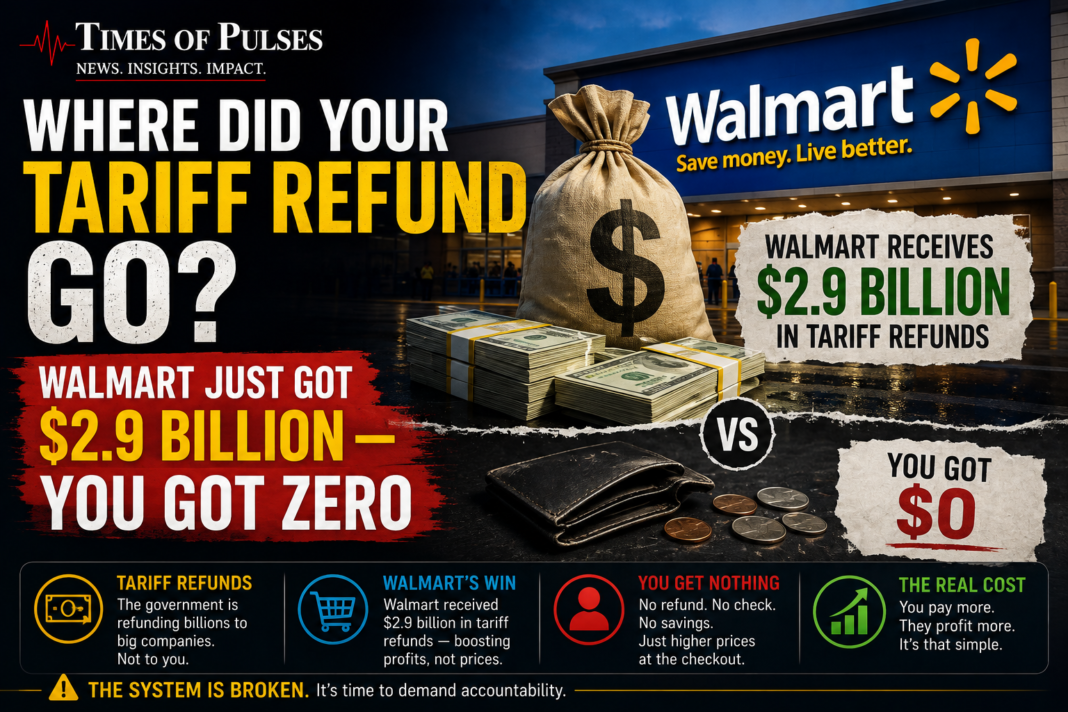
Where Did Your Tariff Refund Go? Walmart Just Got $2.9 Billion — You Got Zero
Remember paying more at the register over the past year because of tariffs? The companies that collected that money are now getting massive tariff refunds — Walmart alone just received $2.9 billion, the largest single tariff refund reported yet. If you’re wondering when your share is coming, the honest answer is uncomfortable: for most people, it isn’t. Here’s what’s actually happening with tariff refunds, and why the money is flowing one direction only.
The Scale of the Tariff Refunds Going Out Right Now
Following the Supreme Court’s February 2026 ruling that struck down the Trump administration’s sweeping IEEPA tariffs as illegal, the government has been processing refunds on the roughly $166 billion collected from over 330,000 importers. As of late July, approximately $100 billion had already been sent out, according to a Customs and Border Protection court filing.
The individual numbers are striking:
- Walmart: $2.9 billion — the largest refund reported to date
- Target: $994 million, which helped push net earnings to nearly $1.9 billion for the quarter
- Apple: an estimated $2.2 billion
- Amazon: approximately $640 million
- Ford: $1.3 billion
- General Motors: $500 million
- Home Depot: $730 million, with Lowe’s receiving $80 million
- TJX (parent of TJ Maxx, Marshalls, HomeGoods): $331 million
- Nike: approximately $300 million
- Stellantis (Jeep, Ram): roughly $467 million
These aren’t hypothetical figures — they’re showing up directly in corporate earnings reports this quarter, meaningfully boosting profits at exactly the companies that passed tariff costs onto shoppers in the first place.
Why Tariff Refunds Are Going to Companies, Not You
This is the core issue worth understanding clearly: tariffs are technically paid by the importer of record — the company bringing goods into the country — not directly by the end consumer. Even though the cost of those tariffs was largely passed through to shoppers via higher prices, the legal refund only goes back to whoever originally paid it at the border. As one CNN Business analysis put it, “in many cases, it’s nearly impossible to figure out how much of a company’s tariff refund came out of consumers’ pockets.”
Making this even messier, companies layered multiple rounds of tariffs on top of each other throughout 2025 and 2026 — some struck down by the Supreme Court, others still legally in effect. Even when a company raised prices, tracing exactly which tariff caused which price increase, and whether a given refund corresponds to money you personally paid, is genuinely close to impossible from the outside.
What Companies Are Actually Doing With Their Tariff Refund Money
Corporate responses to the refund windfall vary, and most aren’t putting cash directly back in your pocket:
Target has been explicit: CFO Jim Lee confirmed the company will not issue direct refunds to customers, instead using the money toward “bringing lower prices” across the store — including reductions on more than 10,000 items over the past year, according to the company.
Walmart and Costco have made similar commitments to use refund money to support pricing rather than issue direct payouts, with Costco CEO Ron Vachris saying the company would return value “in some form,” though specifics remain vague.
Amazon stands out as a genuine exception. The company said it has “identified a limited set of circumstances where we can trace that we passed specific import charges on to customers,” and committed to proactively refunding those specific customers directly — a narrower, more targeted approach than most retailers are taking.
Many companies have said little at all about how refund money will flow through to shoppers, simply reporting the earnings boost without committing to any pricing or refund action.
The Political Fight Brewing Over Tariff Refunds
This gap between corporate refunds and consumer relief has become a genuine midterm election issue. Senate Democrats introduced the Tariff Refund Act of 2026, which would require full refunds with interest directly to affected parties within 180 days, prioritizing small businesses. To date, that legislation hasn’t advanced, and experts caution Americans are “unlikely to see any cash” through this specific path, given the complexity of tracing individual harm.
Trump himself has floated the idea of a tariff “dividend” check funded by tariff revenue at various points, but there’s been no formal follow-through on that proposal.
What the Tariff Refund Gap Means for You Right Now
- Don’t expect a direct tariff refund check. Unless you specifically shopped through a retailer using a customs-broker shipping service (like some overseas purchases through FedEx or UPS, which have started passing along tariff refunds in narrow cases), a direct payment to you personally is unlikely.
- Watch for gradual price adjustments instead. If tariff refund money is genuinely funding “lower prices” as several major retailers claim, the more realistic benefit shows up as smaller price increases or modest cuts over time, not a lump-sum payment.
- Don’t assume tariff costs are fully gone. As we’ve covered in our reporting on the August 1 tariffs, the administration has already replaced the struck-down IEEPA tariffs with new ones under different legal authority (Sections 122 and 301), meaning the underlying cost pressure on many goods hasn’t actually disappeared.
- If you made a specific overseas purchase and used a shipping/customs broker, check your account. This is genuinely the one pathway where individual consumers have started seeing direct refund credits.
Bottom Line
The tariff refund story reveals an uncomfortable but predictable pattern: money moves easily between governments and large corporations with the legal standing and infrastructure to claim it, while the households who actually absorbed higher prices at checkout have no clear mechanism to get their share back. With companies like Walmart, Target, and Apple collectively pocketing billions in refunds this quarter, and most committing that money to future pricing strategy rather than direct consumer payouts, the most realistic outcome for most people is gradual, hard-to-trace relief at the register rather than any kind of refund check. Given how tangled the broader tariff picture remains heading into the rest of 2026, the smartest move is watching your actual receipts over time rather than waiting for a payment that, for most households, likely isn’t coming.
This article is for informational purposes only and does not constitute financial or legal advice. Tariff refund policy continues to evolve and is subject to ongoing litigation; consult official government sources for guidance specific to your situation.