
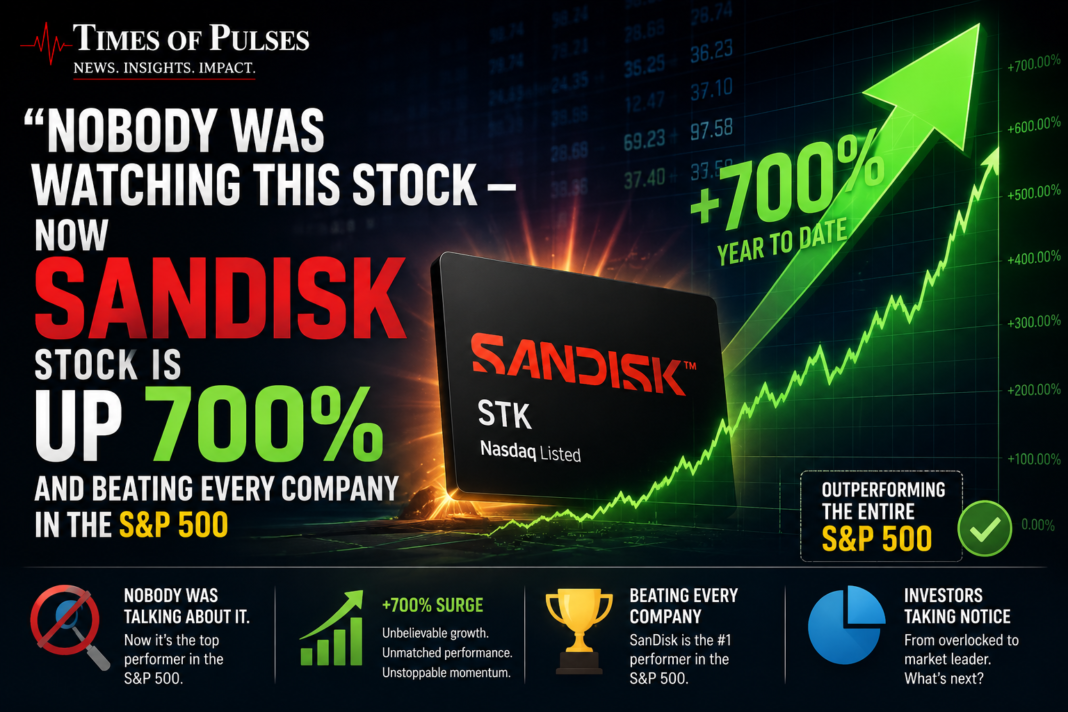
Nobody Was Watching This Stock — Now SanDisk Stock Is Up 700% and Beating Every Company in the S&P 500
While most investors have their eyes on Nvidia, Microsoft, and the usual AI headliners, one company most casual investors barely recognized a year ago has quietly become the best-performing stock in the entire S&P 500. SanDisk is up more than 700% in 2026, and this week’s investor day sent shares surging even further. Here’s the real story behind one of the most dramatic stock rallies of the year, and what it reveals about where AI spending is actually flowing.
The Numbers Behind SanDisk’s Rally
SanDisk shares surged 726% in the first half of 2026 alone, making it the top-performing stock in the S&P 500 — more than double the gain of the index’s second-best performer, Micron, which rose 266% over the same stretch. The momentum hasn’t slowed since. This week, shares jumped as much as 16% after the company’s investor day, where management laid out new long-term growth targets, before extending gains further on JPMorgan’s upgrade and Bank of America raising its price target to $2,500 from $2,100.
For context on just how unusual this move is: SanDisk stock climbed from around $1,214 on July 31 to above $1,528 by mid-August — a genuinely extraordinary run for a company that spun off from Western Digital as recently as February 2025.
What SanDisk Actually Does (And Why It’s Suddenly So Valuable)
SanDisk makes NAND flash memory and enterprise solid-state drives (SSDs) — the storage technology that holds the massive datasets AI systems need to function. As AI infrastructure has exploded in scale throughout 2026, demand for high-capacity, high-performance storage has surged right alongside demand for the processors getting most of the headlines.
JPMorgan analyst Harlan Sur summed up the core thesis clearly, noting SanDisk is uniquely positioned to capture what he called a “structural inflection in NAND demand driven by rapid growth in AI inference.” In plainer terms: as AI shifts from being trained to actually being used at scale, the storage requirements are proving just as critical a bottleneck as computing power itself.
The Investor Day That Reignited the Rally
This week’s surge specifically followed SanDisk’s investor day, where management unveiled a new business model built around multi-year customer agreements, continued technology innovation, and AI-driven data center growth. The company targets mid-to-high-teens revenue growth with 80% gross margins, alongside a substantially expanded share buyback program.
Perhaps most notably, management is explicitly trying to reposition what has historically been a highly cyclical, boom-and-bust business into something steadier and more predictable — a pitch that clearly resonated, given the stock’s reaction. SanDisk’s Q3 non-GAAP gross margin already hit 78.4%, and the company has guided for 79% to 81% in Q4, driven by rising prices and disciplined supply management rather than simply selling more units.
Why This Ripples Beyond SanDisk Itself
The reaction to SanDisk’s investor day extended well beyond its own stock. SanDisk’s partner Kioxia rallied in Tokyo, while SK Hynix posted strong gains in Seoul, as investors broadened their exposure to companies positioned to benefit from growing AI storage demand. This matters because it echoes a pattern we’ve tracked closely all year in the semiconductor and memory sector — from the earlier chip stock bear market to the dramatic swings tied to global memory supply chains.
The S&P 500 closed at a record high the same week, with the Nasdaq also advancing, suggesting SanDisk’s story is feeding into broader confidence about AI infrastructure spending rather than existing in isolation.
Should You Actually Buy SanDisk Stock?
As always, here’s the honest, non-hype answer rather than a recommendation:
The bull case: SanDisk has a debt-free balance sheet, high margins, strong cash generation, and a specific, well-articulated multi-year growth plan backed by real revenue results — its most recent quarter posted revenue of $5.95 billion, up 251% year-over-year, dramatically beating guidance of $4.4 to $4.8 billion.
The genuine risk: A stock up over 700% in roughly seven months has priced in enormous future expectations. Historically cyclical businesses like NAND memory have disappointed investors before when demand cycles turned, even when the underlying technology story remained intact. A stock trading at this kind of momentum can also see sharp, fast pullbacks if any single earnings report or guidance update disappoints, even slightly — a pattern we’ve seen repeatedly with other AI-linked names this year.
What This Means for Your Portfolio
- Don’t chase a 700% rally purely out of fear of missing out. By the time a stock’s momentum is this widely covered, professional investors have typically already priced in much of the known good news.
- Understand the difference between a strong company and a strong stock price. SanDisk’s fundamentals are genuinely impressive, but that doesn’t automatically mean the current valuation offers a good entry point — those are two separate questions.
- Watch for confirmation in the next earnings cycle. SanDisk’s next report will be the real test of whether this growth trajectory holds, similar to how we’ve watched other AI-infrastructure names prove or fail to prove their spending was translating into real revenue.
- If you already hold broad market or tech-sector index funds, you likely have some indirect exposure already given SanDisk’s now-significant weight in the S&P 500.
Bottom Line
SanDisk’s rise from a relatively obscure spinoff to the best-performing stock in the S&P 500 is a genuinely remarkable story, and it offers a clear real-world lesson: the AI infrastructure boom isn’t only rewarding the companies making headlines — it’s flowing into the less glamorous layers of the supply chain, like memory and storage, that turn out to be just as critical. Whether SanDisk can sustain this momentum depends on execution against genuinely ambitious targets, but for now, it stands as one of 2026’s clearest examples of how quickly market leadership can shift toward companies most investors weren’t watching closely a year ago.
This article is for informational and educational purposes only and does not constitute investment advice or a recommendation to buy or sell any security. Stock market movements are unpredictable, and past performance does not guarantee future results; consult a licensed financial advisor before making investment decisions.