
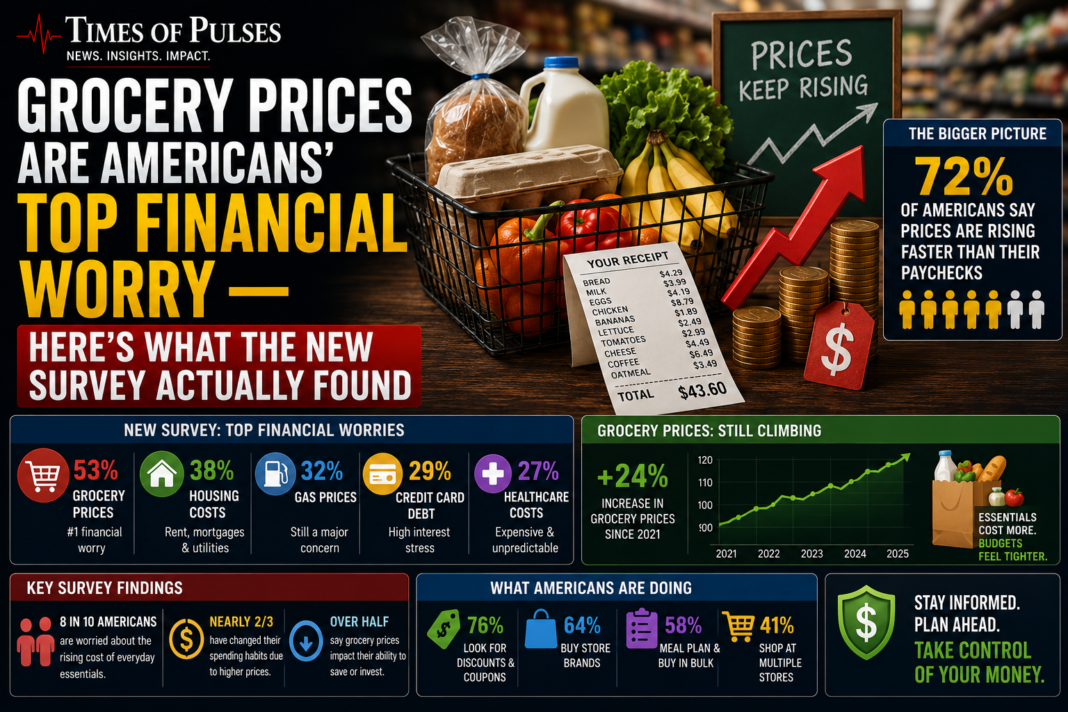
Grocery Prices Are Americans’ Top Financial Worry — Here’s What the New Survey 2026 Actually Found
Forget housing, gas, or healthcare — when Americans are asked what’s actually stressing their wallet the most right now, one answer keeps coming out on top: the grocery store. Multiple 2026 surveys, from different research groups using different methodologies, have all landed on the same conclusion. Here’s what the data actually shows, why groceries specifically hit harder than other rising costs, and what you can realistically do about it.
The Numbers Behind Grocery Prices as Americans’ Top Financial Worry
The consistency across separate surveys this year is genuinely striking. KeyBank’s 2026 Financial Mobility Survey found that 58% of respondents cited grocery prices as their top financial concern, well ahead of housing costs at 44% and healthcare expenses at 30%. A separate survey from The Kitchen Table Project, conducted by Global Strategy Group among 1,100 registered voters, found 63% cited groceries as their top financial pressure — compared to just 36% for housing, 33% for gasoline, and 29% for utilities.
Nearly 9 in 10 Americans (88%) say they’ve adjusted their financial behavior specifically in response to rising costs, and 67% say the overall cost of living is placing significant pressure on their household, according to the same research.
Why Grocery Prices Hit Differently Than Other Rising Costs
It’s worth understanding why groceries specifically top the list, even when housing and healthcare costs are also climbing. Food is unavoidable, recurring, and highly visible in a way other expenses aren’t. You can delay a car repair or negotiate a rent renewal, but you can’t skip eating, and you see the price every single week at checkout. That visibility makes grocery inflation feel more immediate and painful than costs that show up less frequently, like an annual insurance premium or a mortgage rate.
The actual price data backs up the frustration: food-at-home prices have increased more than 30% since January 2020, and are up roughly 25% over just the past five years, according to Urban Institute research. Fruit and vegetable prices specifically rose 5.3% over the past year alone, per Bureau of Labor Statistics data, with meat and poultry singled out repeatedly across surveys as the most painfully unaffordable category.
What’s Actually Driving Grocery Prices Higher
When surveyed about the cause, Americans point to a mix of factors, and they’re not entirely wrong:
- Tariffs and trade restrictions were cited most often (48%) as a driver of higher costs
- Corporate pricing practices were a close second (46%), with many respondents believing companies have raised prices to increase profits beyond what rising input costs alone would justify
- Supply-side shocks have compounded over recent years — the pandemic, avian influenza outbreaks affecting egg and poultry supply, drought affecting crop yields, and geopolitical disruptions to fertilizer and diesel costs tied to the ongoing Middle East conflict we’ve covered extensively this year
Notably, 67% of Americans say current grocery prices are simply “unfair,” and 82% believe elected officials have the power to bring costs down if they choose to act — reflecting genuine, bipartisan frustration that crosses party lines.
How Households Are Actually Coping (And Where It’s Getting Risky)
The survey data reveals some genuinely concerning coping patterns. A separate Urban Institute analysis found that many families are turning to credit to manage grocery costs: about 35% of adults paid for groceries with a credit card and paid the bill in full, which is a manageable habit. But another 20% used a credit card and carried a balance, and 8.7% didn’t even make their minimum payment consistently — meaning grocery costs are now directly feeding into the credit card minimum payment trap we’ve covered in detail before, where average APRs run above 20%.
Beyond credit, roughly 1 in 3 families report buying less produce specifically, according to a separate survey from Advance America, raising real questions about nutrition trade-offs as households stretch tighter budgets.
Why This Likely Isn’t Ending Soon
Unfortunately, the forward-looking data isn’t especially reassuring. Three-quarters of middle-income Americans expect grocery prices to keep climbing over the next six months, according to Primerica’s Q1 2026 survey, and the USDA itself projects food-at-home prices will rise another 2.8% in 2026. The next official Consumer Price Index reading, covering July data, is due August 12 — worth watching closely given how central grocery costs have become to this inflation conversation.
How to Actually Manage Rising Grocery Costs
- Shift your credit card grocery spending to a card you pay in full monthly. If groceries are pushing you toward carrying a balance, that’s a sign to revisit your overall budget rather than let a recurring necessity quietly become expensive debt.
- Focus savings efforts on the specific categories driving the pain. Since meat, poultry, and produce are repeatedly flagged as the most painful categories, look specifically at bulk buying, store brands, or seasonal produce in those areas rather than trying to cut broadly across your entire grocery list.
- Track your actual grocery spending trend, not just individual trip totals. Comparing month-over-month spending helps you see whether your household is keeping pace with the roughly 3% year-over-year food inflation, or falling further behind.
- Build grocery cost volatility into your broader budget, the same way we’ve suggested building flexibility for gas prices and tariff-driven price increases this year — groceries deserve the same buffer treatment given how consistently they’re outpacing general inflation.
- Watch the August 12 CPI report specifically for the food component, since another notable increase would confirm this pressure is continuing rather than easing.
What You Should Actually Do This Week
- Review your last three months of grocery receipts to identify which specific categories are driving your own cost increases
- Check whether grocery spending is contributing to a credit card balance you’re not paying off in full, and treat that as a genuine budget priority to address
- Compare store brand alternatives specifically in the meat, poultry, and produce categories most surveys flag as the biggest pain points
- Build a specific grocery buffer into your monthly budget rather than treating each price increase as a surprise
Bottom Line
Grocery prices topping Americans’ list of financial worries isn’t a matter of perception — it’s backed by consistent data across multiple independent surveys, real price increases exceeding 25-30% over recent years, and forward-looking expectations that costs will keep climbing. The visible, unavoidable, weekly nature of grocery spending makes this pressure feel more immediate than other rising costs, even ones that may cost more overall. Understanding which specific categories are driving your own household’s increase, and building genuine budget flexibility around it, is a more effective response than waiting for prices to simply come back down.
This article is for informational purposes only and does not constitute financial advice. Consult a licensed financial advisor for guidance specific to your household budget.