
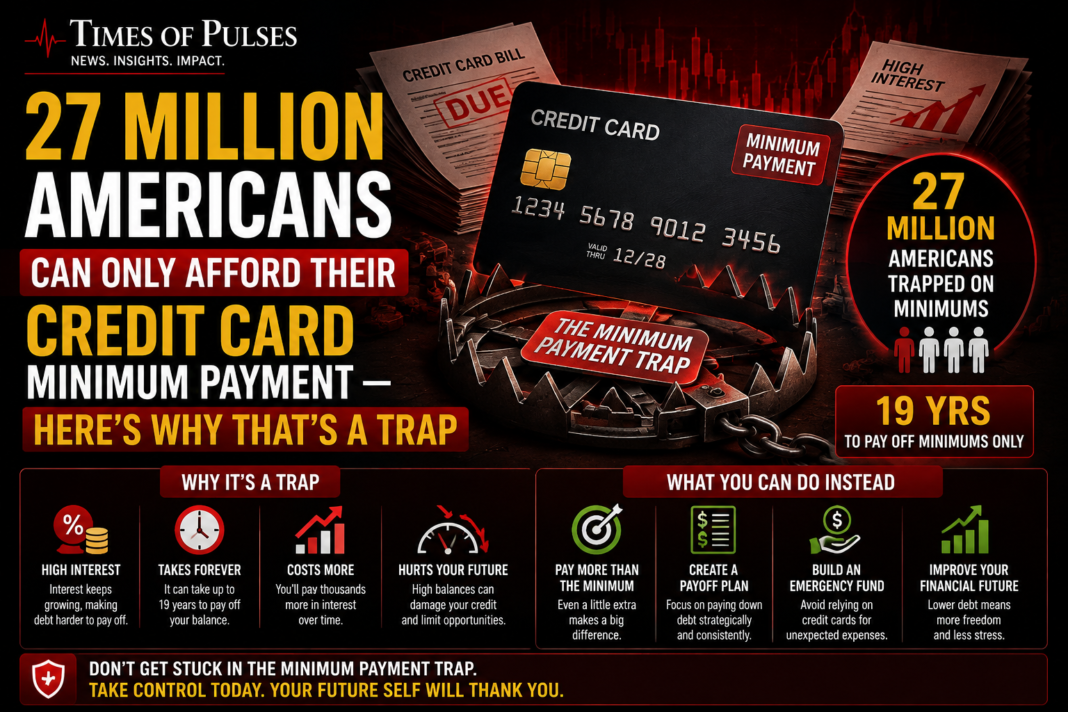
27 Million Americans Can Only Afford Their Credit Card Minimum Payment — Here’s Why That’s a Trap
Here’s a number worth sitting with: more than 27 million Americans can currently only afford to make the minimum payment on their credit cards. If that’s you, or someone in your family, you’re not failing at money management — you’re caught in a mathematically brutal trap that even financial experts say most people misunderstand. Here’s exactly why the credit card minimum payment trap works against you, and a real way out.
The Scale of the Credit Card Minimum Payment Problem
According to a March 2026 report from The Century Foundation and Protect Borrowers, roughly 111 million Americans — about half of all active cardholders — now carry a credit card balance from month to month, up 17% from just five years ago. Of that group, more than 27 million can only afford the credit card minimum payment each month, not a dollar more.
The Consumer Financial Protection Bureau’s own data confirms this is a genuine, worsening trend: 15% of general-purpose cardholders made only the minimum payment in 2024, the highest share recorded since at least 2015. Separately, the Federal Reserve Bank of Philadelphia found that over 11% of accounts at the country’s largest banks were minimum-payment-only in the fourth quarter of 2024 — also a 12-year record.
Why the Credit Card Minimum Payment Feels Responsible (But Isn’t)
This is the part most people genuinely don’t understand: an Experian survey found that 40% of Americans mistakenly believe making the credit card minimum payment is an effective debt management strategy. It feels responsible — your account stays current, you avoid late fees, and no one calls you about collections. But the math tells a very different story.
Take a real example: a $10,000 balance at 20% APR, making only minimum payments, takes 19 years to pay off and costs $21,600 total — more than double the original balance. On a $15,000 balance at 22% APR, if the minimum payment is $300 a month, roughly $275 of that goes straight to interest, leaving just $25 a month actually reducing what you owe.
This is exactly why so many people describe minimum payments as “paying but not getting anywhere” — because mathematically, that’s almost exactly what’s happening.
Why This Is Getting Worse Right Now
A few forces are compounding to push more people into the credit card minimum payment trap specifically in 2026:
Interest rates remain elevated. The average APR across all credit card accounts sat at 20.97% in the most recent quarter, with new card offers averaging even higher at 23.72%. The CFPB found private-label card APRs reaching 31.3% — the highest level recorded since tracking began.
Total debt has hit a record high. Total U.S. credit card debt exceeded $1.17 trillion in early 2026, and Americans paid an estimated $181 billion in credit card interest in 2025 alone — more than double the $75 billion paid just four years earlier.
Income pressure is squeezing the same households from multiple directions. As we’ve covered in our reporting on rising housing costs and paychecks under pressure this year, the same economic squeeze pushing people toward credit cards in the first place is also making it harder to pay down what they’ve already borrowed.
The gap is worse for younger and lower-income households. Bankrate’s 2026 survey found 56% of cardholders earning under $50,000 annually carry debt month to month, and nearly 45% of college students using credit cards report paying only the minimum.
The Real Cost of the Credit Card Minimum Payment Habit
Beyond the raw math, staying on minimum payments carries compounding risks:
- 19% of credit card debtors are specifically worried they might not be able to make even the minimum payment at some point in the next six months, according to Bankrate’s 2026 survey
- 22% believe they will never get out of credit card debt at all — a genuinely alarming sign of how trapped this pattern can feel
- Every dollar spent servicing old debt is a dollar unavailable for building the emergency fund we discussed in our recent coverage of the $2000 emergency fund gap, creating a cycle where new financial shocks just add to the same growing balance
How to Actually Break Out of the Credit Card Minimum Payment Trap
- Pay anything above the minimum, even small amounts. On that $15,000 example above, bumping your payment from $300 to $400 a month dramatically cuts both your payoff timeline and total interest paid, since more of each payment starts attacking principal instead of just covering interest.
- Use the avalanche or snowball method deliberately, rather than spreading small extra payments randomly across multiple cards. Our full guide on how to pay off credit card debt fast walks through both approaches in detail, including which one fits different situations.
- Look into a balance transfer card if your credit qualifies. Moving a high-interest balance to a 0% introductory APR card, even temporarily, means every payment goes toward principal instead of interest during that window.
- Consider a debt consolidation loan for genuinely overwhelming balances. Combining multiple high-APR cards into one fixed-rate loan, often well below 20%, can meaningfully cut what you’re paying in interest each month.
- Contact a nonprofit credit counselor if minimum payments themselves feel unaffordable. Agencies affiliated with the National Foundation for Credit Counseling can sometimes negotiate lower rates through a structured debt management plan, without the credit damage that debt settlement carries.
- Stop new charges on cards you’re actively paying down. Every new purchase on a card carrying a balance immediately starts accruing interest, actively working against the progress you’re making.
What You Should Actually Do This Week
- Calculate what you’re actually paying in interest on your current balances using your card’s APR and balance — seeing the real number is often the push needed to pay more than the minimum
- Identify your highest-APR card first and prioritize extra payments there, regardless of which balance is largest
- Check if you pre-qualify for a balance transfer card without a hard credit inquiry, which most major issuers now allow
- If you’re among the 19% worried about missing even a minimum payment, contact your card issuer proactively — many have hardship programs that are far better than defaulting
Bottom Line
The credit card minimum payment trap catches 27 million Americans not because they’re careless with money, but because minimum payments are specifically structured to feel responsible while barely denting the actual debt. Understanding the real math — how little of each minimum payment actually reduces what you owe — is the first step toward escaping it. The good news: even modest extra payments, applied strategically, can cut years off your payoff timeline and thousands off your total interest, without needing a dramatic change in your monthly budget.
This article is for informational purposes only and does not constitute financial advice. Consult a licensed financial advisor or nonprofit credit counselor for guidance specific to your debt situation.