
Recession 2026 Warning Signs: 7 Red Flags Economists Are Watching Right Now
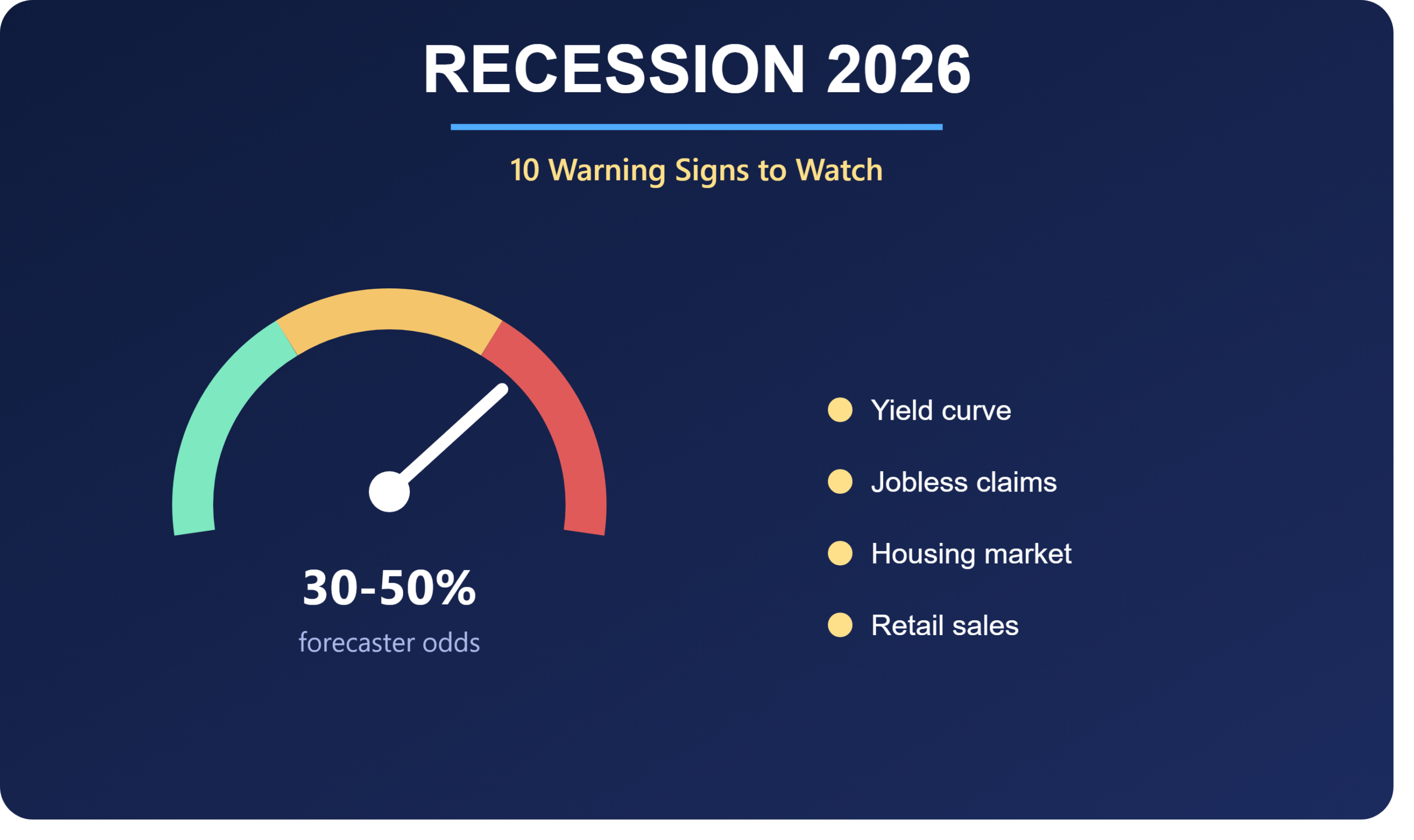
Recession 2026 has gone from a fringe worry to a genuine, widely-discussed possibility among major financial institutions. JPMorgan, Goldman Sachs, Moody’s, and the IMF now put recession odds somewhere between 30% and 50% — not a certainty, but no longer a tail risk you can safely ignore either. If you’ve felt like the economy sends mixed signals depending on who you ask, that’s because it genuinely does right now. Here’s a clear walk through the actual indicators economists track, where each one currently stands, and a realistic plan for preparing your finances regardless of which way this goes.
Why Recession 2026 Predictions Vary So Widely
Before diving into the indicators, it’s worth understanding why estimates range so much. Recession 2026 probability estimates differ because forecasters weigh different data differently — some lean heavily on market valuations, others on labor market softness, others on consumer spending trends. According to recent economic analysis, Wall Street and “Main Street” also seem to be experiencing genuinely different economies right now: stock markets have hit fresh highs and corporate profits remain healthy in many sectors, while ordinary households navigating grocery aisles and gas stations report elevated prices and real financial strain. Both realities are true simultaneously, which is part of why the recession 2026 conversation feels so contradictory.
The 10 Real Indicators Economists Actually Track
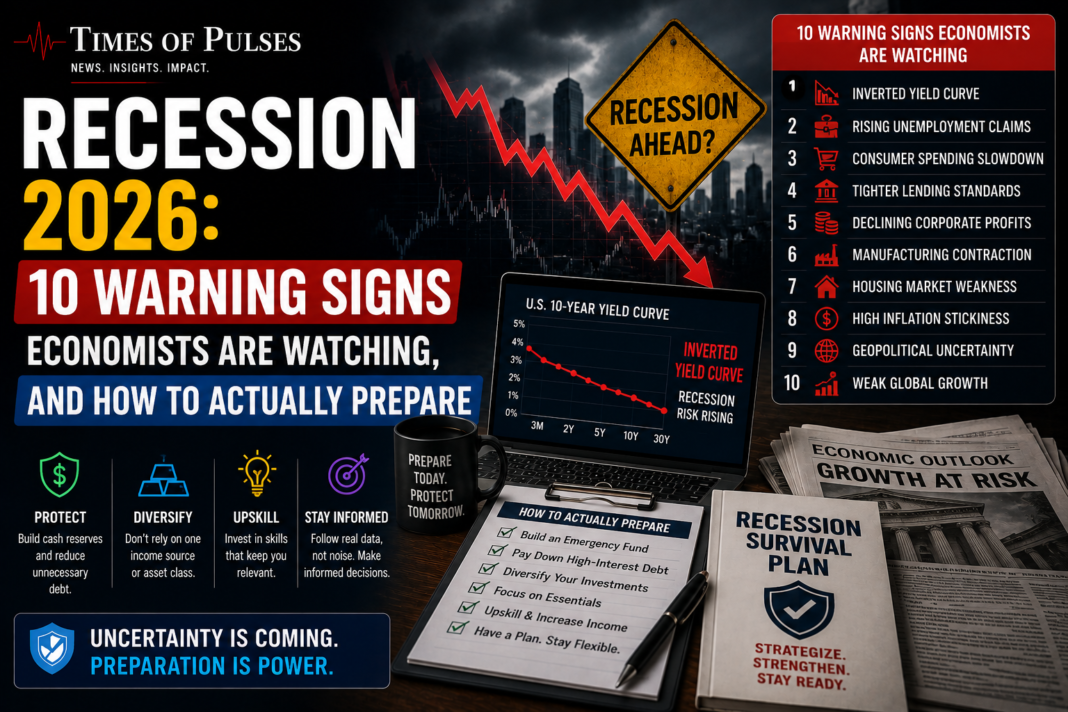
1. The Yield Curve (and Its “Un-Inversion”)
Seven of the last seven U.S. recessions were preceded by an inverted yield curve, where short-term Treasury yields exceed long-term yields. The curve inverted back in 2022 and stayed inverted into 2024. Notably, it’s the “un-inversion” — when the curve steepens back to normal — that has historically preceded the actual onset of recession 2026-style downturns by three to six months, making this both a warning signal and a timing indicator worth watching closely right now.
2. Initial Unemployment Claims
This is one of the most timely labor market signals available, reported weekly with minimal revision. A sustained rise above 250,000-300,000 claims per week has preceded past recessions. As of recent data, claims sit in the 210,000-230,000 range — still in healthy territory, though this is exactly the kind of number worth checking regularly given how quickly it can shift.
3. ISM Manufacturing and Services PMI
These purchasing manager surveys measure new orders, production, and employment across the economy. A reading below 50 signals contraction, and readings below 45 for three or more consecutive months have preceded every recession since 1970. The manufacturing PMI has spent extended periods below 50 recently, though the larger services sector has mostly stayed in expansion — a genuine split that mirrors the broader mixed-signal economy.
4. Consumer Confidence
Sharp drops of 20 or more points over three months have historically preceded downturns, since consumers who feel pessimistic cut spending, which itself can help trigger the recession 2026 forecasters are worried about — a self-reinforcing cycle worth watching.
5. Rising Unemployment Rate Trend
A recession signal specifically triggers when the three-month moving average of unemployment rises 0.5 percentage points above its 12-month low — a more nuanced read than just watching the headline unemployment number alone.
6. Housing Market Weakness
Housing represents roughly 15% of GDP, and steep drops of 30% or more in housing activity often precede or coincide with recessions. As we’ve covered in our reporting on 2026 housing costs, affordability has already declined for months running — a sector economists are watching closely.
7. Corporate Earnings and Profit Margins
Two consecutive quarters of declining margins often signal broader economic weakness. Right now, this presents another split picture: AI-driven tech stocks have kept valuations elevated, but a broad swath of the economy — retail, manufacturing, small business — is reporting shrinking margins beneath the surface.
8. Credit Spreads
Widening spreads between corporate bonds and Treasury yields, particularly above 5%, signal stress in credit markets — a pattern that showed up before both the 2008 and 2020 downturns.
9. Declining Real Retail Sales
Three consecutive months of declining inflation-adjusted retail sales is considered a genuine warning sign, since it reflects actual household purchasing power shrinking, not just nominal spending shifts.
10. Labor Market “Pre-Signals”
Beyond the unemployment rate itself, economists watch job openings (down significantly from their 2022 peak), temporary employment (which tends to fall before permanent layoffs begin), hiring freezes spreading across tech, finance, and professional services, and average hours worked per week trending down — since companies typically cut hours before they cut headcount. The problem: the labor market is a lagging indicator, meaning by the time jobs data turns clearly negative, a recession has often already started.
Two Extra Warning Signs Specific to Recession 2026
Beyond the classic 10 indicators, two factors are uniquely elevated in the current recession 2026 conversation:
Stretched valuations. The Buffett Indicator, which measures total U.S. stock market value against GDP, currently sits around 213% — above even the 193% peak seen in 2021. Warren Buffett himself once said readings approaching 200% mean investors are “playing with fire.”
Geopolitical and energy risk. As we’ve tracked extensively this year, oil prices have swung dramatically amid Iran-related tensions, at one point topping $108 a barrel. Countries with heavy oil import dependence — Japan, South Korea, and Taiwan — have seen some of the sharpest equity declines tied to this risk, compounding the volatility we’ve also seen in chip stocks this year.
Why the 2026 vs. 2027 Debate Matters
Interestingly, some Wall Street analysis suggests recession risk may actually be higher for 2027 than for 2026 itself. Strong corporate earnings, resilient hiring, and hopes for diplomatic resolution on the Iran conflict have helped calm the sharpest fears for this year specifically. But rising debt costs — as companies that refinanced pandemic-era debt at 1-2% now face renewal at 5-6% — combined with elevated living expenses and the ongoing threat of an oil shock, could mean the pressures building now take longer to fully surface.
How to Actually Prepare Your Finances (Regardless of Timing)
The honest truth about recession 2026 forecasting: you don’t need to predict the exact year a downturn arrives. You just need to prepare for the possibility, using steps that make sense whether or not a recession actually materializes:
- Build or top up your emergency fund. As we’ve discussed in our guide to the best high-yield savings accounts, keeping 3-6 months of expenses in an accessible, interest-earning account gives you a genuine buffer if hiring slows or hours get cut.
- Pay down high-interest debt now, while you have income stability. Credit card debt becomes significantly harder to manage if your income drops unexpectedly — our guide on how to pay off credit card debt fast walks through the specific strategies that work fastest.
- Don’t panic-sell your investments based on recession headlines. Market timing is notoriously difficult even for professionals, and the same volatility we’ve tracked all year — from the chip stock selloff to Microsoft’s record rebound just days later — shows how quickly sentiment can reverse in either direction.
- Focus on quality over speculation in your portfolio. Companies with durable cash flow and real earnings tend to weather downturns better than speculative, story-driven stocks.
- Keep your job skills and network active, given that hiring freezes and reduced hours often show up before headline layoffs do.
- Watch your own personal “recession indicators.” Are your hours being cut? Is overtime disappearing? Are raises smaller than usual, something we’ve covered in our reporting on paychecks under pressure this year? Your own household data often tells you more than any national statistic.
What You Should Actually Do This Week
- Check your emergency fund against 3-6 months of actual expenses, not just a round number that feels comfortable
- List your highest-interest debts and prioritize paying them down while your income is stable
- Resist the urge to make dramatic portfolio changes based on recession headlines alone — read the underlying indicators, not just the probability percentage
- Track your own household’s early warning signs — reduced hours, hiring freezes at your employer, or smaller-than-expected raises — since these often arrive before official recession data confirms anything
Bottom Line
Recession 2026 sits in a genuinely uncertain zone — a 30-50% probability range according to major forecasters isn’t a prediction of doom, but it’s far too significant to ignore. The most useful approach isn’t trying to perfectly time when or whether a downturn arrives; it’s building the same financial resilience — an emergency fund, manageable debt, and a diversified, quality-focused portfolio — that serves you well whether the economy avoids a recession entirely or heads into one sooner than expected. Historically, some of the best buying opportunities have appeared long before headlines finally admit trouble has arrived, which is exactly why preparation beats prediction.
This article is for informational and educational purposes only and does not constitute financial or investment advice. Economic forecasts are inherently uncertain and vary significantly across institutions; consult a licensed financial advisor for guidance specific to your situation.