
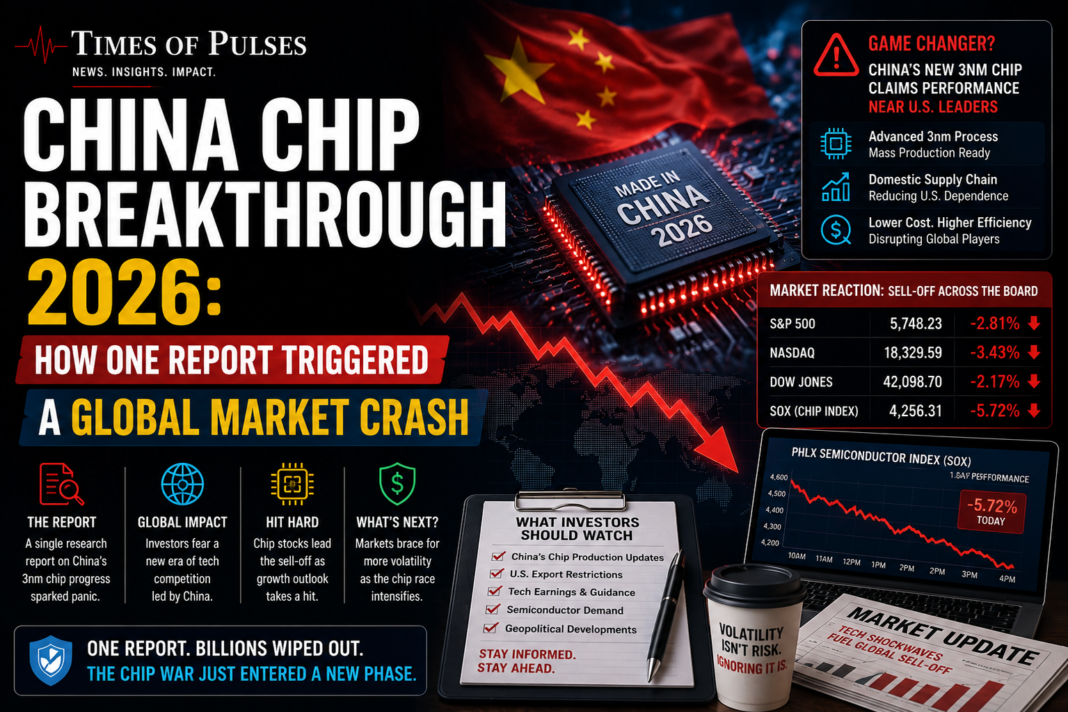
China Chip Breakthrough 2026: How One Report Triggered a Global Market Crash
Rarely does a single piece of news move markets on four different continents in the same 48 hours — but that’s exactly what happened this week. The China chip breakthrough 2026 story sent Nvidia, Samsung, SK Hynix, and chip equipment makers in the Netherlands all tumbling together, wiping hundreds of billions of dollars off global markets. Here’s what actually happened, why it genuinely matters worldwide, and what it means for your portfolio.
What Actually Happened
According to reports first surfaced by tech publication The Information, Chinese state-owned company Shanghai Yuliangsheng has begun mass-producing deep ultraviolet (DUV) lithography machines — the critical equipment needed to manufacture advanced microchips used in AI systems. Separately, Chinese memory chip maker CXMT went public on the A-share market with a valuation that topped the entire Chinese stock exchange on debut.
The China chip breakthrough 2026 story matters because DUV lithography equipment has historically been dominated by a small handful of companies, mainly in the Netherlands and Japan, with export restrictions specifically designed to keep this technology out of Chinese hands. If China has genuinely closed that gap faster than expected, it fundamentally challenges the “scarcity pricing” that has supported premium valuations for Korean and Taiwanese chipmakers for years.
How the China Chip Breakthrough 2026 Rippled Across the Globe
The scale of the reaction is genuinely rare in modern markets:
- South Korea: The Kospi index collapsed nearly 11% in a single session, its worst one-day decline since the early days of the U.S.-Iran conflict in March, and on track for its worst month since 1997. Samsung Electronics posted its worst single-day fall in almost two decades, dropping 13.4%, while SK Hynix fell 14.7% — the two companies together make up nearly half the entire Kospi index.
- Japan: The Nikkei sank more than 4%, with flash memory maker Kioxia Holdings plunging 18.3%.
- Taiwan: The Taiex index fell over 4%, with chip designer MediaTek dropping nearly 10%.
- The Netherlands: Chip equipment makers ASM International and BE Semiconductor — companies whose entire business model depends on controlling this exact lithography technology — fell 7% and nearly 10% respectively.
- The United States: Nvidia dropped 5% on the prior trading day alone, wiping out $250 billion in market value, while rivals Sandisk and AMD fell 11% and 5%.
Samsung and SK Hynix have now fallen almost 50% from the all-time highs they hit just last month — an extraordinary reversal for stocks that had been powering South Korea’s entire market rally for most of 2026.
Why This Is About More Than Just Chips
The China chip breakthrough 2026 reaction reveals something important about how fragile this year’s AI-driven rally had become. As Stephen Innes of SPI Asset Management explained, the AI trade has been behaving like a flywheel: rising stock prices encouraged more spending, that spending validated higher earnings expectations, and those expectations pushed valuations even higher. This selloff shows that same flywheel can just as easily spin in reverse.
Adding to the unease, Nvidia’s own disclosure of $750 billion in AI infrastructure deals fanned separate concerns about how much of the AI boom is being financed through debt and complex financing arrangements rather than straightforward demand — a worry we’ve touched on before in our coverage of AI stock volatility this year.
This Extends a Pattern We’ve Been Tracking All Month
If this feels familiar, it should — we’ve covered the semiconductor sector’s volatile stretch multiple times this year, from the initial bear-market decline to the brief recovery that followed. The China chip breakthrough 2026 story is the latest, and so far the sharpest, chapter in that ongoing tension between AI infrastructure optimism and genuine questions about whether current valuations can hold.
What Regulators Are Already Doing
South Korea’s Financial Services Commission is reportedly considering tighter leverage controls specifically to help stabilize market sentiment — a sign of how concentrated, and therefore fragile, Korea’s equity market has become around a small handful of AI-linked semiconductor names.
What This Means for Your Portfolio
- Don’t assume this reflects collapsing AI demand. Analysts specifically note this isn’t a sign that chip demand has disappeared or that tech giants are abandoning AI infrastructure spending — it reflects a repricing of how much investors are willing to pay for that story today.
- Understand your concentration risk. If you hold individual positions in Samsung, SK Hynix, Nvidia, or similar AI-linked names, this is a real-world example of how concentrated a “hot theme” portfolio can become, and how quickly sentiment can reverse.
- Watch this week’s Big Tech earnings closely. Results from Microsoft, Amazon, Apple, and Meta this week will offer a genuine read on whether AI infrastructure spending guidance holds steady despite this volatility.
- Remember geographic diversification matters too. This selloff shows how interconnected global chip supply chains are — a story originating in China rippled through Korea, Japan, Taiwan, the Netherlands, and the U.S. within days.
What You Should Actually Do This Week
- Avoid panic-selling based on a single dramatic news cycle, especially if your original investment thesis for any specific company hasn’t fundamentally changed
- Check your actual exposure to concentrated AI/semiconductor names, whether through individual stocks or sector-heavy funds
- Watch for confirmation in upcoming earnings calls, not just the initial price reaction, to understand whether this is sentiment-driven or reflects a genuine competitive shift
- Keep perspective on position sizing in any single volatile sector, regardless of how compelling the long-term story sounds
Bottom Line
The China chip breakthrough 2026 story is a genuinely rare example of a single technological development shaking markets across four continents simultaneously. Whether this marks a lasting shift in the global chip industry’s competitive balance, or an overreaction that fades as details become clearer, will likely become apparent over the coming weeks as more analysis and company responses emerge. For now, it’s a powerful reminder of just how much of this year’s market gains have rested on a narrow set of AI-linked names, and how quickly that concentration can cut both ways.
This article is for informational and educational purposes only and does not constitute investment advice or a recommendation to buy or sell any security. International stock market movements are unpredictable and can shift rapidly; consult a licensed financial advisor before making investment decisions.