
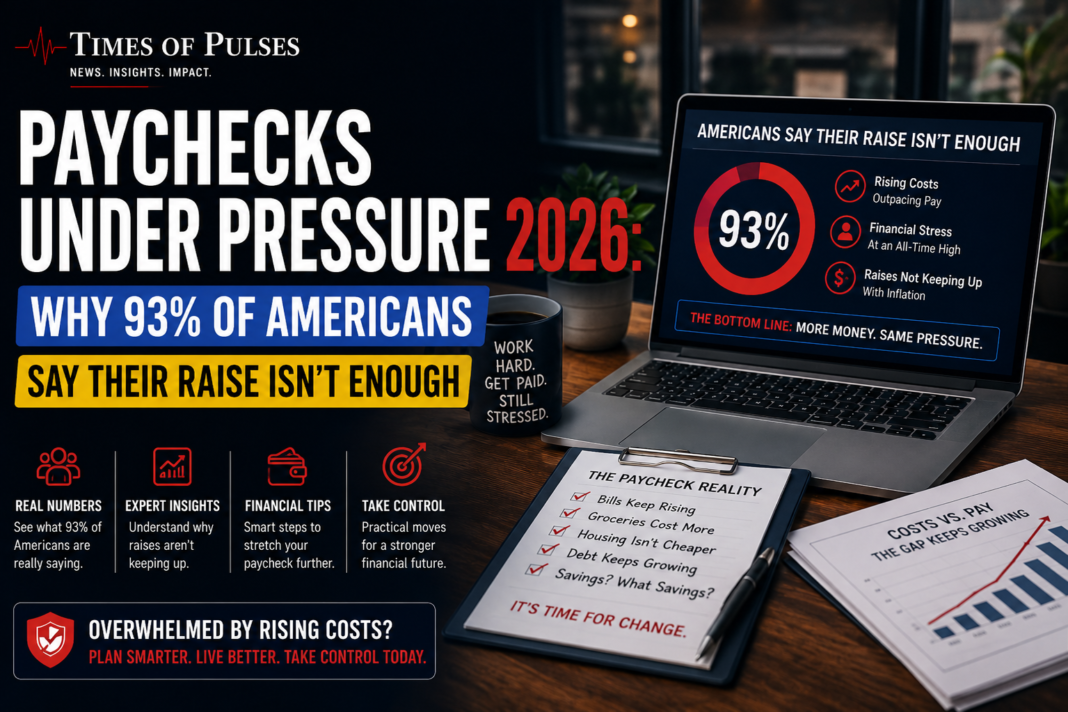
Paychecks Under Pressure 2026: Why 93% of Americans Say Their Raise Isn’t Enough
If your paycheck feels like it’s stretching less than it used to, the data backs you up. Paychecks under pressure 2026 is now a defining financial story, with a new Monster survey finding that 93% of workers say their pay isn’t keeping up with the cost of living — a number that’s barely moved in three years. Here’s what’s actually happening with wages this year, and what you can realistically do about it.
The Numbers Behind Paychecks Under Pressure 2026
According to Monster’s 2026 Cost of Living Report, only 7% of workers received an inflation-related pay bump this year — continuing a steady decline from 9% in 2025 and 11% in 2024. Even more telling: paychecks under pressure 2026 isn’t just a feeling. Bureau of Labor Statistics data confirms that annual inflation-adjusted average hourly wage growth turned negative earlier this year for the first time since April 2023, ending a three-year streak where worker pay had actually been outpacing inflation.
There was a brief bright spot in June, when real wages rose 0.8% — the best one-month gain in over a year. But that improvement came from falling gas prices, not stronger paychecks, and with oil prices climbing again amid renewed Iran-related tensions, that relief may not last into the next report.
Why Paychecks Under Pressure 2026 Is Hitting Frontline Workers Hardest
The pain isn’t distributed evenly. Production and nonsupervisory workers — roughly four-fifths of private payrolls — saw their real hourly earnings rise 0.8% in June too, but their real weekly earnings rose less, just 0.6%, because their average workweek actually shrank slightly. Over the full past year, this group’s real hourly earnings are still down 0.1%, meaning the typical frontline worker has lost ground compared to a year ago, even with the recent monthly improvement.
Why Employers Aren’t Keeping Pace
A few structural reasons explain why paychecks under pressure 2026 has become so widespread:
- Salary budgets have gone flat. According to Payscale, U.S. salary budget increases are expected to hold at 3.5% in 2026 — barely changed from 2025 — as employers face their own cost pressures and economic uncertainty.
- More employers are actively cutting pay budgets than raising them. Over one-fifth of employers reported decreasing their pay budgets this cycle, citing cost management, weak financial results, and inflationary pressure on their own operations.
- The labor market has cooled. As hiring has slowed, workers have less leverage to negotiate raises or switch jobs for better pay than they did during the tighter labor market of recent years.
The Ripple Effect on Savings and Job Searching
Monster’s data reveals a genuinely difficult bind: while many workers say they’re actively searching for higher-paying roles because their current pay isn’t enough, few report actually landing one. This is squeezing household finances from multiple directions — separate CNBC reporting found Americans’ savings rate has fallen to its lowest level since 2022, as inflation continues outpacing paychecks and essentials like groceries, utilities, and gas eat further into monthly budgets.
What You Can Actually Do About Paychecks Under Pressure 2026
- Know your actual market value before asking for a raise. Use sites like Glassdoor, Levels.fyi, or Payscale’s own salary tools to see what your specific role and experience level command right now, rather than guessing.
- Time your ask strategically. Companies typically set annual budgets months in advance — understanding your employer’s review cycle helps you make your case before the budget is already locked in.
- Consider whether switching employers makes more sense than waiting for an internal raise. With salary budgets broadly flat at 3.5%, a new employer facing a talent gap in a growing area may offer meaningfully more than an internal cost-of-living adjustment.
- Revisit your budget around what’s actually rising. As we’ve covered in our guide on rising gas prices, energy costs remain a genuine wildcard — build some flexibility into your monthly budget rather than assuming today’s numbers hold steady.
- If you’re behind on debt payments due to squeezed pay, prioritize the highest-interest balances first rather than spreading thin payments across everything evenly.
What This Means for the Broader Economy
Paychecks under pressure 2026 also complicates the Federal Reserve’s rate decisions, a tension we’ve tracked closely all year. Weak real wage growth is often read as a sign of a cooling economy, which could support the case for rate cuts — but if energy-driven inflation picks back up as oil prices climb again, the Fed faces the same difficult balancing act between supporting workers and controlling prices.
What You Should Actually Do This Week
- Check your actual inflation-adjusted raise, not just the percentage number on your paystub — a 3% raise during 3.8% inflation is technically a pay cut in real terms
- Research your market rate before your next performance review or job search
- Build extra flexibility into your budget for volatile costs like gas, rather than assuming recent relief will hold
- If considering a job change, weigh the total compensation picture, not just the headline salary number, against your current role’s stability
Bottom Line
Paychecks under pressure 2026 reflects a genuine, data-confirmed squeeze: wages have essentially stopped outpacing inflation after three years of modest gains, and employers show little appetite for meaningfully larger raises given their own cost pressures. The most practical response isn’t waiting for the numbers to improve on their own — it’s actively understanding your market value, timing your ask, and building enough budget flexibility to absorb the volatility that’s likely to continue through the rest of the year.
This article is for informational purposes only and does not constitute financial or career advice. Consult a licensed financial advisor or career counselor for guidance specific to your situation.