
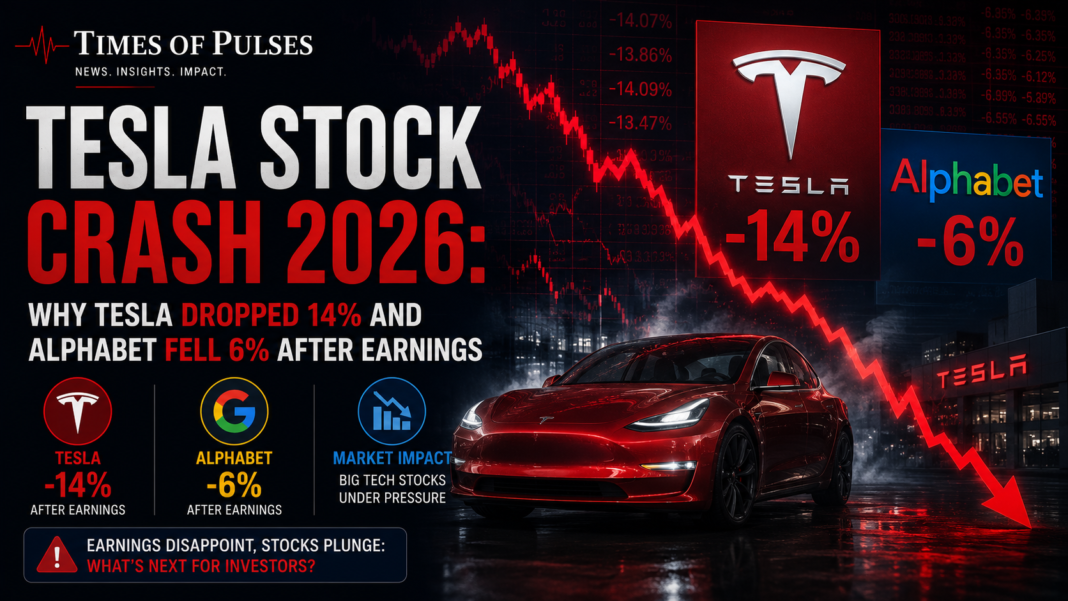
Tesla Stock Crash 2026: Why Tesla Dropped 14% and Alphabet Fell 6% After Earnings
If you were watching yesterday’s Alphabet and Tesla earnings reports, today’s market reaction delivered a genuine shock. The Tesla stock crash 2026 sent shares down nearly 14% in a single session, while Alphabet, Google’s parent company, dropped over 6%. Here’s what actually happened in both reports, and what this dramatic reaction means for anyone holding these stocks.
The Numbers Behind the Tesla Stock Crash 2026
According to CNBC’s market coverage, Tesla stock closed 14.5% lower, marking the company’s worst day since March 2025 and wiping out roughly $200 billion in market capitalization in a single session. That’s an enormous single-day move for a company of Tesla’s size, and it reflects investors reacting sharply to a genuine earnings miss and negative free cash flow for the quarter.
Alphabet wasn’t far behind, losing 7.1% and shedding approximately $300 billion in market value — despite actually beating revenue and earnings expectations for the quarter.
Why the Tesla Stock Crash 2026 Happened
As we covered in our preview of yesterday’s Alphabet and Tesla earnings, analysts had flagged a few specific things that could move Tesla’s stock sharply in either direction: robotaxi progress, delivery numbers, and margin guidance. A drop of this size — nearly 14% — suggests the market found real disappointment in at least one of these areas, likely a combination of softer delivery or margin numbers alongside underwhelming updates on the robotaxi timeline that investors have been pricing in as a major future growth driver.
This is a genuinely useful real-world lesson in how growth stock valuations work: Tesla’s earnings miss, combined with negative free cash flow and operating expenses rising faster than revenue for the quarter, gave investors concrete evidence that the company’s near-term financial performance is weakening, not just its distant future plans.
Why Alphabet Also Dropped Despite Strong Underlying Business
Alphabet’s decline is a bit more nuanced. As we discussed heading into earnings, the key numbers to watch were capital expenditure guidance and Google Cloud’s market share growth. A 6% drop suggests investors reacted negatively to something in the capex outlook specifically — likely a higher-than-expected spending commitment landing at a moment when the broader market is already nervous about whether AI infrastructure spending is becoming difficult to justify, following the semiconductor sector’s own volatile, bear-market stretch just days earlier.
This connects directly to the tension we’ve been tracking all month: strong AI-driven growth stories are colliding with genuine investor anxiety about whether the spending behind that growth will keep paying off.
What This Means If You’re Holding Tesla or Alphabet Stock
- Don’t make an emotional decision based on one day’s move, however dramatic. Both stocks could see continued volatility over the next several trading sessions as analysts digest the full earnings calls and update their models.
- Distinguish between a “miss” and a “structural problem.” A single quarter of softer numbers or conservative guidance is very different from evidence that the underlying business is fundamentally broken — read the actual earnings call commentary, not just the initial price reaction.
- Check your actual portfolio exposure. If you hold broad index funds, you already have exposure to both companies, and a rebalance based on one earnings day is rarely necessary for a genuinely long-term investor.
- Watch analyst commentary over the coming days, since price target revisions and detailed breakdowns of what specifically disappointed the market will offer more useful signal than the initial headline drop.
The Bigger Pattern This Reveals
Both the Tesla stock crash 2026 and Alphabet’s decline fit into a broader theme we’ve tracked all month: markets are genuinely on edge about whether the AI and future-tech spending story can keep justifying today’s valuations. The semiconductor sector’s bear-market stretch, the volatility around this earnings season, and now this dramatic two-stock reaction all point to the same underlying tension — investors want to believe in the long-term story, but they’re punishing any near-term sign that the payoff is taking longer than expected.
What You Should Actually Do This Week
- Read the full earnings call transcripts or detailed summaries, not just the headline stock move, before drawing conclusions about either company
- Watch for analyst price target changes over the next few days as a signal of whether Wall Street sees this as an overreaction or a genuine reassessment
- Avoid panic-selling a long-term position based on a single day, especially if your original investment thesis for either company hasn’t actually changed
- Keep perspective on position sizing — this is exactly the kind of volatility that makes concentrated bets in individual growth stocks riskier than a diversified approach
Bottom Line
The Tesla stock crash 2026 and Alphabet’s sharp decline are a dramatic reminder that even the most closely watched earnings reports in a season can deliver outsized market reactions when future growth expectations, not just current performance, are in question. For long-term investors, the smartest response to days like this is rarely to react to the headline number itself, but to understand what specifically drove the disappointment and whether it changes the actual long-term investment case.
This article is for informational and educational purposes only and does not constitute investment advice or a recommendation to buy or sell any security. Stock market movements are unpredictable, especially around earnings reports; consult a licensed financial advisor before making investment decisions.