
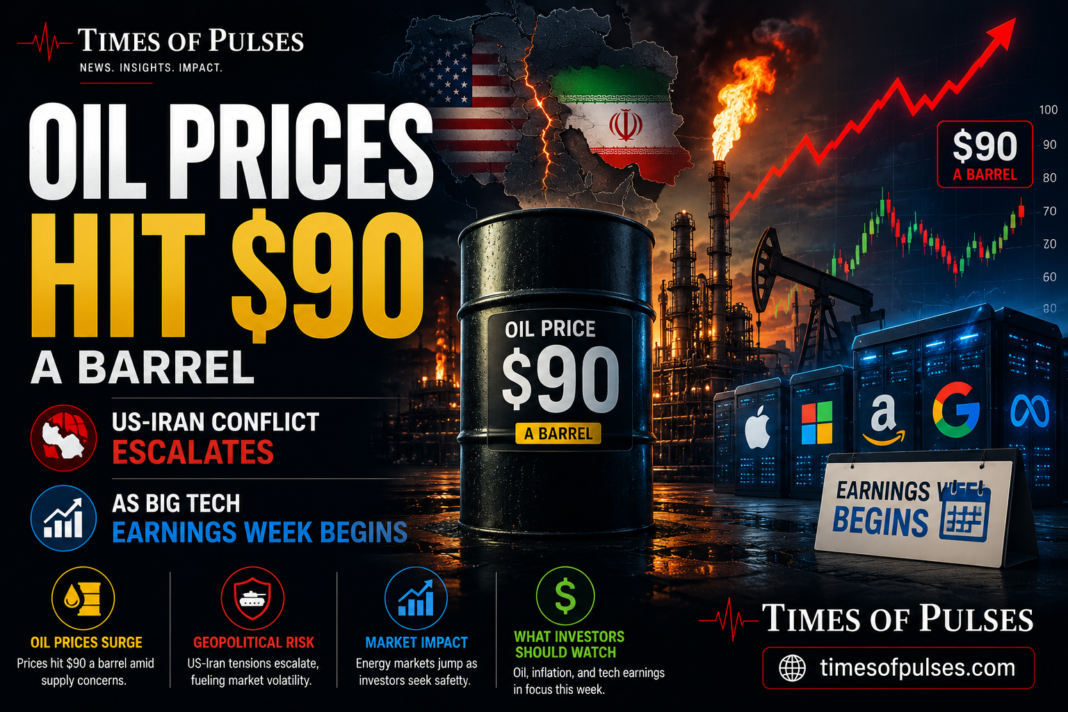
Oil Prices $90 a Barrel: US-Iran Conflict Escalates as Big Tech Earnings Week Begins
Oil prices $90 a barrel is the number rattling markets this week, and it’s not a one-day blip. Brent crude topped $90 a barrel on Monday for the first time in months, as intensifying US-Iran hostilities revived fears of a wider regional conflict. The timing is notable: this surge is landing in the same week Wall Street is bracing for a heavy slate of Big Tech earnings, creating one of the more genuinely complicated weeks for your portfolio in recent memory.
What’s Actually Happening
Brent crude climbed above $90.32 a barrel, up roughly 2.5%, while U.S. West Texas Intermediate crude advanced past $84 a barrel. This came after nine consecutive nights of U.S. strikes against Iranian targets, with the American military death toll in the conflict now reportedly at 17. Iran has responded by striking Gulf energy infrastructure, including a Kuwaiti power plant, water desalination facility, and an oil site, and by intercepting tankers attempting to transit the Strait of Hormuz.
Perhaps most significantly for anyone watching oil prices $90 a barrel headlines, Iran has formally declared the Strait of Hormuz closed and vowed that “not a single drop” of oil or gas would pass through it if U.S. actions continue. Goldman Sachs responded to the escalation by saying its scenario of Brent reaching $100 a barrel is now “back in play.”
Why the Strait of Hormuz Is the Real Story Behind Oil Prices $90 a Barrel
The Strait of Hormuz normally carries roughly a fifth of the world’s oil and petroleum product supply. Any credible disruption to shipping through this single corridor tends to send oil prices $90 a barrel and higher, because the market has to price in the risk of a genuine supply shock, not just a temporary skirmish.
Analysts are split on how long this lasts. One commodities strategist described current pricing as “a bull case” built around escalating tensions, while a Capital Markets analyst noted the region remains “nowhere close to normalisation. ” Neither view suggests a quick resolution.
Why This Week Is Especially Complicated for Investors
Oil prices $90 a barrel would be a significant story on its own, but it’s colliding with a separate, equally important event this week: a heavy slate of Big Tech earnings reports. Markets have been leaning on continued AI-driven capital spending to justify high valuations, and this week’s results from major technology companies will either reinforce or undercut that narrative.
Adding to the tension, semiconductor stocks posted a volatile, loss-heavy week recently before staging a partial rebound, with Asian chipmakers leading gains as investors looked toward this week’s earnings for confirmation that the AI rally can be sustained. That means markets are simultaneously weighing a geopolitical oil shock and a make-or-break earnings week for the sector that’s been driving most of the market’s gains this year.
What Oil Prices $90 a Barrel Means for Your Gas Budget
- Expect pump prices to rise, though not instantly. Gas prices typically lag crude oil moves by one to two weeks, so the impact of this week’s surge will likely show up gradually rather than overnight.
- Don’t assume a quick reversal. With Iran declaring the strait closed and analysts flagging $100 Brent as a real possibility, this isn’t shaping up to be a one-week spike.
- Build a buffer into your fuel budget rather than anchoring to last month’s prices, especially if you commute long distances or rely heavily on driving.
What This Means for Your Portfolio
- Energy stocks tend to benefit directly when oil prices $90 a barrel headlines dominate the news, while airlines, cruise lines, and other fuel-heavy sectors typically face margin pressure.
- Don’t make big portfolio moves based on this week alone. Geopolitical shocks can escalate or de-escalate quickly, and this week’s Big Tech earnings could end up mattering more to your long-term holdings than the oil headlines, depending on your portfolio’s composition.
- If you hold broad index funds, you already have mixed exposure to both the sectors under pressure and the sectors benefiting — there’s usually no urgent action needed.
- Watch how markets react to Big Tech earnings this week as closely as the oil headlines. A strong earnings week could offset investor anxiety about energy costs; a weak one could compound it.
What You Should Actually Do This Week
- Don’t panic-sell based on oil headlines alone. A single week of geopolitical-driven volatility rarely justifies a major portfolio overhaul.
- If you’re planning a long drive or a fuel-dependent purchase, consider timing it sooner rather than later given the current trajectory.
- Watch this week’s Big Tech earnings results closely — they may end up being the more durable driver of market direction once the current oil headlines settle.
- Keep your emergency fund in mind. Elevated gas prices are exactly the kind of scenario an emergency fund is meant to absorb without forcing other budget cuts.
Bottom Line
Oil prices $90 a barrel reflect a genuinely serious escalation, not routine market noise — nine nights of strikes, a declared closure of the Strait of Hormuz, and a $100 Brent scenario that Goldman Sachs says is back on the table. At the same time, this week’s Big Tech earnings could prove just as important for your portfolio as the energy headlines. The smartest response is the same one that’s worked through every other volatile stretch this year: avoid reactive decisions, keep a buffer in your budget, and wait for a clearer pattern to emerge across both stories before making any major moves.
This article is for informational and educational purposes only and does not constitute financial or investment advice. Geopolitical events and market conditions are unpredictable and can change rapidly; consult a licensed financial advisor before making investment decisions.